Ciri dan struktur
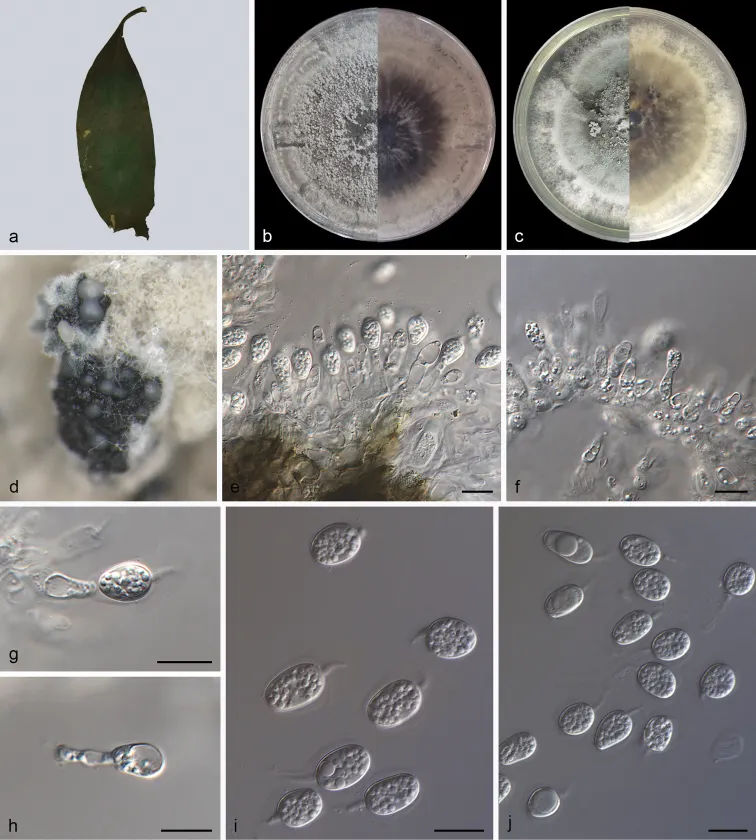
Leaf endogenic and associated with leaf spots. Asexual morph: Conidiomata pycnidial, mostly aggregated in clusters, black, erumpent. In MEA culture exuding colourless to opaque conidial masses within 10 days or longer. Pycnidial wall multilayered, textura angularis, brown to dark brown, up to 30 μm thick; inner walls hyaline. Conidiophores indistinct, often reduced to conidiogenous cells. Conidiogenous cells terminal, subcylindrical, ampulliform, hyaline, smooth, 9.0–14.0 × 2.5–4.5 μm. Conidia 8.0–13.0 × 6.0–8.0 μm, mean ± SD = 10.0 ± 1.3 × 7.2 ± 0.5 μm, hyaline, aseptate, thin and smooth walled, coarsely guttulate or with a single large central guttule, ovoid, ampulliform, ellipsoidal to subglobose, enclosed in a thin mucoid sheath, 1.0–2.0 μm thick and bearing a hyaline, apical mucoid appendage, 3.0–8.5 × 1.0–1.5 μm, flexible, unbranched, tapering towards an acutely rounded tip. . Colonies on PDA occupying an entire 90 mm Petri dish in 14 days at 25 °C in darkness, with a growth rate of 6.0–6.5 mm/day, greenish-black in obverse and reverse. Colonies on MEA 82–86 mm in diameter after 14 days at 25 °C in darkness, with a growth rate of 5.7–6.2 mm/day, undulate at edge, white to grey white in obverse and reverse, with moderate aerial mycelia on the surface, with black, gregarious conidiomata.
Habitat dan peran ekologis
. Colonies on PDA occupying an entire 90 mm Petri dish in 14 days at 25 °C in darkness, with a growth rate of 6.0–6.5 mm/day, greenish-black in obverse and reverse. Colonies on MEA 82–86 mm in diameter after 14 days at 25 °C in darkness, with a growth rate of 5.7–6.2 mm/day, undulate at edge, white to grey white in obverse and reverse, with moderate aerial mycelia on the surface, with black, gregarious conidiomata.
- Habitat atau konteks temuan
- kultur yang didokumentasikan
- Substrat
- Informasi belum tersedia pada sumber rilis ini.
- Peran atau konteks
- Belum dikategorikan pada rilis ini.
Reproduksi
Leaf endogenic and associated with leaf spots. Asexual morph: Conidiomata pycnidial, mostly aggregated in clusters, black, erumpent. In MEA culture exuding colourless to opaque conidial masses within 10 days or longer. Pycnidial wall multilayered, textura angularis, brown to dark brown, up to 30 μm thick; inner walls hyaline. Conidiophores indistinct, often reduced to conidiogenous cells. Conidiogenous cells terminal, subcylindrical, ampulliform, hyaline, smooth, 9.0–14.0 × 2.5–4.5 μm. Conidia 8.0–13.0 × 6.0–8.0 μm, mean ± SD = 10.0 ± 1.3 × 7.2 ± 0.5 μm, hyaline, aseptate, thin and smooth walled, coarsely guttulate or with a single large central guttule, ovoid, ampulliform, ellipsoidal to subglobose, enclosed in a thin mucoid sheath, 1.0–2.0 μm thick and bearing a hyaline, apical mucoid appendage, 3.0–8.5 × 1.0–1.5 μm, flexible, unbranched, tapering towards an acutely rounded tip.
Catatan identitas dan cakupan
- Nama diterima mengikuti Catalogue of Life Base2026-09-11; uraian mempertahankan konsep dan nama sumber aslinya.
- Preserve original treatment localities, hosts and substrate scope. Materials examined describe documented specimens, not the full global range.
- Impor dan terjemahan otomatis belum diperiksa editorial per profil. Struktur reproduktif yang disebutkan tidak membuktikan seluruh siklus hidup diketahui.
- Pengukuran pada uraian mengikuti spesimen, kultur, dan metode sumber; angka tidak diperluas ke semua populasi.
Catatan distribusi dalam narasi mengikuti sumbernya. Dokumentasi spesimen atau foto mengikuti catatan sumber. Bukti wilayah Indonesia dan penilaian konservasi tidak disimpulkan dari gambar.
Melihat dengan konteks
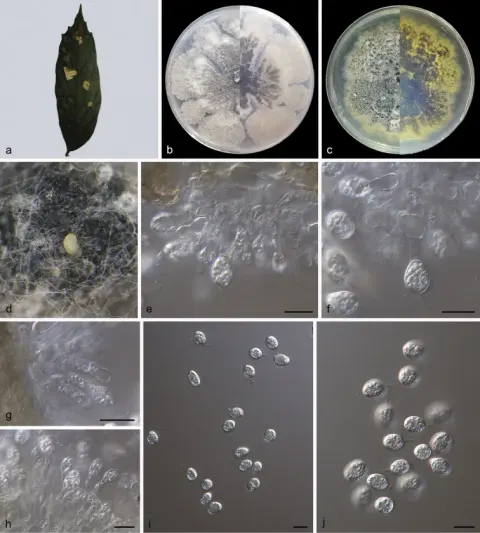
Phyllosticta oblongifoliae (SAUCC 210052) a diseased leaf of Garcinia oblongifolia b, c colonies (left-above, right-reverse) after 15 days on PDA (b) and MEA (c) d conidiomata e–h conidiogenous cells with conidia i–j conidia. Scale bars: 10 μm (e–j).
- Jenis
- Pelat ilmiah
- Kredit
- Zhaoxue Zhang, Xiaoyong Liu, Xiuguo Zhang, Zhe Meng
- Lisensi
- CC BY 4.0
- Sumber media
- Buka entri sumber
Sumber profil
- [1] Morphological and phylogenetic analyses reveal two new species and a new record of Phyllosticta (Botryosphaeriales, Phyllostictaceae) from Hainan, China — Phyllosticta oblongifoliae
- [2] Catalogue of Life Base2026-09-11 — Phyllosticta oblongifoliae
- [3] Dokumentasi visual — Phyllosticta oblongifoliae
Rujukan halaman ini
Fungi. Phyllosticta oblongifoliae. Rilis data fungi-2026-10-12-expansion-2. https://fungi-atlas.mgadib.chatgpt.site/jamur/phyllosticta-oblongifoliae/.
Status: impor sumber; pemeriksaan editorial per profil belum selesai. Untuk klaim biologis, gunakan rujukan pada bagian terkait dan periksa konteks sumber aslinya.