01 / Morfologi

Ciri dan struktur

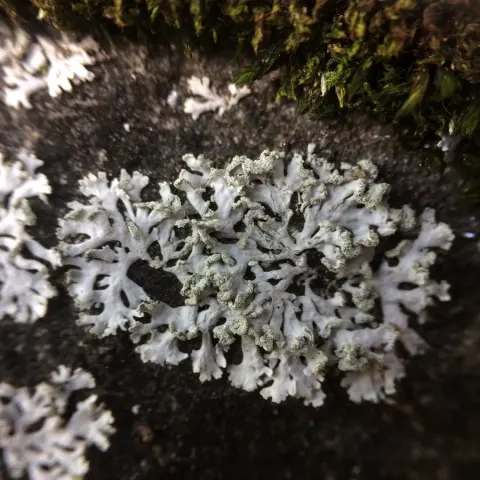
Physcia dakotensis forms a small, leaf-like (foliose) thallus that often merges so tightly with the rock surface that it looks almost crust-like. Mature cushions are generally round and about 1 – 2 cm across (occasionally larger where neighboring thalli fuse). The individual are narrow—roughly 0.2–0.6 mm wide—and lie flat at their tips but become slightly swollen and roof-shaped farther back. Their upper surface is gray to gray-white and may darken at the very ends; as the lichen ages it produces coarse, grainy patches of powdery propagules (soredia). These soredia are densely packed and stand erect, giving the lobe interiors a rough, bristly appearance described as '. Beneath the surface the medulla (inner tissue) is white, while the lower is poorly developed and visible only near the lobe tips. Anchoring threads (rhizines) are sparse, short, and sometimes absent, so most of the lower surface is pressed directly against its siliceous rock substrate. Chemical spot tests show the cortex is K+ (yellow), a reaction caused by the secondary compound atranorin, but the medulla remains unchanged (K–).

Sebagian uraian ditampilkan dalam bahasa sumber; terjemahannya belum tersedia atau belum lolos pemeriksaan.

Rujukan: [1]

Pengukuran mengikuti objek, spesimen atau kultur, dan metode yang disebutkan sumber. Baca uraian asli untuk konteks lengkap.

02 / Kehidupan

Habitat dan peran ekologis

Physcia dakotensis is a species of saxicolous (rock-dwelling) foliose lichen in the family Physciaceae. It was formally described as new to science in 2004, based on specimens collected from granitic rock in South Dakota, USA. The lichen forms small, tightly , leaf-like thalli with narrow gray that produce distinctive coarse, upright soredia, and it was initially mistaken for the eastern North American species P. subtilis. It is distinguished by its highly fissured morphology, poorly developed lower with sparse rhizines, and K-positive cortex containing atranorin.

Sebagian uraian ditampilkan dalam bahasa sumber; terjemahannya belum tersedia atau belum lolos pemeriksaan.

Rujukan: [1]

Habitat atau konteks temuan
Informasi belum tersedia pada sumber rilis ini.
Substrat
Informasi belum tersedia pada sumber rilis ini.
Peran atau konteks
Pembentuk liken
Temukan hubungan serupa
03 / Siklus hidup

Reproduksi

Physcia dakotensis forms a small, leaf-like (foliose) thallus that often merges so tightly with the rock surface that it looks almost crust-like. Mature cushions are generally round and about 1 – 2 cm across (occasionally larger where neighboring thalli fuse). The individual are narrow—roughly 0.2–0.6 mm wide—and lie flat at their tips but become slightly swollen and roof-shaped farther back. Their upper surface is gray to gray-white and may darken at the very ends; as the lichen ages it produces coarse, grainy patches of powdery propagules (soredia). These soredia are densely packed and stand erect, giving the lobe interiors a rough, bristly appearance described as '. Beneath the surface the medulla (inner tissue) is white, while the lower is poorly developed and visible only near the lobe tips.

Sebagian uraian ditampilkan dalam bahasa sumber; terjemahannya belum tersedia atau belum lolos pemeriksaan.

Rujukan: [1]

04 / Batas informasi

Catatan identitas dan cakupan

  • Nama diterima mengikuti Catalogue of Life Base2026-09-11; uraian mempertahankan konsep dan nama sumber aslinya.
  • Original geographic, specimen and life-cycle scope retained; source import awaits individual editorial review.
  • Impor dan terjemahan otomatis belum diperiksa editorial per profil. Struktur reproduktif yang disebutkan tidak membuktikan seluruh siklus hidup diketahui.
  • Pengukuran pada uraian mengikuti spesimen, kultur, dan metode sumber; angka tidak diperluas ke semua populasi.

Catatan distribusi dalam narasi mengikuti sumbernya. Dokumentasi spesimen atau foto mengikuti catatan sumber. Bukti wilayah Indonesia dan penilaian konservasi tidak disimpulkan dari gambar.

05 / Dokumentasi

Melihat dengan konteks

Dokumentasi visual yang memenuhi pemeriksaan subjek dan hak penggunaan belum tersedia. Foto gejala, label, dan gambar yang meragukan tidak dihitung.

06 / Rujukan

Sumber profil

  1. [1] Physcia dakotensis — Wikipedia (en)Bagian sumber: Frozen revision 1326208774
    Tanggal penghimpunan sumber: 2026-10-12
    Teks sumber: CC BY-SA4.0 · Wikipedia contributors
  2. [2] Catalogue of Life Base2026-09-11 — Physcia dakotensisBagian sumber: ColDP NameUsage.tsv ID 4HGK5; accepted species; source 2073
    Tanggal penghimpunan sumber: 2026-10-12

Adaptasi teks: CC BY-SA 4.0. Wikipedia contributors — Physcia dakotensis — Wikipedia (en)

Uraian asli dan riwayat sumber

Riwayat atau halaman sumber

Ringkasan sumber

Physcia dakotensis is a species of saxicolous (rock-dwelling) foliose lichen in the family Physciaceae. It was formally described as new to science in 2004, based on specimens collected from granitic rock in South Dakota, USA. The lichen forms small, tightly , leaf-like thalli with narrow gray that produce distinctive coarse, upright soredia, and it was initially mistaken for the eastern North American species P. subtilis. It is distinguished by its highly fissured morphology, poorly developed lower with sparse rhizines, and K-positive cortex containing atranorin.

Revisi sumber

Morfologi sumber

Physcia dakotensis forms a small, leaf-like (foliose) thallus that often merges so tightly with the rock surface that it looks almost crust-like. Mature cushions are generally round and about 1 – 2 cm across (occasionally larger where neighboring thalli fuse). The individual are narrow—roughly 0.2–0.6 mm wide—and lie flat at their tips but become slightly swollen and roof-shaped farther back. Their upper surface is gray to gray-white and may darken at the very ends; as the lichen ages it produces coarse, grainy patches of powdery propagules (soredia). These soredia are densely packed and stand erect, giving the lobe interiors a rough, bristly appearance described as '. Beneath the surface the medulla (inner tissue) is white, while the lower is poorly developed and visible only near the lobe tips. Anchoring threads (rhizines) are sparse, short, and sometimes absent, so most of the lower surface is pressed directly against its siliceous rock substrate. Chemical spot tests show the cortex is K+ (yellow), a reaction caused by the secondary compound atranorin, but the medulla remains unchanged (K–).

Revisi sumber

Ekologi sumber

Physcia dakotensis is a species of saxicolous (rock-dwelling) foliose lichen in the family Physciaceae. It was formally described as new to science in 2004, based on specimens collected from granitic rock in South Dakota, USA. The lichen forms small, tightly , leaf-like thalli with narrow gray that produce distinctive coarse, upright soredia, and it was initially mistaken for the eastern North American species P. subtilis. It is distinguished by its highly fissured morphology, poorly developed lower with sparse rhizines, and K-positive cortex containing atranorin.

Revisi sumber

Struktur reproduksi sumber

Physcia dakotensis forms a small, leaf-like (foliose) thallus that often merges so tightly with the rock surface that it looks almost crust-like. Mature cushions are generally round and about 1 – 2 cm across (occasionally larger where neighboring thalli fuse). The individual are narrow—roughly 0.2–0.6 mm wide—and lie flat at their tips but become slightly swollen and roof-shaped farther back. Their upper surface is gray to gray-white and may darken at the very ends; as the lichen ages it produces coarse, grainy patches of powdery propagules (soredia). These soredia are densely packed and stand erect, giving the lobe interiors a rough, bristly appearance described as '. Beneath the surface the medulla (inner tissue) is white, while the lower is poorly developed and visible only near the lobe tips.

Revisi sumber

Rujukan halaman ini

Fungi. Physcia dakotensis. Rilis data fungi-2026-10-12-expansion-2. https://fungi-atlas.mgadib.chatgpt.site/jamur/physcia-dakotensis/.

Status: impor sumber; pemeriksaan editorial per profil belum selesai. Untuk klaim biologis, gunakan rujukan pada bagian terkait dan periksa konteks sumber aslinya.