01 / Morfologi

Ciri dan struktur

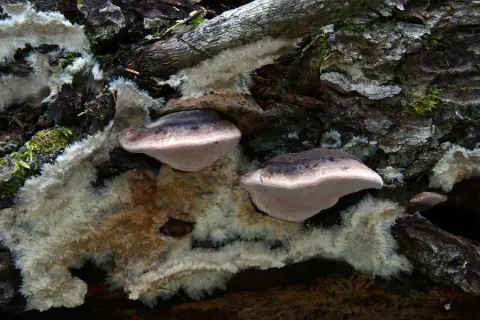
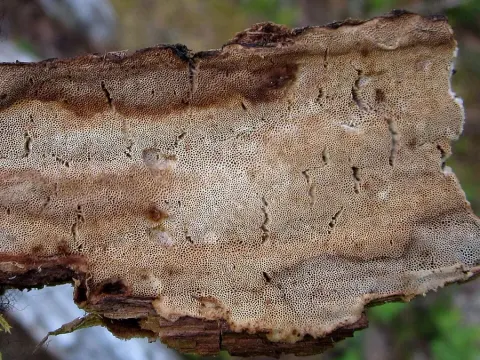
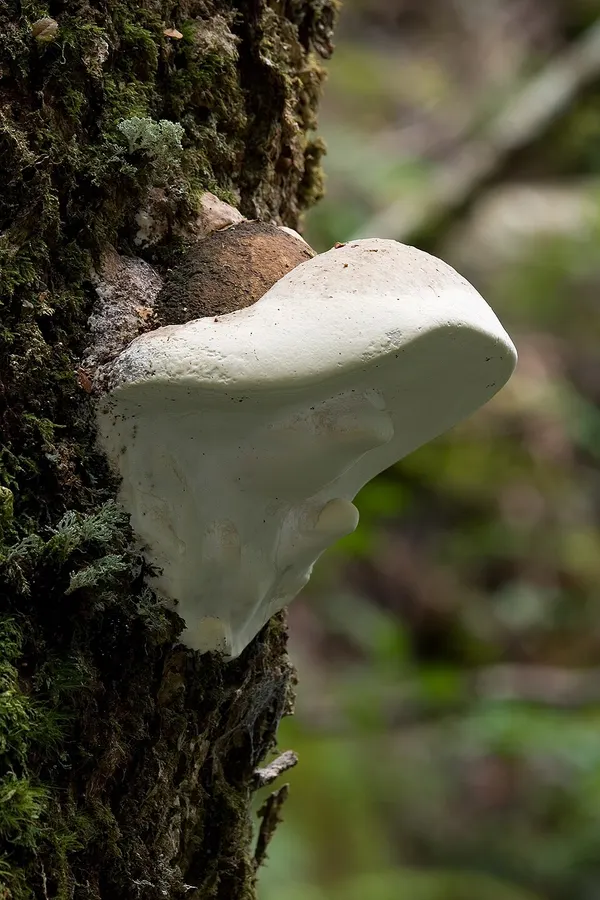
Hymenophore perennial, solitary, hard and woody, attached by a broad lateral base. Pilei applanate or ungulate, 3-20 cm wide, 3-12 cm radius, 1-10 cm thick; pileus surface at first ochre or fawn, becoming bay banded with greyish zones, tobacco brown or fuscous and concolorous, umber in old specimens or sometimes black, strongly concentrically sulcate, often concentrically banded with different shades of brown, finely tomentose becoming glabrous; cortex to 1 mm thick, chestnut with an orange zone beneath, ligneous, brittle, composed of densely intertwined cemented hyphae with chestnut walls; margin bluntly rounded, or thickened and formed from numerous equal growth layers when concentrically sulcate; hymenial surface at first white or straw, drying isabelline, even, slightly concave or as often convex, with a narrow rounded sterile border 2-3 mm wide. Pores in many often obscure strata (2-18), sometimes with zones of context hyphae between, 3-10 mm deep in each layer, wood colour, round or slightly angular, 6-7 per mm, 50-150 µm diameter; dissepi-ments 50-200 µm thick, commonly 75-100 µm, equal, apices even. Context cream or isabelline, to 15 mm thick, often zoned, of densely intertwined hyphae; skeletal hyphae to 4 µm thick, lumena 1.5-2 µm diameter, aseptate, scantily branched and undulate near ends, staining; generative hyphae to 3 µm diameter, walls thin, not staining, sparsely branched, septate in the subhymenium. Hymenial layer to 20 µm deep, a loose palisade of basidia and paraphyses, soon collapsing. Basidia clavate, 8-10 x 4-5 µm bearing 4 spores; sterigmata erect, to 4 µm long.

Sebagian uraian ditampilkan dalam bahasa sumber; terjemahannya belum tersedia atau belum lolos pemeriksaan.

Rujukan: [1]

Pengukuran mengikuti objek, spesimen atau kultur, dan metode yang disebutkan sumber. Baca uraian asli untuk konteks lengkap.

02 / Kehidupan

Habitat dan peran ekologis

Bark or decorticated wood of standing or fallen trunks, associated with a white heart rot.

Sebagian uraian ditampilkan dalam bahasa sumber; terjemahannya belum tersedia atau belum lolos pemeriksaan.

Rujukan: [1]

Habitat atau konteks temuan
Informasi belum tersedia pada sumber rilis ini.
Substrat
Informasi belum tersedia pada sumber rilis ini.
Peran atau konteks
Belum dikategorikan pada rilis ini.
Temukan hubungan serupa
03 / Siklus hidup

Reproduksi

Hymenophore perennial, solitary, hard and woody, attached by a broad lateral base. Pilei applanate or ungulate, 3-20 cm wide, 3-12 cm radius, 1-10 cm thick; pileus surface at first ochre or fawn, becoming bay banded with greyish zones, tobacco brown or fuscous and concolorous, umber in old specimens or sometimes black, strongly concentrically sulcate, often concentrically banded with different shades of brown, finely tomentose becoming glabrous; cortex to 1 mm thick, chestnut with an orange zone beneath, ligneous, brittle, composed of densely intertwined cemented hyphae with chestnut walls; margin bluntly rounded, or thickened and formed from numerous equal growth layers when concentrically sulcate; hymenial surface at first white or straw, drying isabelline, even, slightly concave or as often convex, with a narrow rounded sterile border 2-3 mm wide.

Sebagian uraian ditampilkan dalam bahasa sumber; terjemahannya belum tersedia atau belum lolos pemeriksaan.

Rujukan: [1]

Sinonim menurut acuan taksonomi rilis: Fomes hemitephrus; Fomitopsis hemitephra; Heterobasidion hemitephrum; Polyporus hemitephrus; Scindalma hemitephrum; Trametes hemitephra; Trametes hemitephra var. solomonensis; Ungulina hemitephra
04 / Batas informasi

Catatan identitas dan cakupan

  • Nama diterima mengikuti Catalogue of Life Base2026-09-11; uraian mempertahankan konsep dan nama sumber aslinya.
  • Historical description as cited by BiotaNZ. Preserve explicit New Zealand/locality, host and specimen qualifiers. Distribution is the cited source scope, not a current global range.
  • Impor dan terjemahan otomatis belum diperiksa editorial per profil. Struktur reproduktif yang disebutkan tidak membuktikan seluruh siklus hidup diketahui.
  • Pengukuran pada uraian mengikuti spesimen, kultur, dan metode sumber; angka tidak diperluas ke semua populasi.

Catatan distribusi dalam narasi mengikuti sumbernya. Dokumentasi spesimen atau foto mengikuti catatan sumber. Bukti wilayah Indonesia dan penilaian konservasi tidak disimpulkan dari gambar.

05 / Dokumentasi

Melihat dengan konteks

Dokumentasi Fomes hemitephrus dari Wikimedia Commons. Fomes hemitephrus Meander Forest Reserve, Tasmania, Australia Identifikasi mengikuti record berkas sumber.

Jenis
Fotografi
Kredit
JJ Harrison ( https://www.jjharrison.com.au/ )
Sumber media
Buka entri sumber

Gambar menunjukkan objek menurut identifikasi sumber, bukan verifikasi independen spesimen oleh Fungi. Tidak ada skala baru yang ditambahkan.

06 / Rujukan

Sumber profil

  1. [1] Cunningham, G.H. 1965: Polyporaceae of New Zealand. New Zealand Department of Scientific and Industrial Research, Bulletin. 164. — Heterobasidion hemitephrumBagian sumber: biota:1cb0e308-36b9-11d5-9548-00d0592d548c:1cb1b316-36b9-11d5-9548-00d0592d548c
    Tanggal penghimpunan sumber: 2026-10-12
    Teks sumber: CC BY 4.0 · Cunningham, G.H. 1965: Polyporaceae of New Zealand. New Zealand Department of Scientific and Industrial Research, Bulletin. 164.
  2. [2] Catalogue of Life Base2026-09-11 — Pilatoporus hemitephrusBagian sumber: ColDP NameUsage.tsv ID 4HSHB; accepted species; source 2073
    Tanggal penghimpunan sumber: 2026-10-12
  3. [3] Dokumentasi visual — Fomes hemitephrusBagian sumber: Individual media record; identification follows the source, not independent determination
    Tanggal penghimpunan sumber: 2026-10-12
    Media sumber: CC BY-SA 3.0 · JJ Harrison ( https://www.jjharrison.com.au/ )

Adaptasi teks: CC BY 4.0. Cunningham, G.H. 1965: Polyporaceae of New Zealand. New Zealand Department of Scientific and Industrial Research, Bulletin. 164. — Cunningham, G.H. 1965: Polyporaceae of New Zealand. New Zealand Department of Scientific and Industrial Research, Bulletin. 164. — Heterobasidion hemitephrum

Uraian asli dan riwayat sumber

Riwayat atau halaman sumber

Ringkasan sumber

Hymenophore perennial, solitary, hard and woody, attached by a broad lateral base. Pilei applanate or ungulate, 3-20 cm wide, 3-12 cm radius, 1-10 cm thick; pileus surface at first ochre or fawn, becoming bay banded with greyish zones, tobacco brown or fuscous and concolorous, umber in old specimens or sometimes black, strongly concentrically sulcate, often concentrically banded with different shades of brown, finely tomentose becoming glabrous; cortex to 1 mm thick, chestnut with an orange zone beneath, ligneous, brittle, composed of densely intertwined cemented hyphae with chestnut walls; margin bluntly rounded, or thickened and formed from numerous equal growth layers when concentrically sulcate; hymenial surface at first white or straw, drying isabelline, even, slightly concave or as often convex, with a narrow rounded sterile border 2-3 mm wide.

Revisi sumber

Morfologi sumber

Hymenophore perennial, solitary, hard and woody, attached by a broad lateral base. Pilei applanate or ungulate, 3-20 cm wide, 3-12 cm radius, 1-10 cm thick; pileus surface at first ochre or fawn, becoming bay banded with greyish zones, tobacco brown or fuscous and concolorous, umber in old specimens or sometimes black, strongly concentrically sulcate, often concentrically banded with different shades of brown, finely tomentose becoming glabrous; cortex to 1 mm thick, chestnut with an orange zone beneath, ligneous, brittle, composed of densely intertwined cemented hyphae with chestnut walls; margin bluntly rounded, or thickened and formed from numerous equal growth layers when concentrically sulcate; hymenial surface at first white or straw, drying isabelline, even, slightly concave or as often convex, with a narrow rounded sterile border 2-3 mm wide. Pores in many often obscure strata (2-18), sometimes with zones of context hyphae between, 3-10 mm deep in each layer, wood colour, round or slightly angular, 6-7 per mm, 50-150 µm diameter; dissepi-ments 50-200 µm thick, commonly 75-100 µm, equal, apices even. Context cream or isabelline, to 15 mm thick, often zoned, of densely intertwined hyphae; skeletal hyphae to 4 µm thick, lumena 1.5-2 µm diameter, aseptate, scantily branched and undulate near ends, staining; generative hyphae to 3 µm diameter, walls thin, not staining, sparsely branched, septate in the subhymenium. Hymenial layer to 20 µm deep, a loose palisade of basidia and paraphyses, soon collapsing. Basidia clavate, 8-10 x 4-5 µm bearing 4 spores; sterigmata erect, to 4 µm long.

Revisi sumber

Ekologi sumber

Bark or decorticated wood of standing or fallen trunks, associated with a white heart rot.

Revisi sumber

Struktur reproduksi sumber

Hymenophore perennial, solitary, hard and woody, attached by a broad lateral base. Pilei applanate or ungulate, 3-20 cm wide, 3-12 cm radius, 1-10 cm thick; pileus surface at first ochre or fawn, becoming bay banded with greyish zones, tobacco brown or fuscous and concolorous, umber in old specimens or sometimes black, strongly concentrically sulcate, often concentrically banded with different shades of brown, finely tomentose becoming glabrous; cortex to 1 mm thick, chestnut with an orange zone beneath, ligneous, brittle, composed of densely intertwined cemented hyphae with chestnut walls; margin bluntly rounded, or thickened and formed from numerous equal growth layers when concentrically sulcate; hymenial surface at first white or straw, drying isabelline, even, slightly concave or as often convex, with a narrow rounded sterile border 2-3 mm wide.

Revisi sumber

Rujukan halaman ini

Fungi. Pilatoporus hemitephrus. Rilis data fungi-2026-10-12-expansion-2. https://fungi-atlas.mgadib.chatgpt.site/jamur/pilatoporus-hemitephrus/.

Status: impor sumber; pemeriksaan editorial per profil belum selesai. Untuk klaim biologis, gunakan rujukan pada bagian terkait dan periksa konteks sumber aslinya.