01 / Morfologi

Ciri dan struktur

Placomaronea candelarioides has a leaf-like (foliose) structure, uniquely anchored by a single point, a trait referred to as and . Though most specimens adhere to this typical appearance, some have shown variations, such as having numerous individual, little branched, and ascending lobes that attach to the at the base. The lichen's overall shape is circular and can span up to 20 mm across. It has extensions or that radiate from its centre, each measuring between 0.4 and 1.7 mm in width and potentially growing up to 7 mm in length. These lobes sometimes have smaller offshoots or and can occasionally take on a round shape, layering over each other and forming cushion-like clusters. The color of the lichen's upper surface ranges from dark yellow to brownish-yellow, presenting a smooth, shiny, and unpigmented appearance. The lichen's underside can display colors from white to grey or even brown, influenced by the dust it accumulates. Prominently, the lichen's apothecia appear as darker yellow spots that often densely populate the central regions of the lichen. They sit raised on the surface, measure between 0.5 and 1.6 mm in diameter, and sometimes have a slightly jagged or edge. Internally, the lichen comprises several layers. Just beneath the surface, there is a cortex layer about 15–35 μm thick. Below this, a white layer of medulla. The base of the lichen has another layer, which is similar in structure but slightly thicker, ranging between 25 and 45 μm. Each ascus holds over 30 . These spores are narrowly oval in shape, measuring between 8–12.5 μm in length and 3–4 μm in width.

Sebagian uraian ditampilkan dalam bahasa sumber; terjemahannya belum tersedia atau belum lolos pemeriksaan.

Rujukan: [1]

Pengukuran mengikuti objek, spesimen atau kultur, dan metode yang disebutkan sumber. Baca uraian asli untuk konteks lengkap.

02 / Kehidupan

Habitat dan peran ekologis

Placomaronea candelarioides grows on non-calcareous, acidic rocks in open montane settings. It is recorded along the Andes, from Mendoza (Argentina) north to Peru's Ancash region. Poelt documented material from several Andean provinces and elevations: in Argentina from Mendoza (Dept. Luján: Estancia El Salto; Los Vallecitos, both roughly 2800 m), and Tucumán (Valle de Tafí: Tafí del Valle, 1978 m, on granite boulders in a dry river bed; Carapunco/Infiernillo, 2800 m, on schistose rock), as well as Jujuy (Puna, Dept. Santa Catalina, 3400 to 4300 m). He also cited Peruvian material from Junín (Huancayo, Sapallanga, 11000 to 12000 ft) on exposed outcrops in a dry, "desert" setting. The species may occur with Polycauliona candelaria, suggesting tolerance of nitrogen-enriched sites.

Sebagian uraian ditampilkan dalam bahasa sumber; terjemahannya belum tersedia atau belum lolos pemeriksaan.

Rujukan: [1]

Habitat atau konteks temuan
Informasi belum tersedia pada sumber rilis ini.
Substrat
Informasi belum tersedia pada sumber rilis ini.
Peran atau konteks
Pembentuk liken
Temukan hubungan serupa
03 / Siklus hidup

Reproduksi

Each ascus holds over 30 . These spores are narrowly oval in shape, measuring between 8–12.5 μm in length and 3–4 μm in width. Another distinguishing feature is the presence of , which appear as darker yellow dimples on the lichen's surface.

Sebagian uraian ditampilkan dalam bahasa sumber; terjemahannya belum tersedia atau belum lolos pemeriksaan.

Rujukan: [1]

04 / Batas informasi

Catatan identitas dan cakupan

  • Nama diterima mengikuti Catalogue of Life Base2026-09-11; uraian mempertahankan konsep dan nama sumber aslinya.
  • Original geographic, specimen and life-cycle scope retained; source import awaits individual editorial review.
  • Impor dan terjemahan otomatis belum diperiksa editorial per profil. Struktur reproduktif yang disebutkan tidak membuktikan seluruh siklus hidup diketahui.
  • Pengukuran pada uraian mengikuti spesimen, kultur, dan metode sumber; angka tidak diperluas ke semua populasi.

Catatan distribusi dalam narasi mengikuti sumbernya. Dokumentasi spesimen atau foto mengikuti catatan sumber. Bukti wilayah Indonesia dan penilaian konservasi tidak disimpulkan dari gambar.

05 / Dokumentasi

Melihat dengan konteks

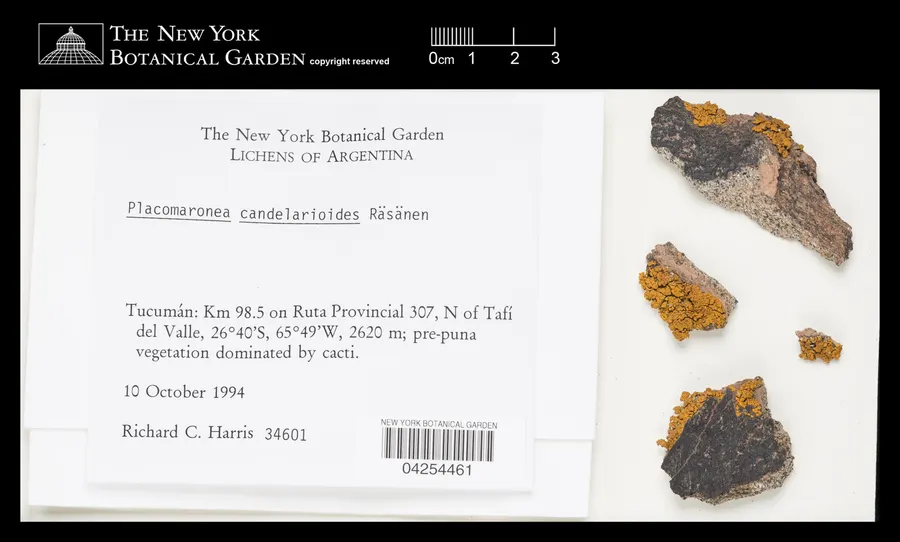
Voucher herbarium Placomaronea candelarioides (4254461), The New York Botanical Garden. Identifikasi mengikuti record spesimen sumber. Foto bahan, kemasan, atau label herbarium sebagaimana tersedia pada record institusi; bukan foto lapangan atau penentuan spesimen independen.

Jenis
Voucher herbarium
Kredit
The New York Botanical Garden
Lisensi
CC BY 4.0
Sumber media
Buka entri sumber

Gambar menunjukkan objek menurut identifikasi sumber, bukan verifikasi independen spesimen oleh Fungi. Tidak ada skala baru yang ditambahkan.

06 / Rujukan

Sumber profil

  1. [1] Placomaronea candelarioides — Wikipedia (en)Bagian sumber: Frozen revision 1312839642
    Tanggal penghimpunan sumber: 2026-10-12
    Teks sumber: CC BY-SA4.0 · Wikipedia contributors
  2. [2] Catalogue of Life Base2026-09-11 — Placomaronea candelarioidesBagian sumber: ColDP NameUsage.tsv ID 77NLZ; accepted species; source 2073
    Tanggal penghimpunan sumber: 2026-10-12
  3. [3] Dokumentasi visual — Placomaronea candelarioidesBagian sumber: Individual media record; identification follows the source, not independent determination
    Tanggal penghimpunan sumber: 2026-10-12
    Media sumber: CC BY 4.0 · The New York Botanical Garden

Adaptasi teks: CC BY-SA 4.0. Wikipedia contributors — Placomaronea candelarioides — Wikipedia (en)

Uraian asli dan riwayat sumber

Riwayat atau halaman sumber

Ringkasan sumber

Placomaronea candelarioides is a species of saxicolous (rock-dwelling), foliose lichen in the family Candelariaceae. It is found in South America. This lichen species can be recognised by its distinct (single attachment point), (single ) growth form. It was first described in 1944 by the Finnish scientist Veli Räsänen from specimens collected in Argentina, and serves as the type species for its genus. The lichen grows on acidic rocks in mountainous regions along the Andes, from Argentina north to Peru, typically at elevations between about 2,000 and 4,000 meters.

Revisi sumber

Morfologi sumber

Placomaronea candelarioides has a leaf-like (foliose) structure, uniquely anchored by a single point, a trait referred to as and . Though most specimens adhere to this typical appearance, some have shown variations, such as having numerous individual, little branched, and ascending lobes that attach to the at the base. The lichen's overall shape is circular and can span up to 20 mm across. It has extensions or that radiate from its centre, each measuring between 0.4 and 1.7 mm in width and potentially growing up to 7 mm in length. These lobes sometimes have smaller offshoots or and can occasionally take on a round shape, layering over each other and forming cushion-like clusters. The color of the lichen's upper surface ranges from dark yellow to brownish-yellow, presenting a smooth, shiny, and unpigmented appearance. The lichen's underside can display colors from white to grey or even brown, influenced by the dust it accumulates. Prominently, the lichen's apothecia appear as darker yellow spots that often densely populate the central regions of the lichen. They sit raised on the surface, measure between 0.5 and 1.6 mm in diameter, and sometimes have a slightly jagged or edge. Internally, the lichen comprises several layers. Just beneath the surface, there is a cortex layer about 15–35 μm thick. Below this, a white layer of medulla. The base of the lichen has another layer, which is similar in structure but slightly thicker, ranging between 25 and 45 μm. Each ascus holds over 30 . These spores are narrowly oval in shape, measuring between 8–12.5 μm in length and 3–4 μm in width.

Revisi sumber

Ekologi sumber

Placomaronea candelarioides grows on non-calcareous, acidic rocks in open montane settings. It is recorded along the Andes, from Mendoza (Argentina) north to Peru's Ancash region. Poelt documented material from several Andean provinces and elevations: in Argentina from Mendoza (Dept. Luján: Estancia El Salto; Los Vallecitos, both roughly 2800 m), and Tucumán (Valle de Tafí: Tafí del Valle, 1978 m, on granite boulders in a dry river bed; Carapunco/Infiernillo, 2800 m, on schistose rock), as well as Jujuy (Puna, Dept. Santa Catalina, 3400 to 4300 m). He also cited Peruvian material from Junín (Huancayo, Sapallanga, 11000 to 12000 ft) on exposed outcrops in a dry, "desert" setting. The species may occur with Polycauliona candelaria, suggesting tolerance of nitrogen-enriched sites.

Revisi sumber

Struktur reproduksi sumber

Each ascus holds over 30 . These spores are narrowly oval in shape, measuring between 8–12.5 μm in length and 3–4 μm in width. Another distinguishing feature is the presence of , which appear as darker yellow dimples on the lichen's surface.

Revisi sumber

Rujukan halaman ini

Fungi. Placomaronea candelarioides. Rilis data fungi-2026-10-12-expansion-2. https://fungi-atlas.mgadib.chatgpt.site/jamur/placomaronea-candelarioides/.

Status: impor sumber; pemeriksaan editorial per profil belum selesai. Untuk klaim biologis, gunakan rujukan pada bagian terkait dan periksa konteks sumber aslinya.