01 / Morfologi

Ciri dan struktur

Placomaronea minima has a crustose thallus made up of individual that form an expanding crust. These areoles, particularly at the margins, tend to have a slightly structure and can sometimes develop small that rise from the base, growing up to about 1 mm in length. The surface of the thallus has a yellow, smooth, and glossy appearance, and it does not have any . The thallus structure is quite compact, with an absent medulla and green algae filling its interior. The lower cortex is mainly evident near the margins of elevated and essentially extends from the upper cortex. The lichen's apothecia, or fruiting structures, measure between 0.2 and 1.3 mm in diameter. The are a darker shade of yellow than the thallus and have a smooth surface that is due to granular pigments. Their margins are clear, somewhat uneven, and rise above the disc, reaching a thickness of up to 0.15 mm. In terms of anatomy, these s have a cortex that mirrors that of the thallus and measures between 15 and 25 μm in thickness. The epihymenium does not form hood-like structures over the tips of the paraphyses. The hymenium stands 90–120 μm tall. The paraphyses can either be or show some branching close to their tips, expanding to 4 μm at their widest point. The asci contain more than 30 spores, and they measure 52–80 by 18–30 μm. The ascospores are clear, primarily simple (though occasionally with a single septum), and are shaped like narrow ellipsoids, measuring around 8.5–11 by 3.0–4.0 μm. The lichen has numerous pycnidia, which are easily identified as tiny orange protuberances on the thallus. These pycnidia produce conidia that are narrowly ellipsoid in shape, with sizes ranging from 2.5 to 4.0 by 1.5 μm.

Sebagian uraian ditampilkan dalam bahasa sumber; terjemahannya belum tersedia atau belum lolos pemeriksaan.

Rujukan: [1]

Pengukuran mengikuti objek, spesimen atau kultur, dan metode yang disebutkan sumber. Baca uraian asli untuk konteks lengkap.

02 / Kehidupan

Habitat dan peran ekologis

Placomaronea minima has a disjunct distribution, being found in both Chile and Argentina, as well as in southern Africa (Lesotho). In its type locality in central Chile it thrives on rock formations situated on semi-arid, partially exposed hill slopes.

Sebagian uraian ditampilkan dalam bahasa sumber; terjemahannya belum tersedia atau belum lolos pemeriksaan.

Rujukan: [1]

Habitat atau konteks temuan
Informasi belum tersedia pada sumber rilis ini.
Substrat
Informasi belum tersedia pada sumber rilis ini.
Peran atau konteks
Pembentuk liken
Temukan hubungan serupa
03 / Siklus hidup

Reproduksi

The lichen's apothecia, or fruiting structures, measure between 0.2 and 1.3 mm in diameter. The are a darker shade of yellow than the thallus and have a smooth surface that is due to granular pigments. Their margins are clear, somewhat uneven, and rise above the disc, reaching a thickness of up to 0.15 mm. In terms of anatomy, these s have a cortex that mirrors that of the thallus and measures between 15 and 25 μm in thickness. The epihymenium does not form hood-like structures over the tips of the paraphyses. The hymenium stands 90–120 μm tall. The paraphyses can either be or show some branching close to their tips, expanding to 4 μm at their widest point. The asci contain more than 30 spores, and they measure 52–80 by 18–30 μm.

Sebagian uraian ditampilkan dalam bahasa sumber; terjemahannya belum tersedia atau belum lolos pemeriksaan.

Rujukan: [1]

04 / Batas informasi

Catatan identitas dan cakupan

  • Nama diterima mengikuti Catalogue of Life Base2026-09-11; uraian mempertahankan konsep dan nama sumber aslinya.
  • Original geographic, specimen and life-cycle scope retained; source import awaits individual editorial review.
  • Impor dan terjemahan otomatis belum diperiksa editorial per profil. Struktur reproduktif yang disebutkan tidak membuktikan seluruh siklus hidup diketahui.
  • Pengukuran pada uraian mengikuti spesimen, kultur, dan metode sumber; angka tidak diperluas ke semua populasi.

Catatan distribusi dalam narasi mengikuti sumbernya. Dokumentasi spesimen atau foto mengikuti catatan sumber. Bukti wilayah Indonesia dan penilaian konservasi tidak disimpulkan dari gambar.

05 / Dokumentasi

Melihat dengan konteks

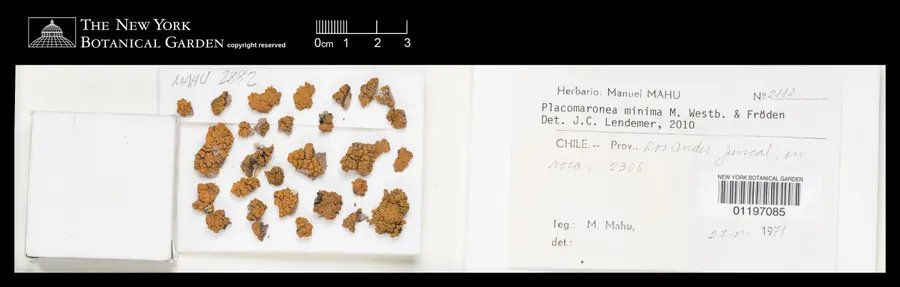
Voucher herbarium Placomaronea minima (1197085), The New York Botanical Garden. Identifikasi mengikuti record spesimen sumber. Foto bahan, kemasan, atau label herbarium sebagaimana tersedia pada record institusi; bukan foto lapangan atau penentuan spesimen independen.

Jenis
Voucher herbarium
Kredit
The New York Botanical Garden
Lisensi
CC BY 4.0
Sumber media
Buka entri sumber

Gambar menunjukkan objek menurut identifikasi sumber, bukan verifikasi independen spesimen oleh Fungi. Tidak ada skala baru yang ditambahkan.

06 / Rujukan

Sumber profil

  1. [1] Placomaronea minima — Wikipedia (en)Bagian sumber: Frozen revision 1341959128
    Tanggal penghimpunan sumber: 2026-10-12
    Teks sumber: CC BY-SA4.0 · Wikipedia contributors
  2. [2] Catalogue of Life Base2026-09-11 — Placomaronea minimaBagian sumber: ColDP NameUsage.tsv ID 77NKD; accepted species; source 2073
    Tanggal penghimpunan sumber: 2026-10-12
  3. [3] Dokumentasi visual — Placomaronea minimaBagian sumber: Individual media record; identification follows the source, not independent determination
    Tanggal penghimpunan sumber: 2026-10-12
    Media sumber: CC BY 4.0 · The New York Botanical Garden

Adaptasi teks: CC BY-SA 4.0. Wikipedia contributors — Placomaronea minima — Wikipedia (en)

Uraian asli dan riwayat sumber

Riwayat atau halaman sumber

Ringkasan sumber

Placomaronea minima is a species of saxicolous (rock-dwelling) crustose lichen in the family Candelariaceae. Found in South America and Southern Africa, it was formally described as a new species in 2009 by lichenologists Martin Westberg and Patrik Frödén. The type specimen was collected by the second author from the Santiago Metropolitan Region (Chile) at an altitude of about 1200 m, where it was found growing on rocks on a hill outside of San José de Maipo. The species epithet minima refers to its small size.

Revisi sumber

Morfologi sumber

Placomaronea minima has a crustose thallus made up of individual that form an expanding crust. These areoles, particularly at the margins, tend to have a slightly structure and can sometimes develop small that rise from the base, growing up to about 1 mm in length. The surface of the thallus has a yellow, smooth, and glossy appearance, and it does not have any . The thallus structure is quite compact, with an absent medulla and green algae filling its interior. The lower cortex is mainly evident near the margins of elevated and essentially extends from the upper cortex. The lichen's apothecia, or fruiting structures, measure between 0.2 and 1.3 mm in diameter. The are a darker shade of yellow than the thallus and have a smooth surface that is due to granular pigments. Their margins are clear, somewhat uneven, and rise above the disc, reaching a thickness of up to 0.15 mm. In terms of anatomy, these s have a cortex that mirrors that of the thallus and measures between 15 and 25 μm in thickness. The epihymenium does not form hood-like structures over the tips of the paraphyses. The hymenium stands 90–120 μm tall. The paraphyses can either be or show some branching close to their tips, expanding to 4 μm at their widest point. The asci contain more than 30 spores, and they measure 52–80 by 18–30 μm. The ascospores are clear, primarily simple (though occasionally with a single septum), and are shaped like narrow ellipsoids, measuring around 8.5–11 by 3.0–4.0 μm. The lichen has numerous pycnidia, which are easily identified as tiny orange protuberances on the thallus. These pycnidia produce conidia that are narrowly ellipsoid in shape, with sizes ranging from 2.5 to 4.0 by 1.5 μm.

Revisi sumber

Ekologi sumber

Placomaronea minima has a disjunct distribution, being found in both Chile and Argentina, as well as in southern Africa (Lesotho). In its type locality in central Chile it thrives on rock formations situated on semi-arid, partially exposed hill slopes.

Revisi sumber

Struktur reproduksi sumber

The lichen's apothecia, or fruiting structures, measure between 0.2 and 1.3 mm in diameter. The are a darker shade of yellow than the thallus and have a smooth surface that is due to granular pigments. Their margins are clear, somewhat uneven, and rise above the disc, reaching a thickness of up to 0.15 mm. In terms of anatomy, these s have a cortex that mirrors that of the thallus and measures between 15 and 25 μm in thickness. The epihymenium does not form hood-like structures over the tips of the paraphyses. The hymenium stands 90–120 μm tall. The paraphyses can either be or show some branching close to their tips, expanding to 4 μm at their widest point. The asci contain more than 30 spores, and they measure 52–80 by 18–30 μm.

Revisi sumber

Rujukan halaman ini

Fungi. Placomaronea minima. Rilis data fungi-2026-10-12-expansion-2. https://fungi-atlas.mgadib.chatgpt.site/jamur/placomaronea-minima/.

Status: impor sumber; pemeriksaan editorial per profil belum selesai. Untuk klaim biologis, gunakan rujukan pada bagian terkait dan periksa konteks sumber aslinya.