01 / Morfologi

Ciri dan struktur

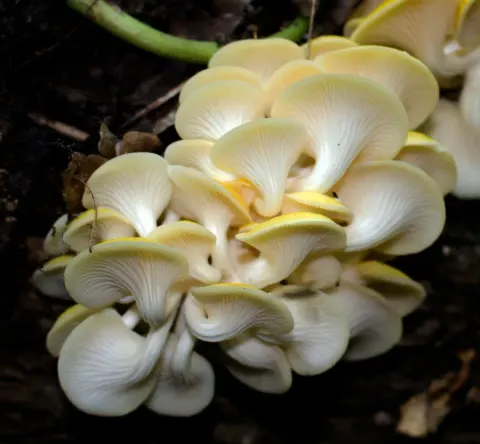
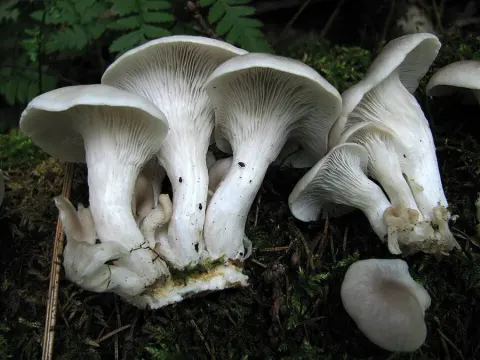
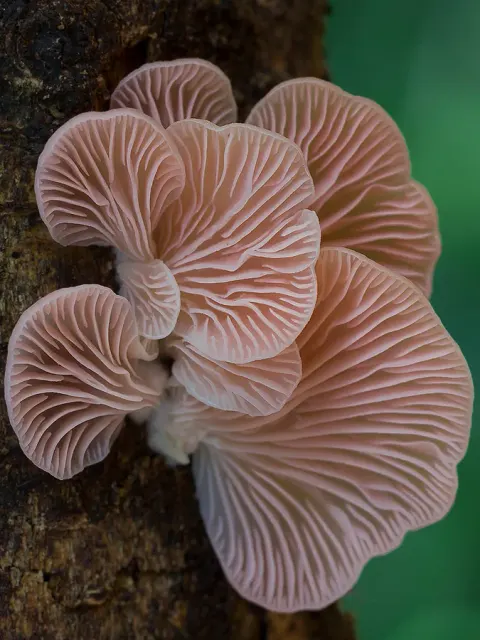
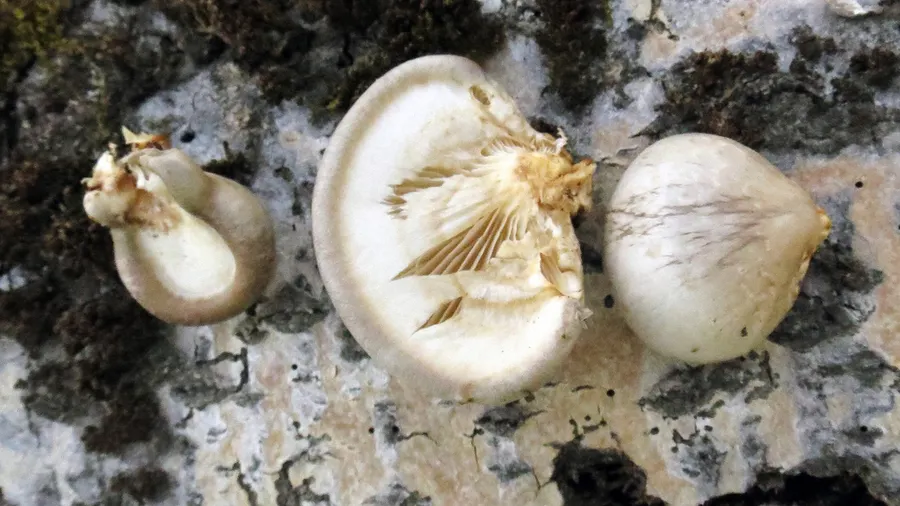
The 2.5-10 cm large fruiting bodies of Pleurotus calyptratus are semicircular, shell-shaped to kidney-shaped. The pileus surface is smooth, wrinkled with age, bald and at least a bit greasy in damp weather. The color spectrum ranges from pale brownish-grey to light grey-blue. Older specimens may fade to cream to whitish. The white, later yellowing, skin-like veil that stretches from the cap edges over the lamellae in young fruiting bodies is striking. The partial velum tears open during growth and ragged remnants get stuck at the edges. The lamellae are densely packed and like to have slightly jagged edges. They are white to cream-colored, yellowish to ocher-brown when old. The white spore powder darkens to a creamy yellow as it dries. The laterally grown stem is either short or absent. The flesh is white in color and does not change color when cut. It smells and tastes pleasantly, sweet like fruit or honey, but also floury. The cylindrical to slenderly elliptical spores are 10.5–15.5 μm long, (3)4–5 μm wide and show no iodine color reaction. Cystidia are absent. The lamella trama has a dimitic structure. The 2–3.5 μm wide skeletal hyphae are thick-walled, relatively short, and have neither septa nor clamp connections.

Sebagian uraian ditampilkan dalam bahasa sumber; terjemahannya belum tersedia atau belum lolos pemeriksaan.

Rujukan: [1]

Pengukuran mengikuti objek, spesimen atau kultur, dan metode yang disebutkan sumber. Baca uraian asli untuk konteks lengkap.

02 / Kehidupan

Habitat dan peran ekologis

Like Pleurotus dryinus, Pleurotus calyptratus parasites the weak - it affects trees weakened by drought or waterlogging. After the host has died, the fungus can continue to feed on the substrate as a saprobiont for some time. It causes intense white rot in the heartwood. The species mainly inhabits trunks, stumps and fallen branches of poplars, especially white and trembling poplars. The fungus is also very rare on willows and rowanberries. The mushroom lives in Europe in the temperate to subarctic climate zones. In Central Europe there are reports of finds from Germany, Croatia, Liechtenstein, Austria, Slovakia, Czech Republic and Hungary. In northern Europe, the species has so far only been found in Finland and Sweden. In Germany, only isolated finds from the southern federal states of Bavaria and Baden-Württemberg are known. It is recognized on the lists of endangered species in Poland, Sweden and Finland. The fungus has not established itself in Baden-Württemberg. It was able to benefit little from the spread of the trembling poplar, planted by humans as soil-preparing forest pioneers after World War II. Since the tree was no longer promoted, the Pleurotus calyptratus has been doomed to extinction.

Sebagian uraian ditampilkan dalam bahasa sumber; terjemahannya belum tersedia atau belum lolos pemeriksaan.

Rujukan: [1]

Habitat atau konteks temuan
hutan
Substrat
Informasi belum tersedia pada sumber rilis ini.
Peran atau konteks
Belum dikategorikan pada rilis ini.
Temukan hubungan serupa
03 / Siklus hidup

Reproduksi

The 2.5-10 cm large fruiting bodies of Pleurotus calyptratus are semicircular, shell-shaped to kidney-shaped. The pileus surface is smooth, wrinkled with age, bald and at least a bit greasy in damp weather. The color spectrum ranges from pale brownish-grey to light grey-blue. Older specimens may fade to cream to whitish. The white, later yellowing, skin-like veil that stretches from the cap edges over the lamellae in young fruiting bodies is striking. The partial velum tears open during growth and ragged remnants get stuck at the edges. The lamellae are densely packed and like to have slightly jagged edges. They are white to cream-colored, yellowish to ocher-brown when old. The white spore powder darkens to a creamy yellow as it dries.

Sebagian uraian ditampilkan dalam bahasa sumber; terjemahannya belum tersedia atau belum lolos pemeriksaan.

Rujukan: [1]

Sinonim menurut acuan taksonomi rilis: Agaricus calyptratus; Armillaria calyptrata; Lentodiopsis calyptrata; Pleurotus djamor f. calyptratus
04 / Batas informasi

Catatan identitas dan cakupan

  • Nama diterima mengikuti Catalogue of Life Base2026-09-11; uraian mempertahankan konsep dan nama sumber aslinya.
  • Original geographic, specimen and life-cycle scope retained; source import awaits individual editorial review.
  • Impor dan terjemahan otomatis belum diperiksa editorial per profil. Struktur reproduktif yang disebutkan tidak membuktikan seluruh siklus hidup diketahui.
  • Pengukuran pada uraian mengikuti spesimen, kultur, dan metode sumber; angka tidak diperluas ke semua populasi.

Catatan distribusi dalam narasi mengikuti sumbernya. Dokumentasi spesimen atau foto mengikuti catatan sumber. Bukti wilayah Indonesia dan penilaian konservasi tidak disimpulkan dari gambar.

05 / Dokumentasi

Melihat dengan konteks

Dokumentasi Pleurotus calyptratus menurut asosiasi foto pada record takson iNaturalist. Kredit: Елена А. Кизилова. Identitas mengikuti sumber; bukan penentuan spesimen independen.

Jenis
Fotografi
Kredit
(c) Елена А. Кизилова, some rights reserved (CC BY), uploaded by Елена А. Кизилова
Lisensi
CC BY 4.0
Sumber media
Buka entri sumber

Gambar menunjukkan objek menurut identifikasi sumber, bukan verifikasi independen spesimen oleh Fungi. Tidak ada skala baru yang ditambahkan.

06 / Rujukan

Sumber profil

  1. [1] Pleurotus calyptratus — Wikipedia (en)Bagian sumber: Frozen revision 1358252022
    Tanggal penghimpunan sumber: 2026-10-12
    Teks sumber: CC BY-SA4.0 · Wikipedia contributors
  2. [2] Catalogue of Life Base2026-09-11 — Pleurotus calyptratusBagian sumber: ColDP NameUsage.tsv ID 6VRXB; accepted species; source 2073
    Tanggal penghimpunan sumber: 2026-10-12
  3. [3] Dokumentasi visual — Pleurotus calyptratusBagian sumber: Individual media record; identification follows the source, not independent determination
    Tanggal penghimpunan sumber: 2026-10-12
    Media sumber: CC BY 4.0 · (c) Елена А. Кизилова, some rights reserved (CC BY), uploaded by Елена А. Кизилова

Adaptasi teks: CC BY-SA 4.0. Wikipedia contributors — Pleurotus calyptratus — Wikipedia (en)

Uraian asli dan riwayat sumber

Riwayat atau halaman sumber

Ringkasan sumber

The 2.5-10 cm large fruiting bodies of Pleurotus calyptratus are semicircular, shell-shaped to kidney-shaped. The pileus surface is smooth, wrinkled with age, bald and at least a bit greasy in damp weather. The color spectrum ranges from pale brownish-grey to light grey-blue. Older specimens may fade to cream to whitish. The white, later yellowing, skin-like veil that stretches from the cap edges over the lamellae in young fruiting bodies is striking. The partial velum tears open during growth and ragged remnants get stuck at the edges.

Revisi sumber

Morfologi sumber

The 2.5-10 cm large fruiting bodies of Pleurotus calyptratus are semicircular, shell-shaped to kidney-shaped. The pileus surface is smooth, wrinkled with age, bald and at least a bit greasy in damp weather. The color spectrum ranges from pale brownish-grey to light grey-blue. Older specimens may fade to cream to whitish. The white, later yellowing, skin-like veil that stretches from the cap edges over the lamellae in young fruiting bodies is striking. The partial velum tears open during growth and ragged remnants get stuck at the edges. The lamellae are densely packed and like to have slightly jagged edges. They are white to cream-colored, yellowish to ocher-brown when old. The white spore powder darkens to a creamy yellow as it dries. The laterally grown stem is either short or absent. The flesh is white in color and does not change color when cut. It smells and tastes pleasantly, sweet like fruit or honey, but also floury. The cylindrical to slenderly elliptical spores are 10.5–15.5 μm long, (3)4–5 μm wide and show no iodine color reaction. Cystidia are absent. The lamella trama has a dimitic structure. The 2–3.5 μm wide skeletal hyphae are thick-walled, relatively short, and have neither septa nor clamp connections.

Revisi sumber

Ekologi sumber

Like Pleurotus dryinus, Pleurotus calyptratus parasites the weak - it affects trees weakened by drought or waterlogging. After the host has died, the fungus can continue to feed on the substrate as a saprobiont for some time. It causes intense white rot in the heartwood. The species mainly inhabits trunks, stumps and fallen branches of poplars, especially white and trembling poplars. The fungus is also very rare on willows and rowanberries. The mushroom lives in Europe in the temperate to subarctic climate zones. In Central Europe there are reports of finds from Germany, Croatia, Liechtenstein, Austria, Slovakia, Czech Republic and Hungary. In northern Europe, the species has so far only been found in Finland and Sweden. In Germany, only isolated finds from the southern federal states of Bavaria and Baden-Württemberg are known. It is recognized on the lists of endangered species in Poland, Sweden and Finland. The fungus has not established itself in Baden-Württemberg. It was able to benefit little from the spread of the trembling poplar, planted by humans as soil-preparing forest pioneers after World War II. Since the tree was no longer promoted, the Pleurotus calyptratus has been doomed to extinction.

Revisi sumber

Struktur reproduksi sumber

The 2.5-10 cm large fruiting bodies of Pleurotus calyptratus are semicircular, shell-shaped to kidney-shaped. The pileus surface is smooth, wrinkled with age, bald and at least a bit greasy in damp weather. The color spectrum ranges from pale brownish-grey to light grey-blue. Older specimens may fade to cream to whitish. The white, later yellowing, skin-like veil that stretches from the cap edges over the lamellae in young fruiting bodies is striking. The partial velum tears open during growth and ragged remnants get stuck at the edges. The lamellae are densely packed and like to have slightly jagged edges. They are white to cream-colored, yellowish to ocher-brown when old. The white spore powder darkens to a creamy yellow as it dries.

Revisi sumber

Rujukan halaman ini

Fungi. Pleurotus calyptratus. Rilis data fungi-2026-10-12-expansion-2. https://fungi-atlas.mgadib.chatgpt.site/jamur/pleurotus-calyptratus/.

Status: impor sumber; pemeriksaan editorial per profil belum selesai. Untuk klaim biologis, gunakan rujukan pada bagian terkait dan periksa konteks sumber aslinya.