Ciri dan struktur
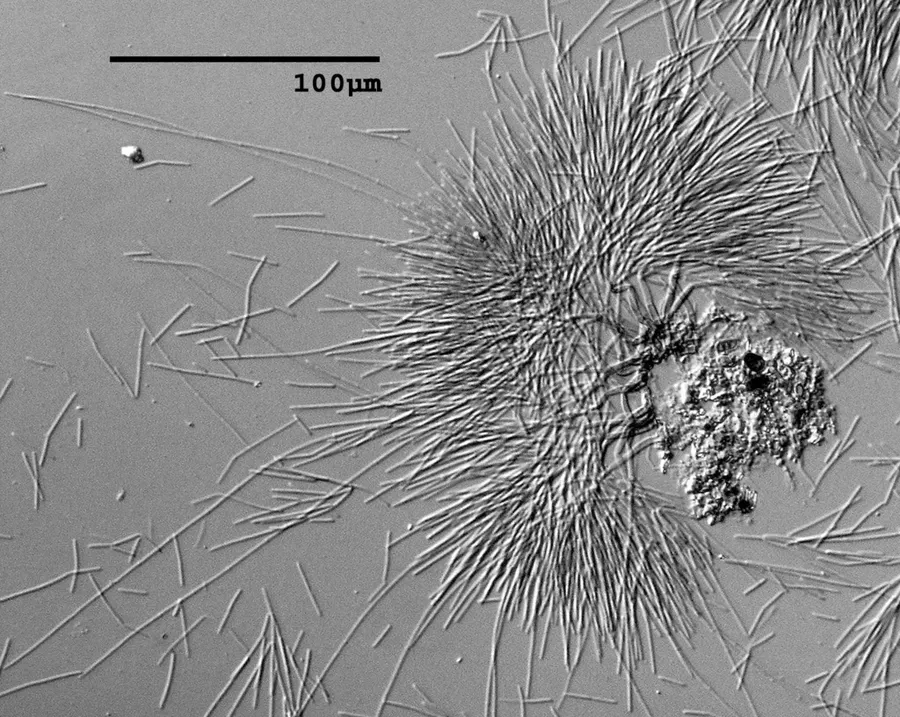
Colonies pulvinate to effuse, up to 70 µm high excluding setae. Conidiophores loosely fasciculate, brown, becoming paler to apex, up to 40 µm high, up to 5 µm at base, verticillately branched. Conidiogenesis blastic. Conidia branched, in acropetal chains, conidiogenous cells continuous with conidia, disarticulating, hyaline, 1 to many septate, 30 × 2 µm (1-septate), to 65 × 2 µm (4-septate). Setae straight, unbranched, slightly pigmented and slightly swollen at septa, up to 400 µm long
Habitat dan peran ekologis
This species bears macro-morphological resemblance to species of Linodochium, which have a distinctly sporodochial habit, holoblastic, sympodial conidiogenesis and unbranched conidia (Dyko & Sutton 1978). The species is considered to be more appropriately placed in Polyscytalum where it shows a degree of similarity with Polyscytalum fuegianum, associated with Nothofagus betuloides and N. dombeyi in Argentina (Gamundí et al. 1977). However, P. ciliatum is clearly differentiated by the presence of long hairs. Sympodiella gracilispora Matsush. has been recorded in New Zealand and was transferred to Polyscytalum as P. gracilisporum by Sutton & Hodges (1976). In New Zealand P. gracilisporum has been recorded on Podocarpus dacrydioides (PDD 38963, 38964), Nothofagus menziesii (PDD 38965), and Kunzea ericoides (PDD 74779). All three species grow on the natural substrate as fasciculate tufts. However, the pulvinate nature of colonies of P. ciliatum, combined with the fasciculate growth and distinctive hairs, may eventually require its removal to a different genus. Marvanová et al. (2002) have recently supported Barron’s (1968) view that Polyscytalum currently encompasses two concepts; one with blastic conidia in acropetal, branched chains, which includes the type, P. foecundissimum Riess, and the other with unbranched chains of arthroconidia arising from verticillate conidiophores, which includes P. gracilisporum.
- Habitat atau konteks temuan
- Informasi belum tersedia pada sumber rilis ini.
- Substrat
- Informasi belum tersedia pada sumber rilis ini.
- Peran atau konteks
- Belum dikategorikan pada rilis ini.
Reproduksi
Colonies pulvinate to effuse, up to 70 µm high excluding setae. Conidiophores loosely fasciculate, brown, becoming paler to apex, up to 40 µm high, up to 5 µm at base, verticillately branched. Conidiogenesis blastic. Conidia branched, in acropetal chains, conidiogenous cells continuous with conidia, disarticulating, hyaline, 1 to many septate, 30 × 2 µm (1-septate), to 65 × 2 µm (4-septate). Setae straight, unbranched, slightly pigmented and slightly swollen at septa, up to 400 µm long
Catatan identitas dan cakupan
- Nama diterima mengikuti Catalogue of Life Base2026-09-11; uraian mempertahankan konsep dan nama sumber aslinya.
- Historical description as cited by BiotaNZ. Preserve explicit New Zealand/locality, host and specimen qualifiers. Distribution is the cited source scope, not a current global range.
- Impor dan terjemahan otomatis belum diperiksa editorial per profil. Struktur reproduktif yang disebutkan tidak membuktikan seluruh siklus hidup diketahui.
- Pengukuran pada uraian mengikuti spesimen, kultur, dan metode sumber; angka tidak diperluas ke semua populasi.
Catatan distribusi dalam narasi mengikuti sumbernya. Dokumentasi spesimen atau foto mengikuti catatan sumber. Bukti wilayah Indonesia dan penilaian konservasi tidak disimpulkan dari gambar.
Melihat dengan konteks
Dokumentasi Polyscytalum ciliatum menurut asosiasi foto pada record takson iNaturalist. Kredit: Jerry Cooper. Identitas mengikuti sumber; bukan penentuan spesimen independen.
- Jenis
- Fotografi
- Kredit
- (c) Jerry Cooper, some rights reserved (CC BY), uploaded by Jerry Cooper
- Lisensi
- CC BY 4.0
- Sumber media
- Buka entri sumber
Sumber profil
- [1] Cooper, J.A. 2005: New Zealand hyphomycete fungi: additional records, new species, and notes on interesting collections. New Zealand Journal of Botany 43(1): 323-349. — Polyscytalum ciliatum
- [2] Catalogue of Life Base2026-09-11 — Polyscytalum ciliatum
- [3] Dokumentasi visual — Polyscytalum ciliatum
Rujukan halaman ini
Fungi. Polyscytalum ciliatum. Rilis data fungi-2026-10-12-expansion-2. https://fungi-atlas.mgadib.chatgpt.site/jamur/polyscytalum-ciliatum/.
Status: impor sumber; pemeriksaan editorial per profil belum selesai. Untuk klaim biologis, gunakan rujukan pada bagian terkait dan periksa konteks sumber aslinya.