01 / Morfologi

Ciri dan struktur

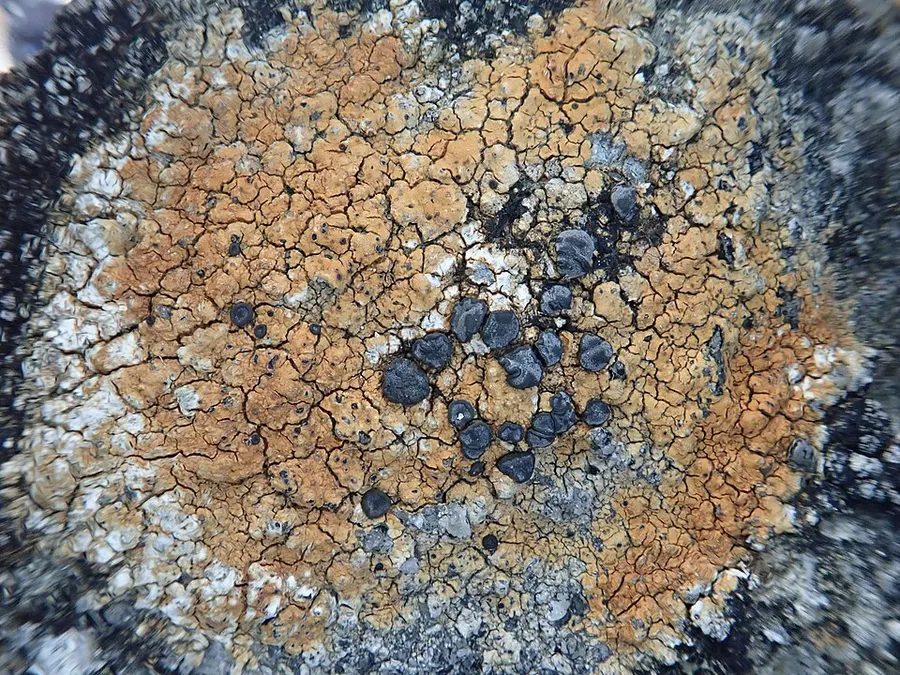
Porpidia flavocruenta forms a thin to moderately thick, yellow–orange crust on rock surfaces, usually cracked into small with an uneven, slightly warted surface from which the fruiting bodies arise; a narrow black border () is often visible where it meets other lichens. The fruiting bodies (apothecia) are relatively large for the genus (typically about 1–1.5 mm across), black and round with a persistent raised rim, and often carry a dusting () that makes the appear grey or orange; they sit on the surface of the thallus and are slightly pinched in at the base. Field workers in the Harz have emphasised that the combination of a bright orange thallus and usually strongly pruinose apothecia makes the species relatively easy to recognise on exposed rock faces. In section the hymenium is clear and stains blue with iodine, and it overlies a dark brown tissue () and a strongly pigmented apothecial rim () made of thick-walled cells whose inner part is orange-brown and whose outer edge is blue-black; when this tissue is treated with potassium hydroxide solution (the K test) it releases a vivid crimson solution, a distinctive pigment reaction that helps separate the species from similar orange Porpidia taxa. The microscopic fertile layer contains abundant, very slender, branched filaments (paraphyses) with only slightly swollen tips, and cylindrical asci that produce simple, colourless, ellipsoid spores surrounded by a clear , measuring 15–19 × 8–10 micrometres. Asexual reproductive structures (pycnidia) are frequent: they appear as tiny black dots with a narrow orange rim and produce rod-shaped conidia.

Sebagian uraian ditampilkan dalam bahasa sumber; terjemahannya belum tersedia atau belum lolos pemeriksaan.

Rujukan: [1]

Pengukuran mengikuti objek, spesimen atau kultur, dan metode yang disebutkan sumber. Baca uraian asli untuk konteks lengkap.

02 / Kehidupan

Habitat dan peran ekologis

Porpidia flavocruenta is a saxicolous (rock-dwelling) lichen that grows on siliceous, usually acidic rocks in cool, moist upland environments. In the British Isles it has been recorded from numerous sites in the Scottish Highlands and in upland Wales, typically on boulders and crags in shaded rock overhangs or other persistently damp microhabitats. Beyond Britain and Ireland it has been found in northern Sweden around Abisko and in the Austrian Alps, as well as in Norway and Iceland, usually in similar montane settings, and it is also known from North America. Fryday suggested that many past records filed under the closely similar orange species P. flavicunda probably include misidentified P. flavocruenta, so the species is likely to be more widespread than current confirmed records suggest. It was reported for the first time from Poland in 2010, from basalt outcrops in the Mały Śnieżny Kocioł cirque in the Karkonosze Mountains of the Sudetes, where it is known from a single montane locality. In central Germany it has been found on granite boulder fields near the summit of Brocken in the Harz National Park, where it was rediscovered in 2016 after an earlier record from 1932. In North America it is known from the North Slope of northern Alaska and from eastern Canada, where it was reported as new to Canada from the Avalon Peninsula of Newfoundland; there it grows on sedimentary rock outcrops in ombrotrophic heath–bogs of the Maritime Barrens ecoregion, and the Newfoundland collection together with a small number of herbarium vouchers represent the only confirmed Canadian records, suggesting that the species has often been overlooked for P. flavicunda.

Sebagian uraian ditampilkan dalam bahasa sumber; terjemahannya belum tersedia atau belum lolos pemeriksaan.

Rujukan: [1]

Habitat atau konteks temuan
Informasi belum tersedia pada sumber rilis ini.
Substrat
Informasi belum tersedia pada sumber rilis ini.
Peran atau konteks
Pembentuk liken
Temukan hubungan serupa
03 / Siklus hidup

Reproduksi

In section the hymenium is clear and stains blue with iodine, and it overlies a dark brown tissue () and a strongly pigmented apothecial rim () made of thick-walled cells whose inner part is orange-brown and whose outer edge is blue-black; when this tissue is treated with potassium hydroxide solution (the K test) it releases a vivid crimson solution, a distinctive pigment reaction that helps separate the species from similar orange Porpidia taxa. The microscopic fertile layer contains abundant, very slender, branched filaments (paraphyses) with only slightly swollen tips, and cylindrical asci that produce simple, colourless, ellipsoid spores surrounded by a clear , measuring 15–19 × 8–10 micrometres.

Sebagian uraian ditampilkan dalam bahasa sumber; terjemahannya belum tersedia atau belum lolos pemeriksaan.

Rujukan: [1]

04 / Batas informasi

Catatan identitas dan cakupan

  • Nama diterima mengikuti Catalogue of Life Base2026-09-11; uraian mempertahankan konsep dan nama sumber aslinya.
  • Original geographic, specimen and life-cycle scope retained; source import awaits individual editorial review.
  • Impor dan terjemahan otomatis belum diperiksa editorial per profil. Struktur reproduktif yang disebutkan tidak membuktikan seluruh siklus hidup diketahui.
  • Pengukuran pada uraian mengikuti spesimen, kultur, dan metode sumber; angka tidak diperluas ke semua populasi.

Catatan distribusi dalam narasi mengikuti sumbernya. Dokumentasi spesimen atau foto mengikuti catatan sumber. Bukti wilayah Indonesia dan penilaian konservasi tidak disimpulkan dari gambar.

05 / Dokumentasi

Melihat dengan konteks

Dokumentasi Porpidia flavocruenta dari Wikimedia Commons. The crustose lichen Porpidia flavocruenta ; location: Germany, Bavaria, Farrenberg Identifikasi mengikuti record berkas sumber.

Jenis
Fotografi
Kredit
Wolfgang von Brackel
Lisensi
CC BY 4.0
Sumber media
Buka entri sumber

Gambar menunjukkan objek menurut identifikasi sumber, bukan verifikasi independen spesimen oleh Fungi. Tidak ada skala baru yang ditambahkan.

06 / Rujukan

Sumber profil

  1. [1] Porpidia flavocruenta — Wikipedia (en)Bagian sumber: Frozen revision 1340123897
    Tanggal penghimpunan sumber: 2026-10-12
    Teks sumber: CC BY-SA4.0 · Wikipedia contributors
  2. [2] Catalogue of Life Base2026-09-11 — Porpidia flavocruentaBagian sumber: ColDP NameUsage.tsv ID 4LZDX; accepted species; source 2073
    Tanggal penghimpunan sumber: 2026-10-12
  3. [3] Dokumentasi visual — Porpidia flavocruentaBagian sumber: Individual media record; identification follows the source, not independent determination
    Tanggal penghimpunan sumber: 2026-10-12
    Media sumber: CC BY 4.0 · Wolfgang von Brackel

Adaptasi teks: CC BY-SA 4.0. Wikipedia contributors — Porpidia flavocruenta — Wikipedia (en)

Uraian asli dan riwayat sumber

Riwayat atau halaman sumber

Ringkasan sumber

Porpidia flavocruenta is a species of saxicolous (rock-dwelling) crustose lichen in the family Lecideaceae. The species forms a bright orange to yellow crust on rock surfaces and is particularly distinctive because of its characteristically black fruiting bodies that often have a greyish or orange dusting on their surface. It grows in cool, damp upland habitats on siliceous rocks, typically in shaded locations such as rock overhangs and cliff faces where moisture levels remain high throughout the year.

Revisi sumber

Morfologi sumber

Porpidia flavocruenta forms a thin to moderately thick, yellow–orange crust on rock surfaces, usually cracked into small with an uneven, slightly warted surface from which the fruiting bodies arise; a narrow black border () is often visible where it meets other lichens. The fruiting bodies (apothecia) are relatively large for the genus (typically about 1–1.5 mm across), black and round with a persistent raised rim, and often carry a dusting () that makes the appear grey or orange; they sit on the surface of the thallus and are slightly pinched in at the base. Field workers in the Harz have emphasised that the combination of a bright orange thallus and usually strongly pruinose apothecia makes the species relatively easy to recognise on exposed rock faces. In section the hymenium is clear and stains blue with iodine, and it overlies a dark brown tissue () and a strongly pigmented apothecial rim () made of thick-walled cells whose inner part is orange-brown and whose outer edge is blue-black; when this tissue is treated with potassium hydroxide solution (the K test) it releases a vivid crimson solution, a distinctive pigment reaction that helps separate the species from similar orange Porpidia taxa. The microscopic fertile layer contains abundant, very slender, branched filaments (paraphyses) with only slightly swollen tips, and cylindrical asci that produce simple, colourless, ellipsoid spores surrounded by a clear , measuring 15–19 × 8–10 micrometres. Asexual reproductive structures (pycnidia) are frequent: they appear as tiny black dots with a narrow orange rim and produce rod-shaped conidia.

Revisi sumber

Ekologi sumber

Porpidia flavocruenta is a saxicolous (rock-dwelling) lichen that grows on siliceous, usually acidic rocks in cool, moist upland environments. In the British Isles it has been recorded from numerous sites in the Scottish Highlands and in upland Wales, typically on boulders and crags in shaded rock overhangs or other persistently damp microhabitats. Beyond Britain and Ireland it has been found in northern Sweden around Abisko and in the Austrian Alps, as well as in Norway and Iceland, usually in similar montane settings, and it is also known from North America. Fryday suggested that many past records filed under the closely similar orange species P. flavicunda probably include misidentified P. flavocruenta, so the species is likely to be more widespread than current confirmed records suggest. It was reported for the first time from Poland in 2010, from basalt outcrops in the Mały Śnieżny Kocioł cirque in the Karkonosze Mountains of the Sudetes, where it is known from a single montane locality. In central Germany it has been found on granite boulder fields near the summit of Brocken in the Harz National Park, where it was rediscovered in 2016 after an earlier record from 1932. In North America it is known from the North Slope of northern Alaska and from eastern Canada, where it was reported as new to Canada from the Avalon Peninsula of Newfoundland; there it grows on sedimentary rock outcrops in ombrotrophic heath–bogs of the Maritime Barrens ecoregion, and the Newfoundland collection together with a small number of herbarium vouchers represent the only confirmed Canadian records, suggesting that the species has often been overlooked for P. flavicunda.

Revisi sumber

Struktur reproduksi sumber

In section the hymenium is clear and stains blue with iodine, and it overlies a dark brown tissue () and a strongly pigmented apothecial rim () made of thick-walled cells whose inner part is orange-brown and whose outer edge is blue-black; when this tissue is treated with potassium hydroxide solution (the K test) it releases a vivid crimson solution, a distinctive pigment reaction that helps separate the species from similar orange Porpidia taxa. The microscopic fertile layer contains abundant, very slender, branched filaments (paraphyses) with only slightly swollen tips, and cylindrical asci that produce simple, colourless, ellipsoid spores surrounded by a clear , measuring 15–19 × 8–10 micrometres.

Revisi sumber

Rujukan halaman ini

Fungi. Porpidia flavocruenta. Rilis data fungi-2026-10-12-expansion-2. https://fungi-atlas.mgadib.chatgpt.site/jamur/porpidia-flavocruenta/.

Status: impor sumber; pemeriksaan editorial per profil belum selesai. Untuk klaim biologis, gunakan rujukan pada bagian terkait dan periksa konteks sumber aslinya.