01 / Morfologi

Ciri dan struktur

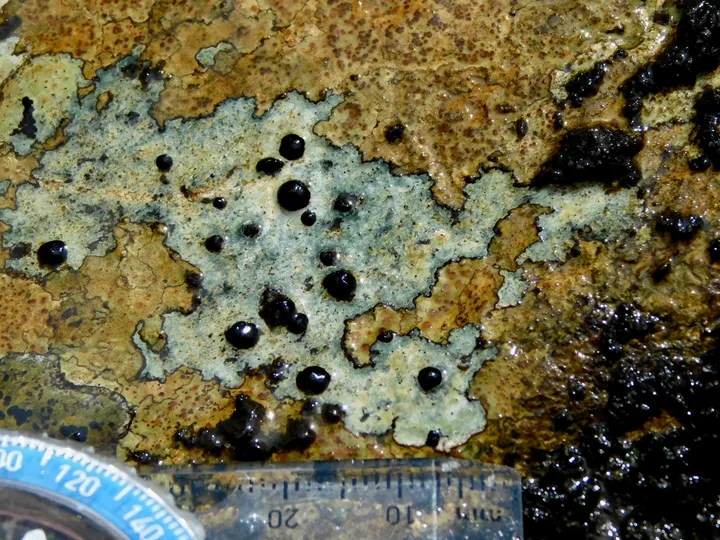
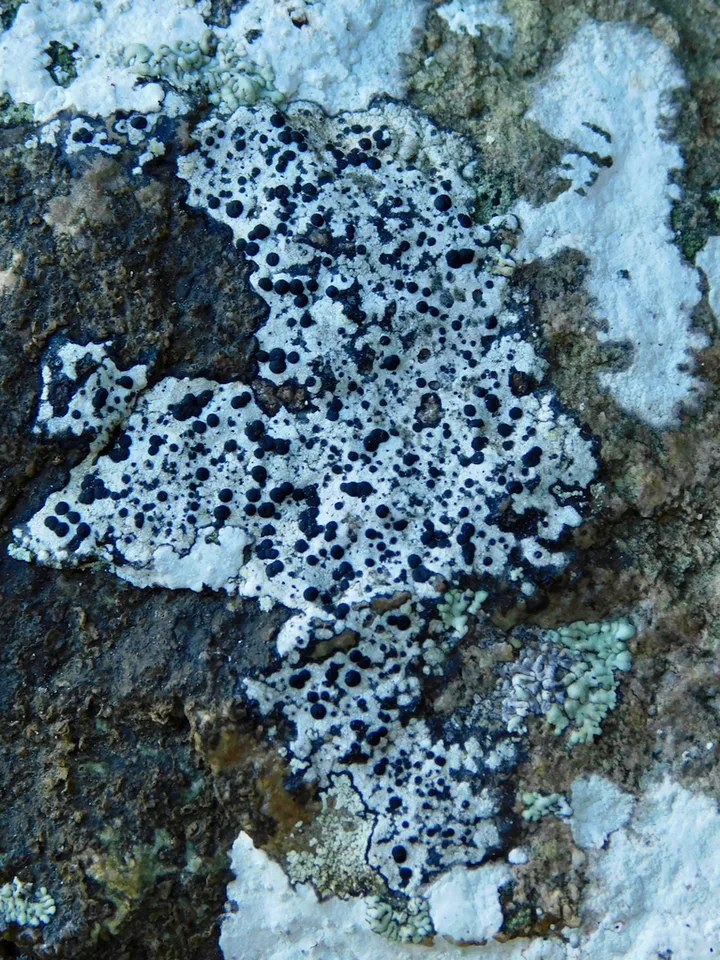
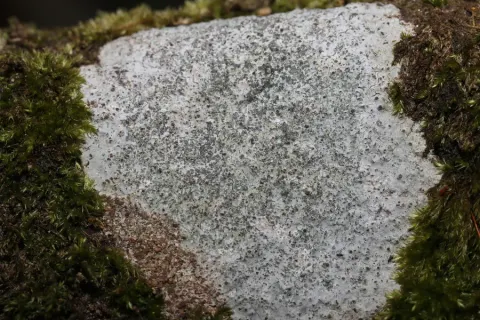
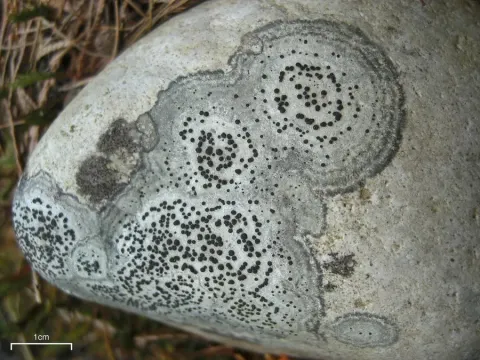
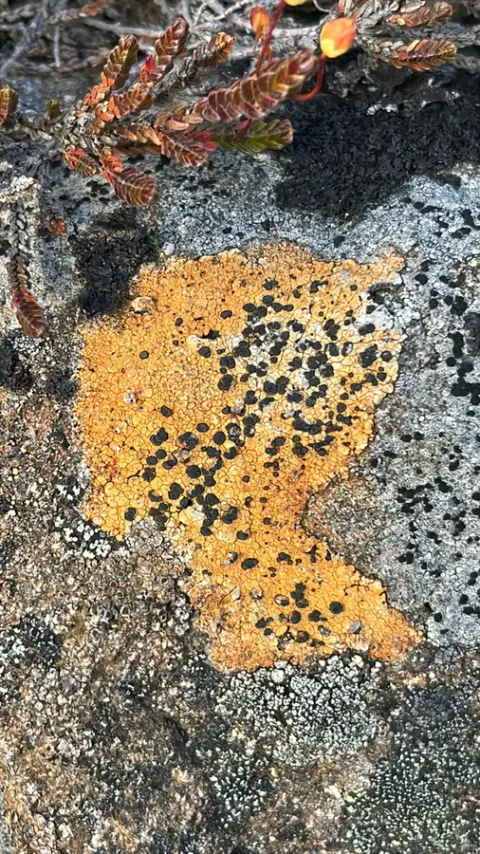
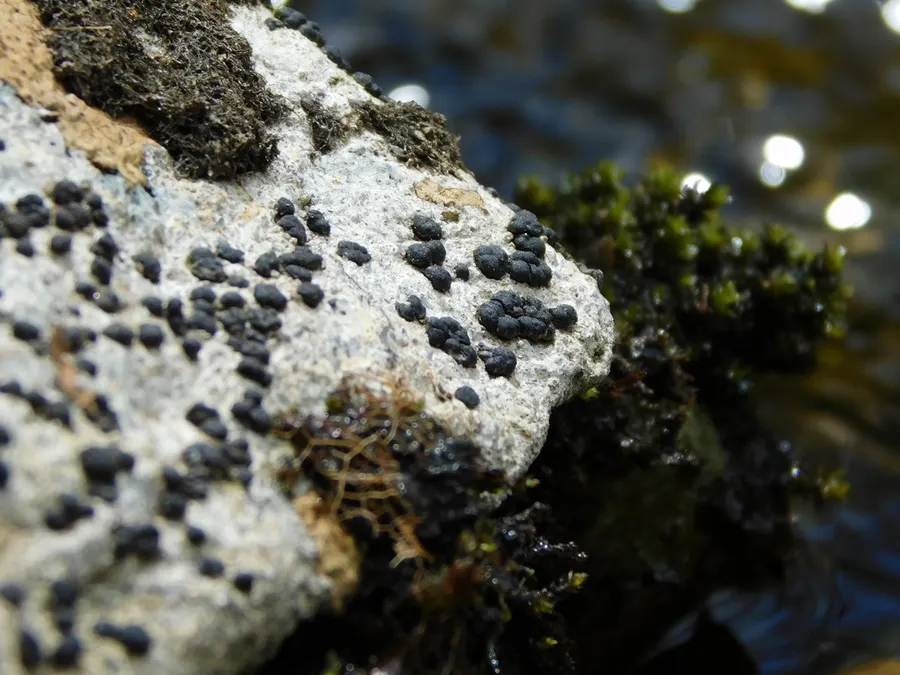
Porpidia macrocarpa is a crustose lichen with a variable thallus, typically appearing (embedded in the ) to thin and continuous, but it can sometimes be thicker and become cracked () or divided into small sections (). The surface of the thallus is rough and web-like () with a colour range from pale grey to greenish-grey. It frequently shows patches or continuous areas of orange to rust-red due to oxidation. The medulla (internal tissue) does not react to iodine (I–). The (initial growth stage) is indistinct at the margins of immersed thalli but becomes wavy, black, and somewhat distinct at the margins of more superficial thalli. The apothecia (fruiting bodies) are up to 3 mm in diameter, usually (sitting directly on the thallus), abundant, and can be scattered or crowded together. They are constricted at the base with a thick, swollen (rim) that is persistent, black, shiny, and raised, ranging from entire to somewhat wavy (). The hyphae (filamentous fungal cells) measure 3–9 μm in diameter. The of the apothecia can be slightly concave to flat or convex, black or brown-black, with a or shiny finish, and sometimes covered with a grey powdery coating (). Larger apothecia often appear to divide through the formation of secondary margins within the disc. The (upper layer of the hymenium) is pale brown to olive-brown, and the hymenium (spore-producing layer) measures 80–100 μm tall. The (layer below the hymenium) and inner exciple may show a reddish tinge when treated with potassium hydroxide solution (K+). The are elongated, measuring 16–20 μm in length and 6–11.5 μm in width. The medulla reacts variably to chemical spot tests, sometimes showing a yellowish reaction with potassium hydroxide (K±) and an orange reaction with p-phenylenediamine (Pd±), indicating the presence of stictic and cryptostictic acids.

Sebagian uraian ditampilkan dalam bahasa sumber; terjemahannya belum tersedia atau belum lolos pemeriksaan.

Rujukan: [1]

Pengukuran mengikuti objek, spesimen atau kultur, dan metode yang disebutkan sumber. Baca uraian asli untuk konteks lengkap.

02 / Kehidupan

Habitat dan peran ekologis

In Nepal, Porpidia macrocarpa has been reported from 2,950 to 4,000 m elevation in a compilation of published records.

Sebagian uraian ditampilkan dalam bahasa sumber; terjemahannya belum tersedia atau belum lolos pemeriksaan.

Rujukan: [1]

Habitat atau konteks temuan
Informasi belum tersedia pada sumber rilis ini.
Substrat
Informasi belum tersedia pada sumber rilis ini.
Peran atau konteks
Pembentuk liken
Temukan hubungan serupa
03 / Siklus hidup

Reproduksi

The apothecia (fruiting bodies) are up to 3 mm in diameter, usually (sitting directly on the thallus), abundant, and can be scattered or crowded together. They are constricted at the base with a thick, swollen (rim) that is persistent, black, shiny, and raised, ranging from entire to somewhat wavy (). The hyphae (filamentous fungal cells) measure 3–9 μm in diameter. The of the apothecia can be slightly concave to flat or convex, black or brown-black, with a or shiny finish, and sometimes covered with a grey powdery coating (). Larger apothecia often appear to divide through the formation of secondary margins within the disc. The (upper layer of the hymenium) is pale brown to olive-brown, and the hymenium (spore-producing layer) measures 80–100 μm tall.

Sebagian uraian ditampilkan dalam bahasa sumber; terjemahannya belum tersedia atau belum lolos pemeriksaan.

Rujukan: [1]

Sinonim menurut acuan taksonomi rilis: Biatora confluens f. steriza; Biatora platycarpa; Biatora platycarpa var. steriza; Buellia epipolia f. calcarea; Diplotomma alboatrum var. calcareum; Haplocarpon convexum; Haplocarpon macrocarpum; Haplocarpon nigrocruentum; Haplocarpon phylliscinum; Haplocarpon sterizum; Huilia macrocarpa; Huilia macrocarpa var. convexa; Huilia nigrocruenta; Lecidea albocaerulescens var. convexa; Lecidea albocaerulescens var. platycarpa; Lecidea calcarea; Lecidea confluens f. steriza; Lecidea confluens var. steriza; Lecidea contigua f. calcarea; Lecidea contigua f. notabilis; Lecidea contigua f. platycarpa; Lecidea contigua f. steriza; Lecidea contigua subsp. platycarpa; Lecidea contigua var. calcarea; Lecidea contigua var. convexa; Lecidea contigua var. notabilis; Lecidea contigua var. oxydata; Lecidea contigua var. platycarpa; Lecidea contigua var. steriza; Lecidea contortula; Lecidea convexa; Lecidea crustulata var. steriza; Lecidea macrocarpa; Lecidea macrocarpa f. oxydata; Lecidea macrocarpa f. steriza; Lecidea macrocarpa subsp. convexa; Lecidea macrocarpa var. platycarpa; Lecidea macrocarpa var. steriza; Lecidea nigrocruenta; Lecidea parasema f. macrocarpa; Lecidea parasema var. convexa; Lecidea parasema var. platycarpa; Lecidea phylliscina; Lecidea platycarpa; Lecidea platycarpa convexa; Lecidea platycarpa f. convexa; Lecidea platycarpa f. oxydata; Lecidea platycarpa f. steriza; Lecidea platycarpa var. convexa; Lecidea platycarpa var. macrocarpa; Lecidea platycarpa var. oxydata; Lecidea platycarpa var. steriza; Lecidea steriza; Lecidea steriza f. macrocarpa; Lecidea steriza f. platycarpa; Lecidea tenebrans; Lichen albozonaria var. steriza; Lichen peltatus platycarpa; Patellaria confluens f. platycarpa; Patellaria confluens platycarpa; Patellaria macrocarpa; Patellaria platycarpa; Porpidia macrocarpa f. nigrocruenta; Porpidia macrocarpa var. striata; Porpidia nigrocruenta; Psora contortula
04 / Batas informasi

Catatan identitas dan cakupan

  • Nama diterima mengikuti Catalogue of Life Base2026-09-11; uraian mempertahankan konsep dan nama sumber aslinya.
  • Original geographic, specimen and life-cycle scope retained; source import awaits individual editorial review.
  • Impor dan terjemahan otomatis belum diperiksa editorial per profil. Struktur reproduktif yang disebutkan tidak membuktikan seluruh siklus hidup diketahui.
  • Pengukuran pada uraian mengikuti spesimen, kultur, dan metode sumber; angka tidak diperluas ke semua populasi.

Catatan distribusi dalam narasi mengikuti sumbernya. Dokumentasi spesimen atau foto mengikuti catatan sumber. Bukti wilayah Indonesia dan penilaian konservasi tidak disimpulkan dari gambar.

05 / Dokumentasi

Melihat dengan konteks

Dokumentasi Porpidia macrocarpa menurut asosiasi foto pada record takson iNaturalist. Kredit: Michael J. Papay. Identitas mengikuti sumber; bukan penentuan spesimen independen.

Jenis
Fotografi
Kredit
(c) Michael J. Papay, some rights reserved (CC BY), uploaded by Michael J. Papay
Lisensi
CC BY 4.0
Sumber media
Buka entri sumber

Gambar menunjukkan objek menurut identifikasi sumber, bukan verifikasi independen spesimen oleh Fungi. Tidak ada skala baru yang ditambahkan.

Dokumentasi tambahan

06 / Rujukan

Sumber profil

  1. [1] Porpidia macrocarpa — Wikipedia (en)Bagian sumber: Frozen revision 1342805831
    Tanggal penghimpunan sumber: 2026-10-12
    Teks sumber: CC BY-SA4.0 · Wikipedia contributors
  2. [2] Catalogue of Life Base2026-09-11 — Porpidia macrocarpaBagian sumber: ColDP NameUsage.tsv ID 787J5; accepted species; source 2073
    Tanggal penghimpunan sumber: 2026-10-12
  3. [3] Dokumentasi visual — Porpidia macrocarpaBagian sumber: Identitas mengikuti sumber dokumentasi; bukan penentuan spesimen independen.
    Tanggal penghimpunan sumber: 2026-10-17
    Media sumber: CC BY 4.0 · (c) Michael J. Papay, some rights reserved (CC BY), uploaded by Michael J. Papay
  4. [4] Dokumentasi visual — Porpidia macrocarpaBagian sumber: Identitas mengikuti sumber dokumentasi; bukan penentuan spesimen independen.
    Tanggal penghimpunan sumber: 2026-10-17
    Teks sumber: CC BY 4.0 · (c) Michael J. Papay, some rights reserved (CC BY), uploaded by Michael J. Papay
  5. [5] Dokumentasi visual — Porpidia macrocarpaBagian sumber: Identitas mengikuti sumber dokumentasi; bukan penentuan spesimen independen.
    Tanggal penghimpunan sumber: 2026-10-17
    Teks sumber: CC BY 4.0 · (c) Michael J. Papay, some rights reserved (CC BY), uploaded by Michael J. Papay

Adaptasi teks: CC BY-SA 4.0. Wikipedia contributors — Porpidia macrocarpa — Wikipedia (en)

Uraian asli dan riwayat sumber

Riwayat atau halaman sumber

Ringkasan sumber

Porpidia macrocarpa is a species of saxicolous (rock-dwelling), crustose lichen in the family Lecideaceae.

Revisi sumber

Morfologi sumber

Porpidia macrocarpa is a crustose lichen with a variable thallus, typically appearing (embedded in the ) to thin and continuous, but it can sometimes be thicker and become cracked () or divided into small sections (). The surface of the thallus is rough and web-like () with a colour range from pale grey to greenish-grey. It frequently shows patches or continuous areas of orange to rust-red due to oxidation. The medulla (internal tissue) does not react to iodine (I–). The (initial growth stage) is indistinct at the margins of immersed thalli but becomes wavy, black, and somewhat distinct at the margins of more superficial thalli. The apothecia (fruiting bodies) are up to 3 mm in diameter, usually (sitting directly on the thallus), abundant, and can be scattered or crowded together. They are constricted at the base with a thick, swollen (rim) that is persistent, black, shiny, and raised, ranging from entire to somewhat wavy (). The hyphae (filamentous fungal cells) measure 3–9 μm in diameter. The of the apothecia can be slightly concave to flat or convex, black or brown-black, with a or shiny finish, and sometimes covered with a grey powdery coating (). Larger apothecia often appear to divide through the formation of secondary margins within the disc. The (upper layer of the hymenium) is pale brown to olive-brown, and the hymenium (spore-producing layer) measures 80–100 μm tall. The (layer below the hymenium) and inner exciple may show a reddish tinge when treated with potassium hydroxide solution (K+). The are elongated, measuring 16–20 μm in length and 6–11.5 μm in width. The medulla reacts variably to chemical spot tests, sometimes showing a yellowish reaction with potassium hydroxide (K±) and an orange reaction with p-phenylenediamine (Pd±), indicating the presence of stictic and cryptostictic acids.

Revisi sumber

Ekologi sumber

In Nepal, Porpidia macrocarpa has been reported from 2,950 to 4,000 m elevation in a compilation of published records.

Revisi sumber

Struktur reproduksi sumber

The apothecia (fruiting bodies) are up to 3 mm in diameter, usually (sitting directly on the thallus), abundant, and can be scattered or crowded together. They are constricted at the base with a thick, swollen (rim) that is persistent, black, shiny, and raised, ranging from entire to somewhat wavy (). The hyphae (filamentous fungal cells) measure 3–9 μm in diameter. The of the apothecia can be slightly concave to flat or convex, black or brown-black, with a or shiny finish, and sometimes covered with a grey powdery coating (). Larger apothecia often appear to divide through the formation of secondary margins within the disc. The (upper layer of the hymenium) is pale brown to olive-brown, and the hymenium (spore-producing layer) measures 80–100 μm tall.

Revisi sumber

Rujukan halaman ini

Fungi. Porpidia macrocarpa. Rilis data fungi-2026-10-12-expansion-2. https://fungi-atlas.mgadib.chatgpt.site/jamur/porpidia-macrocarpa/.

Status: impor sumber; pemeriksaan editorial per profil belum selesai. Untuk klaim biologis, gunakan rujukan pada bagian terkait dan periksa konteks sumber aslinya.