Ciri dan struktur
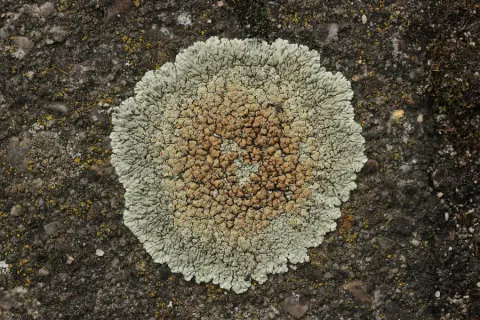
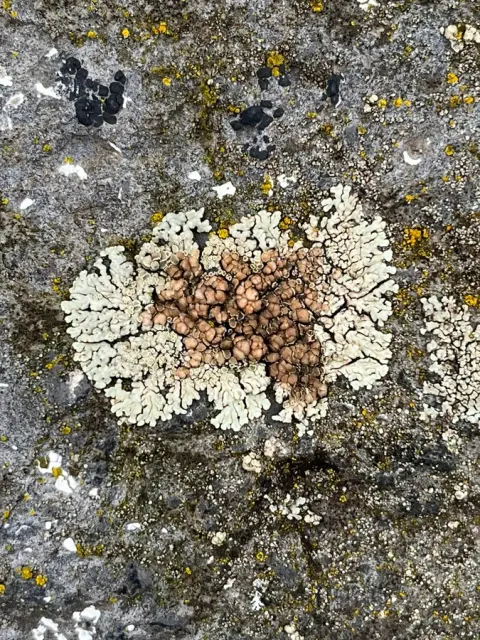
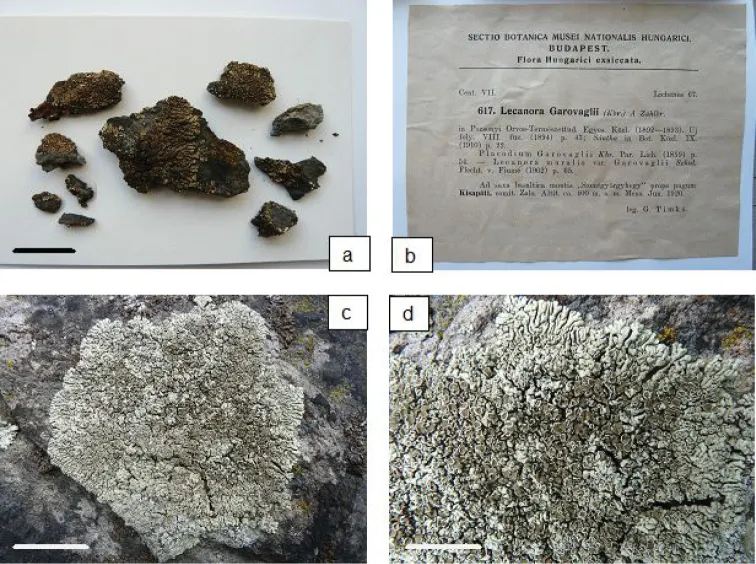
Thallus lichenised, placodioid, thick, usually distinctly circular, up to 12 cm diam., not very closely attached to the substrate, prothallus not present. Marginal lobes elongated, distinctly convex, swollen, sinuous, smooth 0.4–1.8 mm wide and 3–10 mm long, broadened and rounded at the ends (Figs 2c–d). Thallus centre more or less areolate. Areoles convex, irregular, overlapping, 0.25–1.0 mm diam. Upper surface mat, pale yellowish-green to greyish-green, tending to be darker in the central part of the thallus, sometimes shining and darker also at the edges of the marginal lobes. Lower surface pale brown. Medulla white, in older lobes distinctly hollow in the middle part. Apothecia sessile to constricted at base, dispersed to clustered towards thallus centre, 0.5–2.0 mm diam., circular, older angular, proper margin persistent, paler or concolorous with thallus, matte, slightly radially cracked, flexuose in older and disappearing in mature apothecia. Disc pale brown to yellowish-brown, becoming darker in the centre of thallus, epruinose, flat. Hymenium colourless, 50–60 μm high, hypothecium colourless, epihymenium orange-brown with small granules soluble in K and insoluble in N. Asci clavate, eight-spored. Paraphyses simple or weakly branched with swollen apices. Ascospores hyaline, simple, ellipsoid to oblong-elipsoid, 10–12 × 6–7 μm. Pycnidia not seen.
Habitat dan peran ekologis
the species is widely distributed in the world. It occurs in Europe, Asia, Africa (Morocco; Egea 1996), North America (Canada; Freebury 2014 and USA; Ryan et al. 2004) and South America (Feuerer et al. 1998; Feuerer and Sipman 2005). In Asia, it has been noted in Afghanistan (Poelt and Wirth 1968), India (Upreti and Chatterjee 1998; Singh and Sinha 2010), Iran (Sohrabi et al. 2010), Mongolia (Schubert and Klement 1971), Pakistan (Poelt 1961), Russia (Vondráková and Vondrák 2015), Tajikistan (Kudratov and Mayrhofer 2002) and Turkey (Halici and Candan 2007). In Europe, its records are derived so far from Armenia (Gasparyan et al. 2016), Austria (Hafellner and Türk 2001), the Czech Republic (Vězda and Liška 1999), Germany (Wirth 1995), Greece (Grube et al. 2001), Italy (Nimis 2016), Netherlands (Aptroot 2011), Portugal and Spain (Llimona and Hladun 2001), as well as Ukraine (Kondratyuk et al. 1996). Here, the species is reported for the first time from Poland. Protoparmeliopsis garovaglii is widespread, occurring mostly in dry and warm Mediterranean to mountain areas, foothills and submontane sites (Ryan et al. 2004). It prefers slightly calcareous or basic silicate rocks (limestone, basalt, rhyolite, schist, pumice, volcanic ash, sandstone) and usually occupies sunny habitats, especially steep surfaces (Wirth 1995; Ryan et al. 2004).
- Habitat atau konteks temuan
- Informasi belum tersedia pada sumber rilis ini.
- Substrat
- Informasi belum tersedia pada sumber rilis ini.
- Peran atau konteks
- Pembentuk liken
Reproduksi
Thallus lichenised, placodioid, thick, usually distinctly circular, up to 12 cm diam., not very closely attached to the substrate, prothallus not present. Marginal lobes elongated, distinctly convex, swollen, sinuous, smooth 0.4–1.8 mm wide and 3–10 mm long, broadened and rounded at the ends (Figs 2c–d). Thallus centre more or less areolate. Areoles convex, irregular, overlapping, 0.25–1.0 mm diam. Upper surface mat, pale yellowish-green to greyish-green, tending to be darker in the central part of the thallus, sometimes shining and darker also at the edges of the marginal lobes. Lower surface pale brown. Medulla white, in older lobes distinctly hollow in the middle part. Apothecia sessile to constricted at base, dispersed to clustered towards thallus centre, 0.5–2.0 mm diam., circular, older angular, proper margin persistent, paler or concolorous with thallus, matte, slightly radially cracked, flexuose in older and disappearing in mature apothecia.
Catatan identitas dan cakupan
- Nama diterima mengikuti Catalogue of Life Base2026-09-11; uraian mempertahankan konsep dan nama sumber aslinya.
- Preserve original treatment localities, hosts and substrate scope. Materials examined describe documented specimens, not the full global range.
- Impor dan terjemahan otomatis belum diperiksa editorial per profil. Struktur reproduktif yang disebutkan tidak membuktikan seluruh siklus hidup diketahui.
- Pengukuran pada uraian mengikuti spesimen, kultur, dan metode sumber; angka tidak diperluas ke semua populasi.
Catatan distribusi dalam narasi mengikuti sumbernya. Dokumentasi spesimen atau foto mengikuti catatan sumber. Bukti wilayah Indonesia dan penilaian konservasi tidak disimpulkan dari gambar.
Melihat dengan konteks
a, b Neotype for Protoparmeliopsis garovaglii designated in WRSL herbarium c, d Thallus of Protoparmeliopsis garovaglii in natural habitat. Scales: 2 cm (a); 4 cm (c); 2 cm (d).
- Jenis
- Pelat ilmiah
- Kredit
- Katarzyna Szczepańska, Pamela Rodriguez-Flakus, Jacek Urbaniak, Lucyna Śliwa
- Lisensi
- CC BY 4.0
- Sumber media
- Buka entri sumber
Sumber profil
- [1] Neotypification of Protoparmeliopsis garovaglii and molecular evidence of its occurrence in Poland and South America — Protoparmeliopsis garovaglii
- [2] Catalogue of Life Base2026-09-11 — Protoparmeliopsis garovaglii
- [3] Dokumentasi visual — Protoparmeliopsis garovaglii
Rujukan halaman ini
Fungi. Protoparmeliopsis garovaglii. Rilis data fungi-2026-10-12-expansion-2. https://fungi-atlas.mgadib.chatgpt.site/jamur/protoparmeliopsis-garovaglii/.
Status: impor sumber; pemeriksaan editorial per profil belum selesai. Untuk klaim biologis, gunakan rujukan pada bagian terkait dan periksa konteks sumber aslinya.