Ciri dan struktur
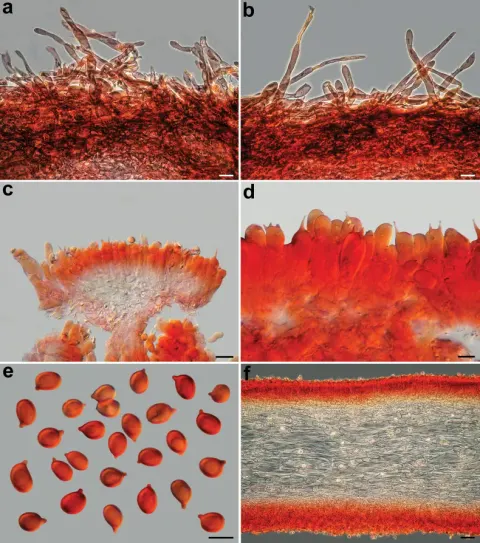
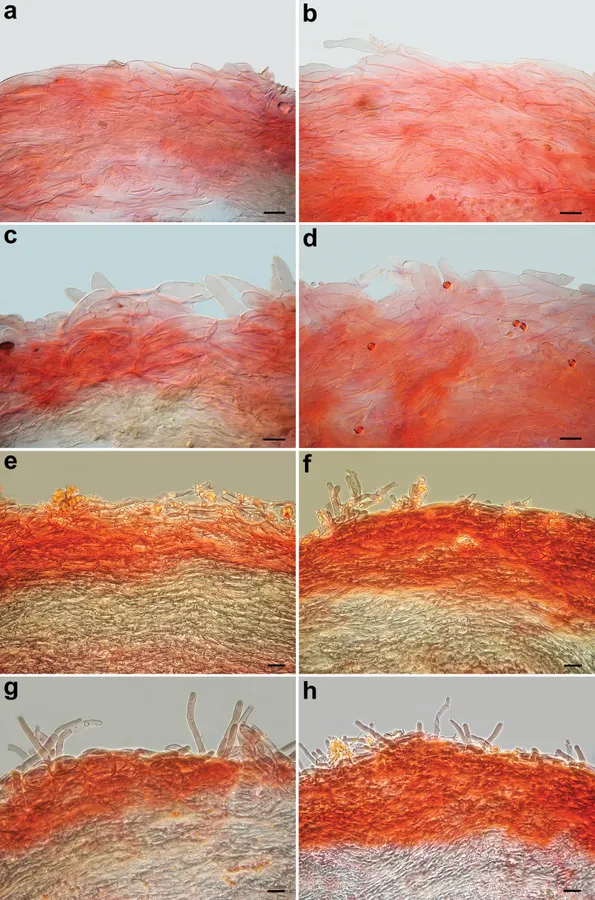
Kühner and Romagnesi (1954: 92, as Collybia pillodii); Horak (1968: 511–513, as P. oligophylla); Redhead (1982: 217, as P. pillodii, no data on presence/absence of clamp-connections); Bas (2003: 192–193, as P. pillodii, 194–195 as P. oligophylla); Morozova and Popov (2013: 129–130, as P. pillodii, in Russian). Spores (2.8–)3.3–3.7–4.2(–5.6) × (2.5–)2.9–3.1–3.4(–4.2) µm (288/5/5), Q = (0.96–)1.07–1.19–1.32(–1.69), V = (10.2–)14.6–19.8–25.0(–46.1) μm 3, globose to subglobose or broadly ellipsoid in frontal and side view, wall up to 0.2–0.3 µm thick, smooth, colorless in L4; hilar appendix prominent, 0.5–0.8 µm long (Fig. 6c–f). Basidia 16–17.5 × 5–6 µm, mostly tetraspored but also bispored, clavate, sterigmata up to 5 µm long. Hymenophoral trama regular to subregular, consisting of up to 8 µm wide hyphae, colorless in L4. Hymenial cystidia absent. Pileipellis suprapellis as a quite compact (dense) cutis of broadly ellipsoid up to 16 µm wide hyphae mixed with cylindrical, up to 8 µm wide hyphae, with rounded apex, slightly gelatinized, smooth, sometimes ascendant and forming small trichodermic patches; subpellis formed by broadly ellipsoid, densely septate hyphae up to 10 µm wide (Fig. 5a–h). Pigments brownish, intracellular. Stipitipellis of cylindrical, up to 6 µm wide hyphae (Fig. 6a). Stipititrama of up to 16 µm wide hyphae. Caulocystidia usually present, clustered, versiform, thin-walled, colorless, up to 6 µm wide (Fig. 6b). Clamp-connections absent everywhere.
Habitat dan peran ekologis
Collybia pillodii was described and illustrated by the French mycologist Lucien Quélet (1890) from Jura hills as a very small entirely violet species with a campanulate to convex pruinose pileus, whitish pileus margin, adnate and distant lamellae paler than the pileus, a fistulous and slender rooting stipe bristling at the base with white and radiant rhizoids, very thin violaceous context, and minute subglobose to ovoid spores. He reported its spores as minutely aculeate (“finement aculeolée”), but his observation was probably incorrect because it was not confirmed by all the subsequent authors who observed always smooth spores. The species was later described in detail by Kühner and Romagnesi (1954), who suggested its possibly placement in Tricholoma section Liposperma. Favre (1960) believed that the species was better placed within the tribe Orcellées (see below) in sense of Kühner (see Kühner and Romagnesi 1953, Kühner 1969 = Entolomataceae). When Singer (1938) described Baeospora oligophylla he did not compare it to Collybia pillodii described 48 years earlier by Quélet (1890). He merely noted that the latter species probably also belongs to the genus Baeospora Singer. Then, when Singer (1942) established the genus Pseudobaeospora for the species of Baeospora with dextrinoid spores, he included only B. oligophylla.
- Habitat atau konteks temuan
- Informasi belum tersedia pada sumber rilis ini.
- Substrat
- Informasi belum tersedia pada sumber rilis ini.
- Peran atau konteks
- Belum dikategorikan pada rilis ini.
Reproduksi
Spores (2.8–)3.3–3.7–4.2(–5.6) × (2.5–)2.9–3.1–3.4(–4.2) µm (288/5/5), Q = (0.96–)1.07–1.19–1.32(–1.69), V = (10.2–)14.6–19.8–25.0(–46.1) μm 3, globose to subglobose or broadly ellipsoid in frontal and side view, wall up to 0.2–0.3 µm thick, smooth, colorless in L4; hilar appendix prominent, 0.5–0.8 µm long (Fig. 6c–f). Basidia 16–17.5 × 5–6 µm, mostly tetraspored but also bispored, clavate, sterigmata up to 5 µm long. Hymenophoral trama regular to subregular, consisting of up to 8 µm wide hyphae, colorless in L4. Hymenial cystidia absent. Pileipellis suprapellis as a quite compact (dense) cutis of broadly ellipsoid up to 16 µm wide hyphae mixed with cylindrical, up to 8 µm wide hyphae, with rounded apex, slightly gelatinized, smooth, sometimes ascendant and forming small trichodermic patches; subpellis formed by broadly ellipsoid, densely septate hyphae up to 10 µm wide (Fig. 5a–h).
Catatan identitas dan cakupan
- Nama diterima mengikuti Catalogue of Life Base2026-09-11; uraian mempertahankan konsep dan nama sumber aslinya.
- Preserve original treatment localities, hosts and substrate scope. Materials examined describe documented specimens, not the full global range.
- Impor dan terjemahan otomatis belum diperiksa editorial per profil. Struktur reproduktif yang disebutkan tidak membuktikan seluruh siklus hidup diketahui.
- Pengukuran pada uraian mengikuti spesimen, kultur, dan metode sumber; angka tidak diperluas ke semua populasi.
Catatan distribusi dalam narasi mengikuti sumbernya. Dokumentasi spesimen atau foto mengikuti catatan sumber. Bukti wilayah Indonesia dan penilaian konservasi tidak disimpulkan dari gambar.
Melihat dengan konteks
Pseudobaeospora pillodii, microscopic features. Pileipellis. a–c (KRAM F-53298); d (KRAM F-53314); e, f (LE 254346); g, h (O-F:258872); a–h in ammoniacal Congo red. Scale bars: 10 µm (a–c); 20 µm (e–h). Photos by L. Setti.
- Jenis
- Pelat ilmiah
- Kredit
- Alfredo Vizzini, Giovanni Consiglio, Katarína Adamčíková, Ledo Setti, Slavomír Adamčík
- Lisensi
- CC BY 4.0
- Sumber media
- Buka entri sumber
Dokumentasi tambahan
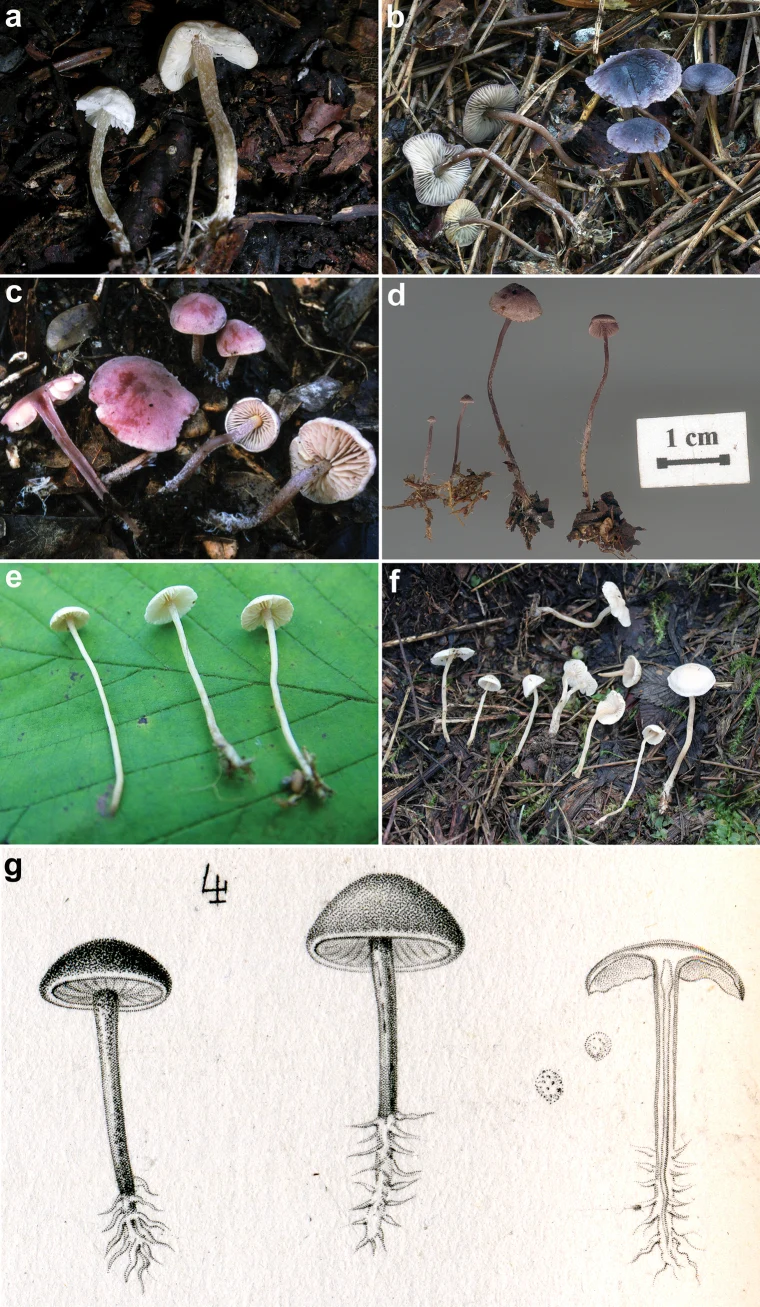
Basidiomes of some sequenced Pseudobaeospora collections. a P. calcarea (LIP PAM06090111-FR2013078); b P. cyanea (GDOR M3986); c P. laguncularis var. denudata (LIP PAM99101004-FR2013079); d P. pillodii (KRAM F-53314); e P. terrayi (SAV-F:3317, holotype); f P. terrayi (SAV-F:20813). Lectotype of. C. pillodii; g Quélet’s original plate, pl. XV, fig. 4. Photos: a, c by P.A. Moreau; b by D. Gisotti; d by A. Ronikier; e, f by S. Jančovičová.
Kredit dan penggunaan
Alfredo Vizzini, Giovanni Consiglio, Katarína Adamčíková, Ledo Setti, Slavomír Adamčík
Ukuran dan format gambar disesuaikan tanpa pemotongan, retus, atau penambahan skala. Lisensi sumber dipertahankan.
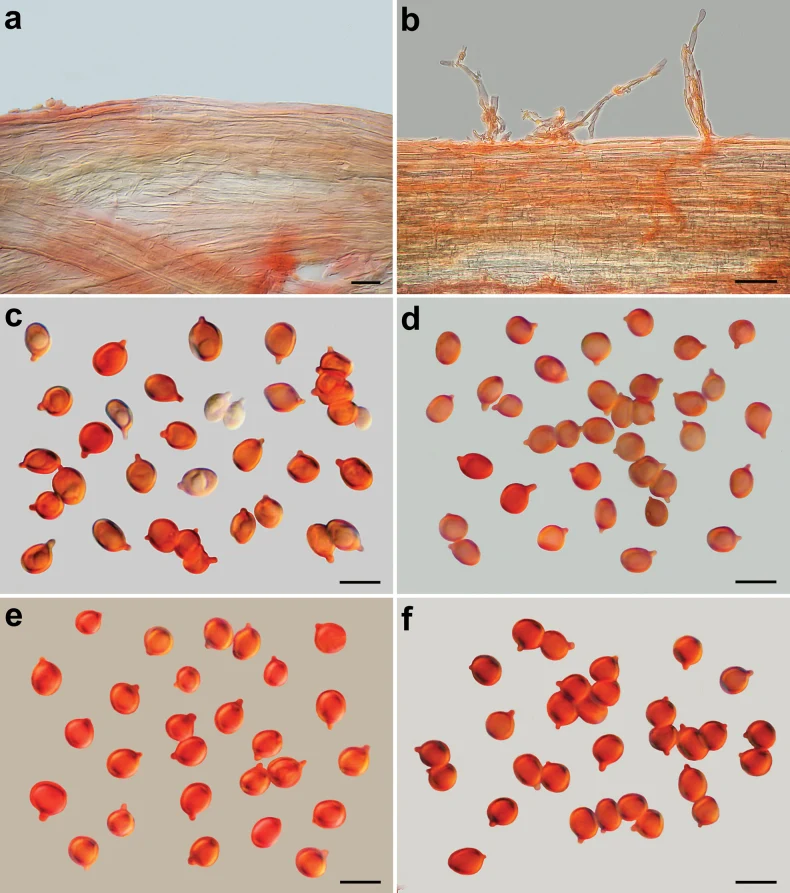
Pseudobaeospora pillodii, microscopic features. Stipitipellis. a (KRAM F-53298); b (KRAM F-53314). Spores; c (KRAM F-53298); d (KRAM F-53314); e (LE 254346); f (O-F:258872); a–f in ammoniacal Congo red. Scale bars: 10 µm (a); 20 µm (b); 5 µm (c–f). Photos by L. Setti.
Kredit dan penggunaan
Alfredo Vizzini, Giovanni Consiglio, Katarína Adamčíková, Ledo Setti, Slavomír Adamčík
Ukuran dan format gambar disesuaikan tanpa pemotongan, retus, atau penambahan skala. Lisensi sumber dipertahankan.
Sumber profil
- [1] Pseudobaeosporoideae, a new subfamily within the Tricholomataceae for the genus Pseudobaeospora (Agaricales, Tricholomatineae) based on morphological and molecular inference — Pseudobaeospora pillodii
- [2] Catalogue of Life Base2026-09-11 — Pseudobaeospora pillodii
- [3] Dokumentasi visual — Pseudobaeospora pillodii
- [4] Dokumentasi visual — Pseudobaeospora pillodii
- [5] Dokumentasi visual — Pseudobaeospora pillodii
Rujukan halaman ini
Fungi. Pseudobaeospora pillodii. Rilis data fungi-2026-10-12-expansion-2. https://fungi-atlas.mgadib.chatgpt.site/jamur/pseudobaeospora-pillodii/.
Status: impor sumber; pemeriksaan editorial per profil belum selesai. Untuk klaim biologis, gunakan rujukan pada bagian terkait dan periksa konteks sumber aslinya.