Ciri dan struktur
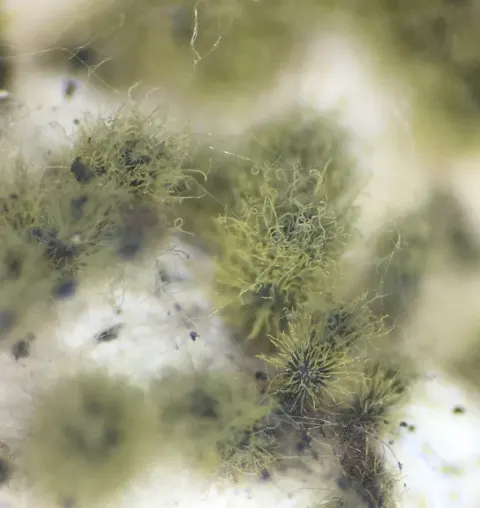
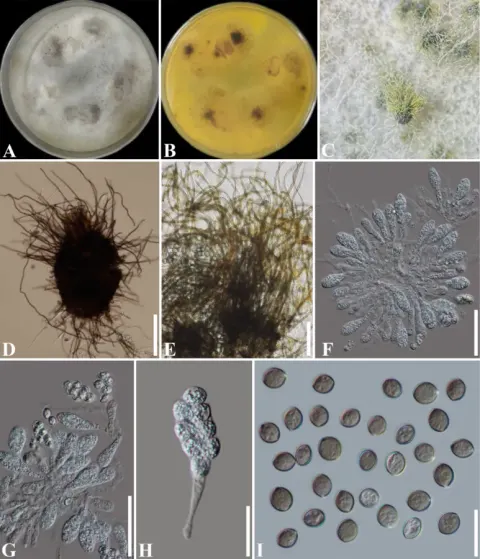
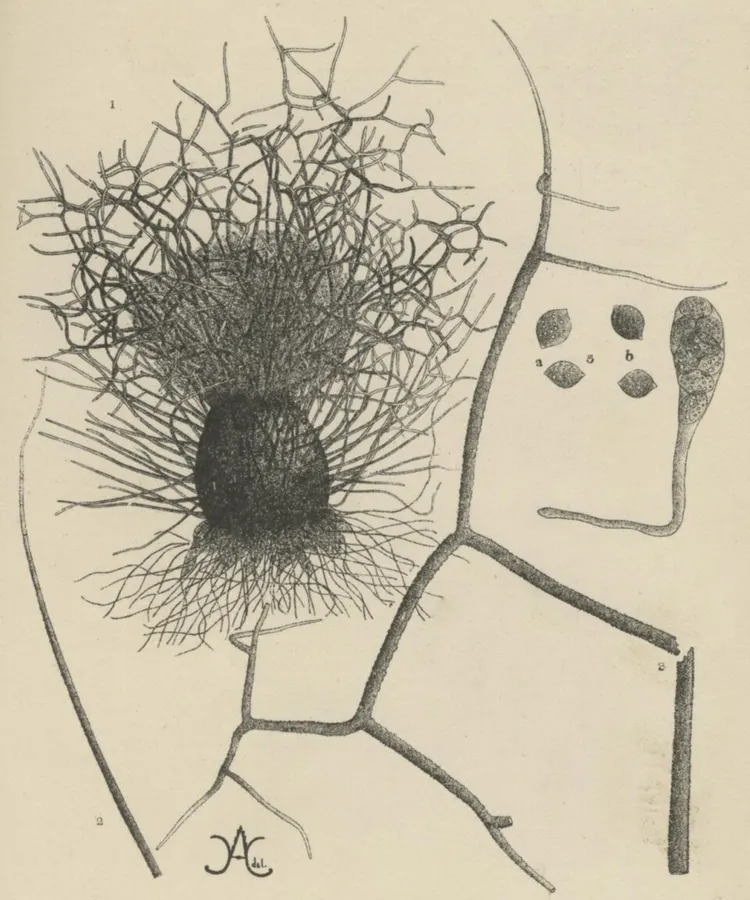
Chaetomium elatum produces darkly-coloured oval perithecia covered with stiff, black hairs. The perithecia are typically attached firmly to the substratum by dark/black rhizoids. In laboratory colonies C. elatum generally grows 5–6 mm per day, but can show different growth rates and colour characteristics depending on the growth medium. Under certain growth conditions, colonies of some strains of C. elatum may develop coloured guttation droplets of liquid on their surfaces whose function and composition are unknown. C. elatum has a homothallic mating system. The perithecia are superficial, usually mature in 13 to 20 days, and are 280–440 μm high with a diameter of 255–380 μm. They may appear greenish in color under reflected light with a round/oval-like shape and have an ostiole that is sparsely covered in white/buff aerial hyphae. The perithecial wall is made of brown interwoven hyphae or tightly packed pseudoparenchyma. Morphology of the black/dark perithecium hairs varies depending on their location. Terminal hairs are extremely coarse, branched at right to straight angles, have irregular projections, blunt spines, and dwindle off to thin translucent tips. Lateral hairs are thin, long, unbranched, coarsely roughened by irregular projections and dwindle into translucent smooth tips that are vaguely separate. The difference between the terminal hair of C. elatum and C. globosum is a distinguishing factor between the two taxa. The asci of C. elatum are generally club-shaped and contain 8 round ascospores. The ascospores are translucent/light olive when young and become brown with pointed tips when they mature giving them lemon-like shape when viewed in profile.
Habitat dan peran ekologis
Chaetomium elatum is a very common and widely distributed species of Chaetomium, with it being found all over the world. The species has been found in many areas of the United States, Canada, England, France, Russia, Switzerland, Germany, Scotland, the Galapagos Islands and many other localities. It is the most common species of fungi that grows on damp rotting straw, but has also been found and isolated from a variety of materials like rope, burlap, wood, paper, cellulose products, animal dung, seeds, barrel hoops, old brooms, Hordeum vulgare L, Triticum aestivum and the dead leaves of Typha and Sparganium. In general this species of Chaetomium mainly colonizes cereal, Alkali seepweed, True grasses, has been found to interact with Japanese yew, Alkali seepweed, European rabbit, Bread wheat, True grasses, Corn. It has also been associated with the mycobiota of Sugarcane as well as is known as a root-colonizing fungus in the avocado plant where it serves as both a rhizoplane and rhizosphere.
- Habitat atau konteks temuan
- Informasi belum tersedia pada sumber rilis ini.
- Substrat
- Informasi belum tersedia pada sumber rilis ini.
- Peran atau konteks
- Belum dikategorikan pada rilis ini.
Reproduksi
The asci of C. elatum are generally club-shaped and contain 8 round ascospores. The ascospores are translucent/light olive when young and become brown with pointed tips when they mature giving them lemon-like shape when viewed in profile. The ascospores also have a thick wall with a small pore on the outer wall of their apex. Morphology of the ascospores is a distinguishing factor when compared to other Chaetomium species with which it might be confused like C. indicum, C. funicolum, and C. virgecephalum. The asexual morph of C. elatum has acremonium-like growth, with its conidia being borne on phialidic conidiophogeous cells that form on aerial aseptate hyphae and are 6–24.5 μm long with a diameter of 1.5–3.5 μm at the base.
Catatan identitas dan cakupan
- Nama diterima mengikuti Catalogue of Life Base2026-09-11; uraian mempertahankan konsep dan nama sumber aslinya.
- Original geographic, specimen and life-cycle scope retained; source import awaits individual editorial review.
- Impor dan terjemahan otomatis belum diperiksa editorial per profil. Struktur reproduktif yang disebutkan tidak membuktikan seluruh siklus hidup diketahui.
- Pengukuran pada uraian mengikuti spesimen, kultur, dan metode sumber; angka tidak diperluas ke semua populasi.
Catatan distribusi dalam narasi mengikuti sumbernya. Dokumentasi spesimen atau foto mengikuti catatan sumber. Bukti wilayah Indonesia dan penilaian konservasi tidak disimpulkan dari gambar.
Melihat dengan konteks
Dokumentasi Chaetomium elatum dari Wikimedia Commons. Illustration of Chaetomium elatum by A.H. Chivers Identifikasi mengikuti record berkas sumber.
- Jenis
- Fotografi
- Kredit
- A.H. Chivers
- Lisensi
- Public domain
- Sumber media
- Buka entri sumber
Sumber profil
- [1] Chaetomium elatum — Wikipedia (en)
- [2] Catalogue of Life Base2026-09-11 — Chaetomium elatum
- [3] Dokumentasi visual — Chaetomium elatum
Rujukan halaman ini
Fungi. Chaetomium elatum. Rilis data fungi-2026-10-12-expansion-2. https://fungi-atlas.mgadib.chatgpt.site/jamur/chaetomium-elatum/.
Status: impor sumber; pemeriksaan editorial per profil belum selesai. Untuk klaim biologis, gunakan rujukan pada bagian terkait dan periksa konteks sumber aslinya.