01 / Morfologi

Ciri dan struktur

Basidiome annual, resupinate, membranaceous, effused to approximately ten centimetres in diameter. Mature parts continuous, with a cottony to rather firm, fibrous and compact, yet quite soft and elastic texture. Hymenium smooth; bluish-grey to brownish-grey. Immature parts discontinuous, byssoid with a cottony texture. Subhymenium and hymenium of immature parts bluish-grey. Subiculum well-developed, loose, fibrous, orange brown; forms the outer edge of the basidiome, extending noticeably beyond the hymenium. All characters recorded in dried state. Hyphal cords lacking, but loose bundles of subicular hyphae sometimes present. Hyphal system monomitic, clamp connections absent from all hyphae. Subicular hyphae noticeably long and straight, thick-walled; forming a loose tissue. Individual hyphae 4.9–7.2 μm wide, with a mean width of 6.2 μm; orange brown to brown in KOH, orange to orange brown in water. Subhymenial hyphae often somewhat sinuous, thin to thick-walled; forming a rather dense tissue. Individual hyphae (3.0–) 3.2–4.9 (–6.1) μm wide, with a mean width of 3.9 μm; pale brownish-green in KOH, blue green in the presence of air; brownish-green in water, with strongly granular contents. Encrustation granular, probably amyloid (hard to observe due to the colour); dark brownish-green in KOH, dark blue green in the presence of air; blackish in water; scattered in occurrence on the upper parts of subhymenial hyphae and on the lower parts of basidia. Basidia with four very long, slightly curved to hypha-like sterigmata, occasionally two-sterigmate; clavate or sometimes clavopedunculate, thin-walled, with one-three slight constrictions.

Sebagian uraian ditampilkan dalam bahasa sumber; terjemahannya belum tersedia atau belum lolos pemeriksaan.

Rujukan: [1]

Pengukuran mengikuti objek, spesimen atau kultur, dan metode yang disebutkan sumber. Baca uraian asli untuk konteks lengkap.

02 / Kehidupan

Habitat dan peran ekologis

The only specimen of P. longisterigmata recorded to date is the type collection, which was collected on coniferous wood in a coastal forest in the state of Washington, United States. Basidiomata encountered in: the United States.

Sebagian uraian ditampilkan dalam bahasa sumber; terjemahannya belum tersedia atau belum lolos pemeriksaan.

Rujukan: [1]

Habitat atau konteks temuan
hutan
Substrat
Informasi belum tersedia pada sumber rilis ini.
Peran atau konteks
Belum dikategorikan pada rilis ini.
Temukan hubungan serupa
03 / Siklus hidup

Reproduksi

Basidiome annual, resupinate, membranaceous, effused to approximately ten centimetres in diameter. Mature parts continuous, with a cottony to rather firm, fibrous and compact, yet quite soft and elastic texture. Hymenium smooth; bluish-grey to brownish-grey. Immature parts discontinuous, byssoid with a cottony texture. Subhymenium and hymenium of immature parts bluish-grey. Subiculum well-developed, loose, fibrous, orange brown; forms the outer edge of the basidiome, extending noticeably beyond the hymenium. All characters recorded in dried state. Hyphal cords lacking, but loose bundles of subicular hyphae sometimes present. Hyphal system monomitic, clamp connections absent from all hyphae. Subicular hyphae noticeably long and straight, thick-walled; forming a loose tissue.

Sebagian uraian ditampilkan dalam bahasa sumber; terjemahannya belum tersedia atau belum lolos pemeriksaan.

Rujukan: [1]

04 / Batas informasi

Catatan identitas dan cakupan

  • Nama diterima mengikuti Catalogue of Life Base2026-09-11; uraian mempertahankan konsep dan nama sumber aslinya.
  • Preserve original treatment localities, hosts and substrate scope. Materials examined describe documented specimens, not the full global range.
  • Impor dan terjemahan otomatis belum diperiksa editorial per profil. Struktur reproduktif yang disebutkan tidak membuktikan seluruh siklus hidup diketahui.
  • Pengukuran pada uraian mengikuti spesimen, kultur, dan metode sumber; angka tidak diperluas ke semua populasi.

Catatan distribusi dalam narasi mengikuti sumbernya. Dokumentasi spesimen atau foto mengikuti catatan sumber. Bukti wilayah Indonesia dan penilaian konservasi tidak disimpulkan dari gambar.

05 / Dokumentasi

Melihat dengan konteks

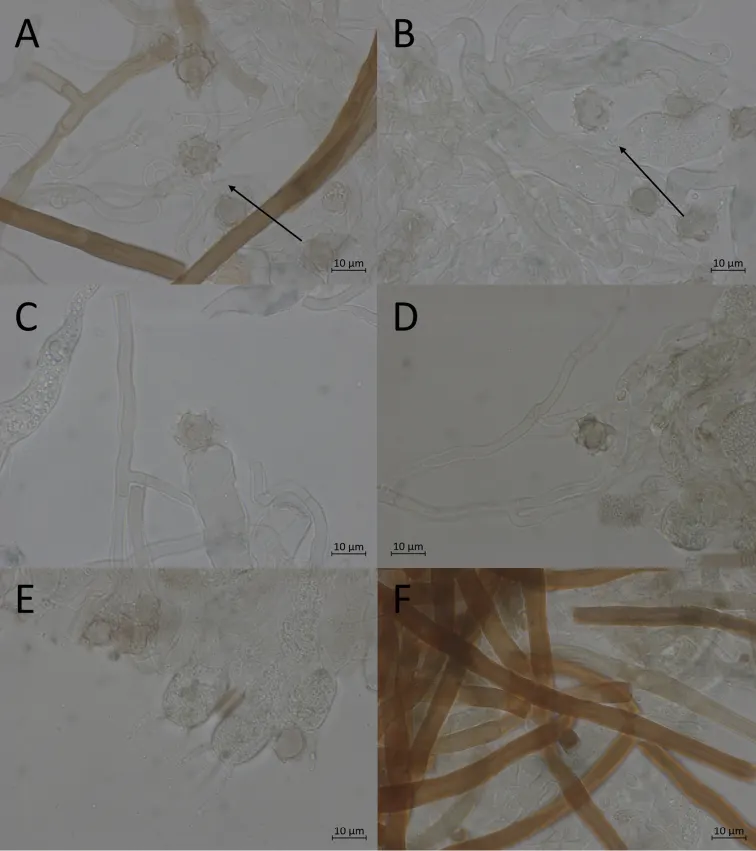
Micromorphological features of P. longisterigmata in KOH. Holotype: A, B, C basidiospores in frontal face D in lateral face E basidia F subicular hyphae.

Jenis
Pelat ilmiah
Kredit
Sten Svantesson, Karl-Henrik Larsson, Urmas Kõljalg, Tom W. May, Patrik Cangren, R. Henrik Nilsson, Ellen Larsson
Lisensi
CC BY 4.0
Sumber media
Buka entri sumber

Gambar menunjukkan objek menurut identifikasi sumber, bukan verifikasi independen spesimen oleh Fungi. Tidak ada skala baru yang ditambahkan.

06 / Rujukan

Sumber profil

  1. [1] Solving the taxonomic identity of Pseudotomentella tristis s.l. (Thelephorales, Basidiomycota) – a multi-gene phylogeny and taxonomic review, integrating ecological and geographical data — Pseudotomentella longisterigmataBagian sumber: PMC6477855_section_131
    Tanggal penghimpunan sumber: 2026-10-12
    Teks sumber: CC BY 4.0 · Svantesson S, Larsson KH, Kõljalg U, W May T, Patrik Cangren, Henrik Nilsson R, Larsson E.
  2. [2] Catalogue of Life Base2026-09-11 — Pseudotomentella longisterigmataBagian sumber: ColDP NameUsage.tsv ID 4PDRL; accepted species; source 2073
    Tanggal penghimpunan sumber: 2026-10-12
  3. [3] Dokumentasi visual — Pseudotomentella longisterigmataBagian sumber: Individual media record; identification follows the source, not independent determination
    Tanggal penghimpunan sumber: 2026-10-12
    Media sumber: CC BY 4.0 · Sten Svantesson, Karl-Henrik Larsson, Urmas Kõljalg, Tom W. May, Patrik Cangren, R. Henrik Nilsson, Ellen Larsson

Adaptasi teks: CC BY 4.0. Svantesson S, Larsson KH, Kõljalg U, W May T, Patrik Cangren, Henrik Nilsson R, Larsson E. — Solving the taxonomic identity of Pseudotomentella tristis s.l. (Thelephorales, Basidiomycota) – a multi-gene phylogeny and taxonomic review, integrating ecological and geographical data — Pseudotomentella longisterigmata

Uraian asli dan riwayat sumber

Riwayat atau halaman sumber

Ringkasan sumber

Basidiome annual, resupinate, membranaceous, effused to approximately ten centimetres in diameter. Mature parts continuous, with a cottony to rather firm, fibrous and compact, yet quite soft and elastic texture. Hymenium smooth; bluish-grey to brownish-grey. Immature parts discontinuous, byssoid with a cottony texture. Subhymenium and hymenium of immature parts bluish-grey. Subiculum well-developed, loose, fibrous, orange brown; forms the outer edge of the basidiome, extending noticeably beyond the hymenium.

Revisi sumber

Morfologi sumber

Basidiome annual, resupinate, membranaceous, effused to approximately ten centimetres in diameter. Mature parts continuous, with a cottony to rather firm, fibrous and compact, yet quite soft and elastic texture. Hymenium smooth; bluish-grey to brownish-grey. Immature parts discontinuous, byssoid with a cottony texture. Subhymenium and hymenium of immature parts bluish-grey. Subiculum well-developed, loose, fibrous, orange brown; forms the outer edge of the basidiome, extending noticeably beyond the hymenium. All characters recorded in dried state. Hyphal cords lacking, but loose bundles of subicular hyphae sometimes present. Hyphal system monomitic, clamp connections absent from all hyphae. Subicular hyphae noticeably long and straight, thick-walled; forming a loose tissue. Individual hyphae 4.9–7.2 μm wide, with a mean width of 6.2 μm; orange brown to brown in KOH, orange to orange brown in water. Subhymenial hyphae often somewhat sinuous, thin to thick-walled; forming a rather dense tissue. Individual hyphae (3.0–) 3.2–4.9 (–6.1) μm wide, with a mean width of 3.9 μm; pale brownish-green in KOH, blue green in the presence of air; brownish-green in water, with strongly granular contents. Encrustation granular, probably amyloid (hard to observe due to the colour); dark brownish-green in KOH, dark blue green in the presence of air; blackish in water; scattered in occurrence on the upper parts of subhymenial hyphae and on the lower parts of basidia. Basidia with four very long, slightly curved to hypha-like sterigmata, occasionally two-sterigmate; clavate or sometimes clavopedunculate, thin-walled, with one-three slight constrictions.

Revisi sumber

Ekologi sumber

The only specimen of P. longisterigmata recorded to date is the type collection, which was collected on coniferous wood in a coastal forest in the state of Washington, United States. Basidiomata encountered in: the United States.

Revisi sumber

Struktur reproduksi sumber

Basidiome annual, resupinate, membranaceous, effused to approximately ten centimetres in diameter. Mature parts continuous, with a cottony to rather firm, fibrous and compact, yet quite soft and elastic texture. Hymenium smooth; bluish-grey to brownish-grey. Immature parts discontinuous, byssoid with a cottony texture. Subhymenium and hymenium of immature parts bluish-grey. Subiculum well-developed, loose, fibrous, orange brown; forms the outer edge of the basidiome, extending noticeably beyond the hymenium. All characters recorded in dried state. Hyphal cords lacking, but loose bundles of subicular hyphae sometimes present. Hyphal system monomitic, clamp connections absent from all hyphae. Subicular hyphae noticeably long and straight, thick-walled; forming a loose tissue.

Revisi sumber

Rujukan halaman ini

Fungi. Pseudotomentella longisterigmata. Rilis data fungi-2026-10-12-expansion-2. https://fungi-atlas.mgadib.chatgpt.site/jamur/pseudotomentella-longisterigmata/.

Status: impor sumber; pemeriksaan editorial per profil belum selesai. Untuk klaim biologis, gunakan rujukan pada bagian terkait dan periksa konteks sumber aslinya.