Saprobic on batang mati dari Helichrysum sp. Morph seksual tidak ditentukan. Morph asexual Conidiomata black, bercahaya, diangkat atau datar, bulat, 170–250 μm tinggi, 280–400 μm lebar (\(\bar{x} \) = 200 × 340 μm, n = 10) acervular ke pycnidioid, tersebar atau gregarious, uni-loculate, globose atau oval dengan dasar datar, semi-merem ke permukaan, kadang-kadang erumpent. Pycnidial walls terdiri dari beberapa lapisan sel yang tidak jelas dari sel coklat emas ke coklat pucat dari textura angularis ke textura prismatica, dan ke bagian atas tubuh berbuah, lebih dari textura prismatica dan textura globulosa.
Profil ini diimpor dari uraian spesies pada sumber berlisensi dan sebagian teks diterjemahkan otomatis. Pemeriksaan editorial per profil belum selesai. Bagian yang belum diterjemahkan atau belum lolos pemeriksaan terjemahan tetap ditampilkan dalam bahasa sumber. Angka dan nama ilmiah dipertahankan.
Saprobic on dead stem of Helichrysum sp. Sexual morph Undetermined. Asexual morph Conidiomata black, shiny, raised or flattened, rounded, 170–250 μm high, 280–400 μm wide (\(\bar{x} \) = 200 × 340 μm, n = 10) acervular to pycnidioid, scattered or gregarious, uni-loculate, globose or oval with a flattened base, semi-immersed to superficial, sometimes erumpent. Pycnidial walls comprising several indistinct cell layers of golden brown to pale brown cells of textura angularis to textura prismatica, and towards the upper part of the fruiting body, more of textura prismatica and textura globulosa. Conidiophores arising from the basal and lateral cells of the conidioma cavity, cylindrical, reduced to conidiogenous cells, unbranched, smooth, hyaline. Conidiogenous cells 10–38 × 1.5–3 μm (\(\bar{x} \) = 26 × 2 μm, n = 20) cylindrical, hyaline, smooth, determinate, holoblastic, proliferating percurrently at apex, aseptate. Conidia 28–35 × 6–8.5 μm, (\(\bar{x} \) = 31 × 7.3 μm, n = 40), fusoid, straight to slightly curved, 2-septate, slightly constricted at second septum from base, basal cell 5.8–12 × 2.5–3.5 μm (\(\bar{x} \) = 9 × 2.8 μm), 15–30 × 1.5–2 μm, narrowly obconic, truncate at base, hyaline, smooth-walled, thin-walled, second and third cells from the base, together 18.5–26 × 5.5–9 μm (\(\bar{x} \) = 22 × 6.8 μm), dark brown, smooth-walled, thick-walled, slightly guttulate, fusoid, bearing three tubular apical appendages, 18.6–25.8 μm (\(\bar{x} \) = 23.2 μm) long, smooth, tubular, unbranched. Culture characteristics: Colonies on PDA growing up to 20 mm in diam. at 16–18 °C after seven days.
Sebagian uraian ditampilkan dalam bahasa sumber; terjemahannya belum tersedia atau belum lolos pemeriksaan.
Pengukuran mengikuti objek, spesimen atau kultur, dan metode yang disebutkan sumber. Baca uraian asli untuk konteks lengkap.
02 / Kehidupan
Habitat dan peran ekologis
Saprobic on dead stem of Helichrysum sp. Sexual morph Undetermined. Asexual morph Conidiomata black, shiny, raised or flattened, rounded, 170–250 μm high, 280–400 μm wide (\(\bar{x} \) = 200 × 340 μm, n = 10) acervular to pycnidioid, scattered or gregarious, uni-loculate, globose or oval with a flattened base, semi-immersed to superficial, sometimes erumpent. Pycnidial walls comprising several indistinct cell layers of golden brown to pale brown cells of textura angularis to textura prismatica, and towards the upper part of the fruiting body, more of textura prismatica and textura globulosa. Conidiophores arising from the basal and lateral cells of the conidioma cavity, cylindrical, reduced to conidiogenous cells, unbranched, smooth, hyaline. Conidiogenous cells 10–38 × 1.5–3 μm (\(\bar{x} \) = 26 × 2 μm, n = 20) cylindrical, hyaline, smooth, determinate, holoblastic, proliferating percurrently at apex, aseptate. Conidia 28–35 × 6–8.5 μm, (\(\bar{x} \) = 31 × 7.3 μm, n = 40), fusoid, straight to slightly curved, 2-septate, slightly constricted at second septum from base, basal cell 5.8–12 × 2.5–3.5 μm (\(\bar{x} \) = 9 × 2.8 μm), 15–30 × 1.5–2 μm, narrowly obconic, truncate at base, hyaline, smooth-walled, thin-walled, second and third cells from the base, together 18.5–26 × 5.5–9 μm (\(\bar{x} \) = 22 × 6.8 μm), dark brown, smooth-walled, thick-walled, slightly guttulate, fusoid, bearing three tubular apical appendages, 18.6–25.8 μm (\(\bar{x} \) = 23.2 μm) long, smooth, tubular, unbranched.
Sebagian uraian ditampilkan dalam bahasa sumber; terjemahannya belum tersedia atau belum lolos pemeriksaan.
Saprobic on dead stem of Helichrysum sp. Sexual morph Undetermined. Asexual morph Conidiomata black, shiny, raised or flattened, rounded, 170–250 μm high, 280–400 μm wide (\(\bar{x} \) = 200 × 340 μm, n = 10) acervular to pycnidioid, scattered or gregarious, uni-loculate, globose or oval with a flattened base, semi-immersed to superficial, sometimes erumpent. Pycnidial walls comprising several indistinct cell layers of golden brown to pale brown cells of textura angularis to textura prismatica, and towards the upper part of the fruiting body, more of textura prismatica and textura globulosa. Conidiophores arising from the basal and lateral cells of the conidioma cavity, cylindrical, reduced to conidiogenous cells, unbranched, smooth, hyaline.
Sebagian uraian ditampilkan dalam bahasa sumber; terjemahannya belum tersedia atau belum lolos pemeriksaan.
Nama diterima mengikuti Catalogue of Life Base2026-09-11; uraian mempertahankan konsep dan nama sumber aslinya.
Preserve original monograph treatment localities, hosts and specimen/substrate scope. Materials examined document specimens, not the full global range.
Impor dan terjemahan otomatis belum diperiksa editorial per profil. Struktur reproduktif yang disebutkan tidak membuktikan seluruh siklus hidup diketahui.
Pengukuran pada uraian mengikuti spesimen, kultur, dan metode sumber; angka tidak diperluas ke semua populasi.
Catatan distribusi dalam narasi mengikuti sumbernya. Dokumentasi spesimen atau foto mengikuti catatan sumber. Bukti wilayah Indonesia dan penilaian konservasi tidak disimpulkan dari gambar.
05 / Dokumentasi
Melihat dengan konteks
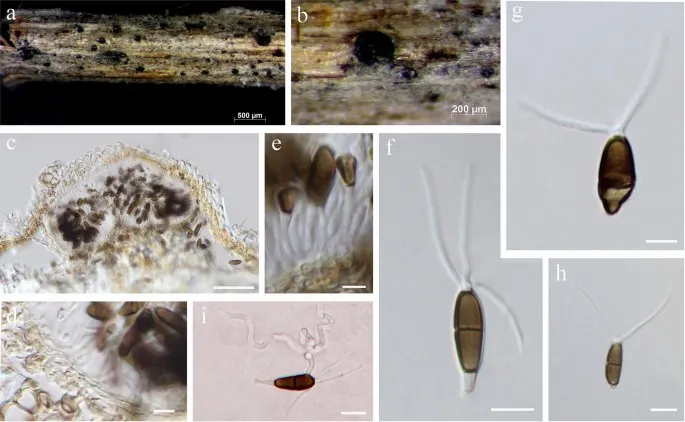
Pseudotruncatella camporesii (MFLU 15-0796, holotype). a Conidiomata on dead stem of Helichrysum sp. b A close-up of conidioma. c Cross section of conidioma. d Pycnidial wall. e Developing conidia from conidiogenous cells. f – h Conidia. i Germinating spore. Scale bars c = 50 µm, d, e, g, h = 10 µm, f, i = 20 µm
Jenis
Pelat ilmiah
Kredit
Penulis dan sumber artikel: Hyde, Kevin D.; Dong, Yang; Phookamsak, Rungtiwa; Jeewon, Rajesh; Bhat, D. Jayarama; Jones, E. B. Gareth; Liu, Ning-Guo; Abeywickrama, Pranami D.; Mapook, Ausana; Wei, Deping; Perera, Rekhani H.; Manawasinghe, Ishara S.; Pem, Dhandevi; Bundhun, Digvijayini; Karunarathna, Anuruddha; Ekanayaka, Anusha H.; Bao, Dan-Feng; Li, Junfu; Samarakoon, Milan C.; Chaiwan, Napalai; Lin, Chuan-Gen; Phutthacharoen, Kunthida; Zhang, Sheng-Nan; Senanayake, Indunil C.; Goonasekara, Ishani D.; Thambugala, Kasun M.; Phukhamsakda, Chayanard; Tennakoon, Danushka S.; Jiang, Hong-Bo; Yang, Jing; Zeng, Ming; Huanraluek, Naruemon; Liu, Jian-Kui (Jack); Wijesinghe, Subodini N.; Tian, Qing; Tibpromma, Saowaluck; Brahmanage, Rashika S.; Boonmee, Saranyaphat; Huang, Shi-Ke; Thiyagaraja, Vinodhini; Lu, Yong-Zhong; Jayawardena, Ruvishika S.; Dong, Wei; Yang, Er-Fu; Singh, Sanjay K.; Singh, Shiv Mohan; Rana, Shiwali; Lad, Sneha S.; Anand, Garima; Devadatha, Bandarupalli; Niranjan, M.; Sarma, V. Venkateswara; Liimatainen, Kare; Aguirre-Hudson, Begoña; Niskanen, Tuula; Overall, Andy; Alvarenga, Renato Lúcio Mendes; Gibertoni, Tatiana Baptista; Pfliegler, Walter P.; Horváth, Enikő; Imre, Alexandra; Alves, Amanda Lucia; da Silva Santos, Ana Carla; Tiago, Patricia Vieira; Bulgakov, Timur S.; Wanasinghe, Dhanushaka N.; Bahkali, Ali H.; Doilom, Mingkwan; Elgorban, Abdallah M.; Maharachchikumbura, Sajeewa S. N.; Rajeshkumar, Kunhiraman C.; Haelewaters, Danny; Mortimer, Peter E.; Zhao, Qi; Lumyong, Saisamorn; Xu, Jianchu; Sheng, Jun
Saprobic on dead stem of Helichrysum sp.
Sexual morph Undetermined.
Asexual morph Conidiomata black, shiny, raised or flattened, rounded, 170–250 μm high, 280–400 μm wide (\(\bar{x} \) = 200 × 340 μm, n = 10) acervular to pycnidioid, scattered or gregarious, uni-loculate, globose or oval with a flattened base, semi-immersed to superficial, sometimes erumpent.
Pycnidial walls comprising several indistinct cell layers of golden brown to pale brown cells of textura angularis to textura prismatica, and towards the upper part of the fruiting body, more of textura prismatica and textura globulosa.
Saprobic on dead stem of Helichrysum sp.
Sexual morph Undetermined.
Asexual morph Conidiomata black, shiny, raised or flattened, rounded, 170–250 μm high, 280–400 μm wide (\(\bar{x} \) = 200 × 340 μm, n = 10) acervular to pycnidioid, scattered or gregarious, uni-loculate, globose or oval with a flattened base, semi-immersed to superficial, sometimes erumpent.
Pycnidial walls comprising several indistinct cell layers of golden brown to pale brown cells of textura angularis to textura prismatica, and towards the upper part of the fruiting body, more of textura prismatica and textura globulosa.
Conidiophores arising from the basal and lateral cells of the conidioma cavity, cylindrical, reduced to conidiogenous cells, unbranched, smooth, hyaline.
Conidiogenous cells 10–38 × 1.5–3 μm (\(\bar{x} \) = 26 × 2 μm, n = 20) cylindrical, hyaline, smooth, determinate, holoblastic, proliferating percurrently at apex, aseptate.
Conidia 28–35 × 6–8.5 μm, (\(\bar{x} \) = 31 × 7.3 μm, n = 40), fusoid, straight to slightly curved, 2-septate, slightly constricted at second septum from base, basal cell 5.8–12 × 2.5–3.5 μm (\(\bar{x} \) = 9 × 2.8 μm), 15–30 × 1.5–2 μm, narrowly obconic, truncate at base, hyaline, smooth-walled, thin-walled, second and third cells from the base, together 18.5–26 × 5.5–9 μm (\(\bar{x} \) = 22 × 6.8 μm), dark brown, smooth-walled, thick-walled, slightly guttulate, fusoid, bearing three tubular apical appendages, 18.6–25.8 μm (\(\bar{x} \) = 23.2 μm) long, smooth, tubular, unbranched.
Culture characteristics: Colonies on PDA growing up to 20 mm in diam. at 16–18 °C after seven days.
Saprobic on dead stem of Helichrysum sp.
Sexual morph Undetermined.
Asexual morph Conidiomata black, shiny, raised or flattened, rounded, 170–250 μm high, 280–400 μm wide (\(\bar{x} \) = 200 × 340 μm, n = 10) acervular to pycnidioid, scattered or gregarious, uni-loculate, globose or oval with a flattened base, semi-immersed to superficial, sometimes erumpent.
Pycnidial walls comprising several indistinct cell layers of golden brown to pale brown cells of textura angularis to textura prismatica, and towards the upper part of the fruiting body, more of textura prismatica and textura globulosa.
Conidiophores arising from the basal and lateral cells of the conidioma cavity, cylindrical, reduced to conidiogenous cells, unbranched, smooth, hyaline.
Conidiogenous cells 10–38 × 1.5–3 μm (\(\bar{x} \) = 26 × 2 μm, n = 20) cylindrical, hyaline, smooth, determinate, holoblastic, proliferating percurrently at apex, aseptate.
Conidia 28–35 × 6–8.5 μm, (\(\bar{x} \) = 31 × 7.3 μm, n = 40), fusoid, straight to slightly curved, 2-septate, slightly constricted at second septum from base, basal cell 5.8–12 × 2.5–3.5 μm (\(\bar{x} \) = 9 × 2.8 μm), 15–30 × 1.5–2 μm, narrowly obconic, truncate at base, hyaline, smooth-walled, thin-walled, second and third cells from the base, together 18.5–26 × 5.5–9 μm (\(\bar{x} \) = 22 × 6.8 μm), dark brown, smooth-walled, thick-walled, slightly guttulate, fusoid, bearing three tubular apical appendages, 18.6–25.8 μm (\(\bar{x} \) = 23.2 μm) long, smooth, tubular, unbranched.
Saprobic on dead stem of Helichrysum sp.
Sexual morph Undetermined.
Asexual morph Conidiomata black, shiny, raised or flattened, rounded, 170–250 μm high, 280–400 μm wide (\(\bar{x} \) = 200 × 340 μm, n = 10) acervular to pycnidioid, scattered or gregarious, uni-loculate, globose or oval with a flattened base, semi-immersed to superficial, sometimes erumpent.
Pycnidial walls comprising several indistinct cell layers of golden brown to pale brown cells of textura angularis to textura prismatica, and towards the upper part of the fruiting body, more of textura prismatica and textura globulosa.
Conidiophores arising from the basal and lateral cells of the conidioma cavity, cylindrical, reduced to conidiogenous cells, unbranched, smooth, hyaline.
Status: impor sumber; pemeriksaan editorial per profil belum selesai. Untuk klaim biologis, gunakan rujukan pada bagian terkait dan periksa konteks sumber aslinya.
Puccinia porri (Sowerby) G. Winter ⁇ adalah spesies jamur dari famili Pucciniaceae. Jamur mikroskopis, parasit pada berbagai spesies dari jenis Allium (cebulus, bawang putih, por). Mereka memiliki penyakit yang disebut "kerawatan".
Puccinia convolvuli (Pers.) Castagne ⁇ spesies jamur dari keluarga ruminant (Pucciniaceae). Jamur mikroskopis yang merupakan parasit wajib tumbuhan jenis kalystegium dan convolvulus.
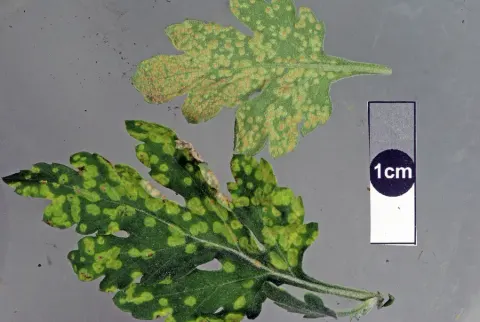
Plants infected oleh krisantim putih karat menunjukkan bintik-bintik di permukaan atas daun. These spots are initially pale-green to yellow in color and up to 5mm in diameter, but may turn brown as the tissue becomes necrotic. Di bagian…