Ciri dan struktur
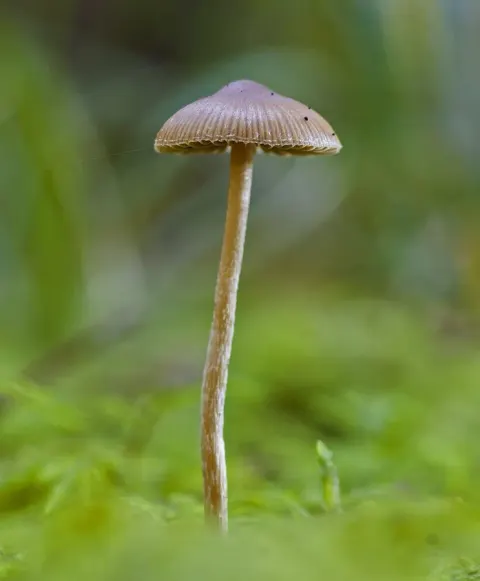
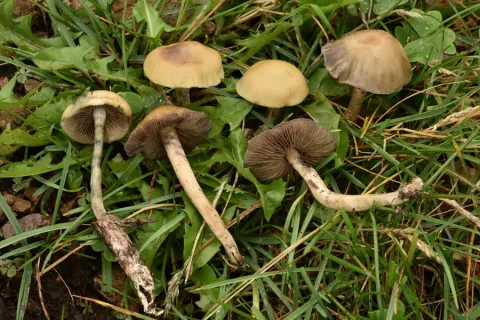
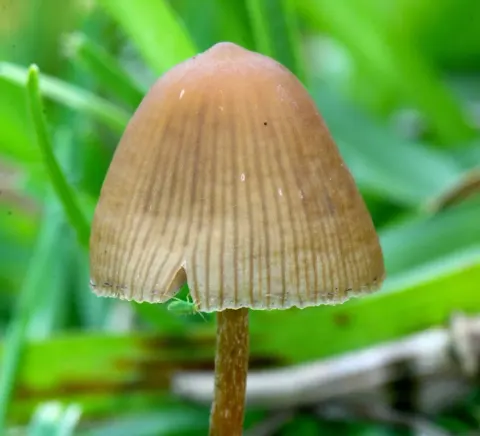
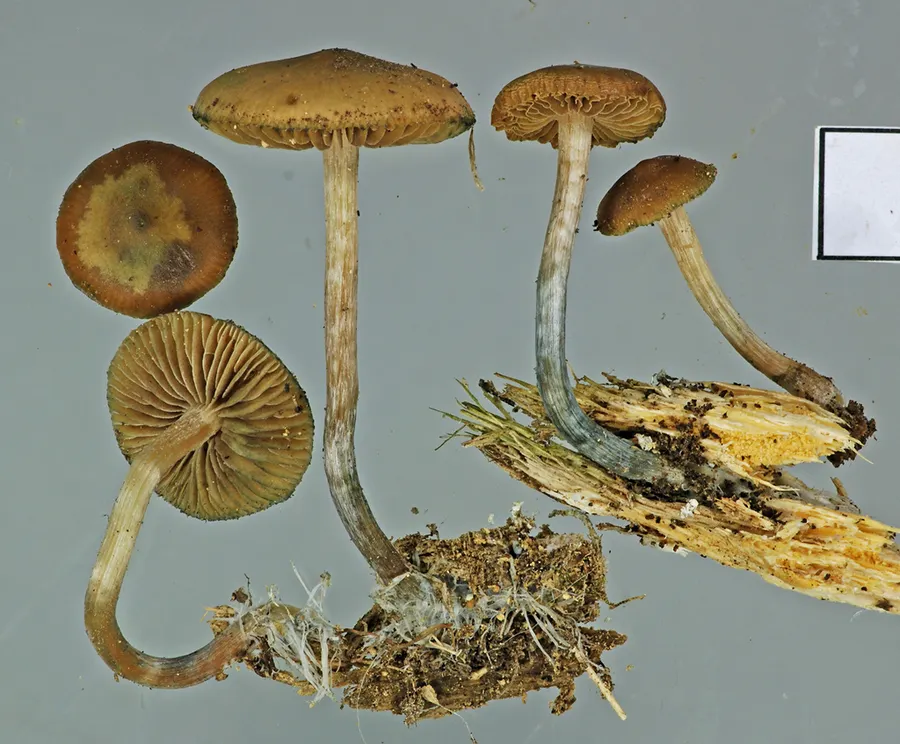
The cap is initially conical to bell shaped, but as the mushroom grows, it expands to become convex with a prominent umbo, and attains a diameter of 15 – 55 mm. The cap surface is dry to slightly tacky. Its colour is yellow-brown to orange-brown, often paler towards the margin, which has fine striations corresponding to the gills on the underside. The flesh is white. Gills have an adnexed attachment to the stem, and are pale greyish brown. The whitish stipe is 30 – 60 mm long by 2–4 mm wide. It is cylindrical, with a surface of pressed silky fibrils. The base of the stem is often brownish, with white rhizoids present. The veil of young fruit bodies is cortinate—resembling the cobweb-like partial veil found in Cortinarius species. As the mushroom grows, its remnants often remain visible on the stem, but it never forms a complete ring. Both the cap and the stem stain greenish-blue when damaged. The spore print is dark purplish brown. Spores typically measure 7.5–9.5 by 5.5–6.5 by 4.5–5.5 μm, averaging 8.7 by 6.0 by 5.3 μm. Its shape in face view is ovate (egg-shaped) to roughly rhomboid, while viewed from the side it appears elliptical. The spore wall is brown, smooth, about 0.8–1 μm thick, and has a germ pore. The basidia (spore-bearing cells) are four-spored and somewhat club-shaped, tapering slightly to the base; they are clamped, and measure 25–31 by 7–8.5 μm. The cheilocystidia (cystidia on the gill edge) have dimensions of 18–26 by 6–9 μm, and a shape ranging from ventricose-rostrate (broad in the middle and tapering to a beaklike neck) to mucronate (ending abruptly in a short sharp point).
Habitat dan peran ekologis
Psilocybe makarorae adalah spesies jamur psilocybin dari keluarga Hymenogastraceae. Officially described sebagai baru untuk sains di 1995, itu hanya dikenal dari Selandia Baru, di mana tumbuh di kayu busuk dan cabang bukit selatan. Tubuh buah (serangga) memiliki topi coklat dengan margin berwarna lebih terang, berukuran hingga lebar 3.5 cm. Bentuk topi adalah kerucut, berbentuk lonceng, tetapi saat jamur tumbuh, ia berkembang menjadi kongks, dan memiliki umbo yang menonjol. Although the whitish stipe does not form a true ring, it retains remnants of the partial veil that covers and protects the gills of young fruit bodies. Jamur P. makarorae dapat dibedakan dari Jamur Utara American species Psilocybe caerulipes yang serupa dengan karakteristik mikroskopis seperti kehadiran sistidia pada wajah gill (pleurosistidia), dan keilosistidia (dijumpai di tepi gill) dengan leher yang lebih memanjang. Based on reaksi bluing terhadap cedera, P. makarorae dianggap mengandung senyawa psilocybin dan psilocin. Kapsul awalnya ber bentuk kerucut, tetapi saat jamur tumbuh, ia berkembang menjadi kongkes dengan umbo yang menonjol, dan mencapai diameter 15 – 55 mm. permukaan tutup kering hingga sedikit menempel.
- Habitat atau konteks temuan
- Informasi belum tersedia pada sumber rilis ini.
- Substrat
- kayu
- Peran atau konteks
- Belum dikategorikan pada rilis ini.
Reproduksi
The spore print is dark purplish brown. Spores typically measure 7.5–9.5 by 5.5–6.5 by 4.5–5.5 μm, averaging 8.7 by 6.0 by 5.3 μm. Its shape in face view is ovate (egg-shaped) to roughly rhomboid, while viewed from the side it appears elliptical. The spore wall is brown, smooth, about 0.8–1 μm thick, and has a germ pore. The basidia (spore-bearing cells) are four-spored and somewhat club-shaped, tapering slightly to the base; they are clamped, and measure 25–31 by 7–8.5 μm.
Catatan identitas dan cakupan
- Nama diterima mengikuti Catalogue of Life Base2026-09-11; uraian mempertahankan konsep dan nama sumber aslinya.
- Original geographic, specimen and life-cycle scope retained; source import awaits individual editorial review.
- Impor dan terjemahan otomatis belum diperiksa editorial per profil. Struktur reproduktif yang disebutkan tidak membuktikan seluruh siklus hidup diketahui.
- Pengukuran pada uraian mengikuti spesimen, kultur, dan metode sumber; angka tidak diperluas ke semua populasi.
Catatan distribusi dalam narasi mengikuti sumbernya. Dokumentasi spesimen atau foto mengikuti catatan sumber. Bukti wilayah Indonesia dan penilaian konservasi tidak disimpulkan dari gambar.
Melihat dengan konteks
Dokumentasi Psilocybe makarorae menurut asosiasi foto pada record takson iNaturalist. Kredit: Jerry Cooper. Identitas mengikuti sumber; bukan penentuan spesimen independen.
- Jenis
- Fotografi
- Kredit
- (c) Jerry Cooper, some rights reserved (CC BY), uploaded by Jerry Cooper
- Lisensi
- CC BY 4.0
- Sumber media
- Buka entri sumber
Dokumentasi tambahan
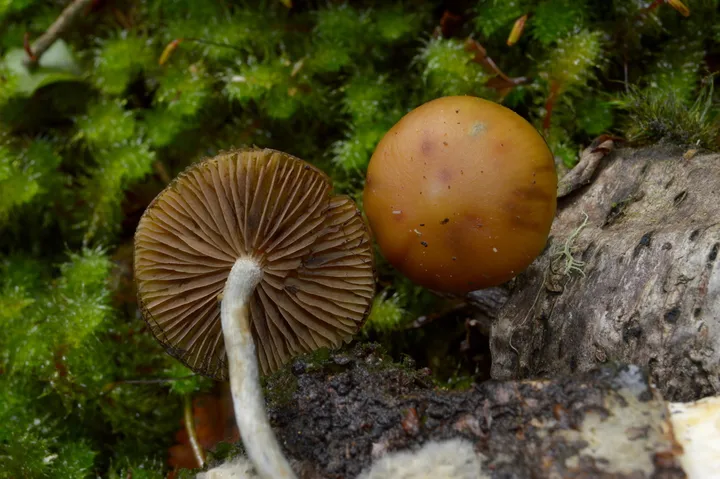
Foto yang diasosiasikan dengan Psilocybe makarorae pada iNaturalist. Identifikasi mengikuti sumber; bukan penentuan spesimen independen.
Kredit dan penggunaan
(c) foreverfungi, some rights reserved (CC BY), uploaded by foreverfungi
Ukuran dan format gambar disesuaikan tanpa pemotongan, retus, atau penambahan skala. Lisensi sumber dipertahankan.
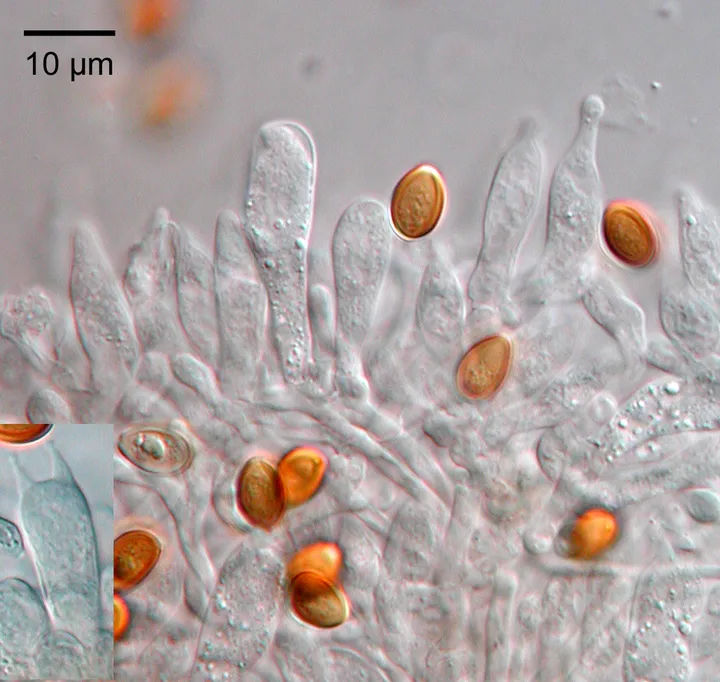
Foto yang diasosiasikan dengan Psilocybe makarorae pada iNaturalist. Identifikasi mengikuti sumber; bukan penentuan spesimen independen.
Kredit dan penggunaan
(c) Jerry Cooper, some rights reserved (CC BY), uploaded by Jerry Cooper
Ukuran dan format gambar disesuaikan tanpa pemotongan, retus, atau penambahan skala. Lisensi sumber dipertahankan.
Sumber profil
- [1] Psilocybe makarorae — Wikipedia (en)
- [2] Catalogue of Life Base2026-09-11 — Psilocybe makarorae
- [3] Dokumentasi visual — Psilocybe makarorae
- [4] Dokumentasi visual — Psilocybe makarorae
- [5] Dokumentasi visual — Psilocybe makarorae
Rujukan halaman ini
Fungi. Psilocybe makarorae. Rilis data fungi-2026-10-12-expansion-2. https://fungi-atlas.mgadib.chatgpt.site/jamur/psilocybe-makarorae/.
Status: impor sumber; pemeriksaan editorial per profil belum selesai. Untuk klaim biologis, gunakan rujukan pada bagian terkait dan periksa konteks sumber aslinya.