Ciri dan struktur
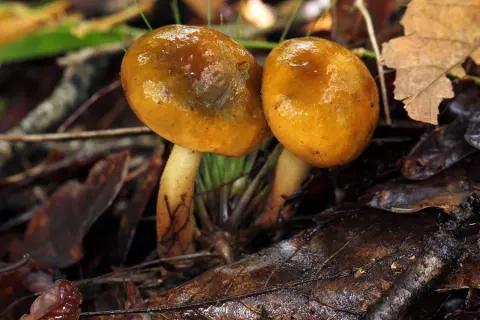
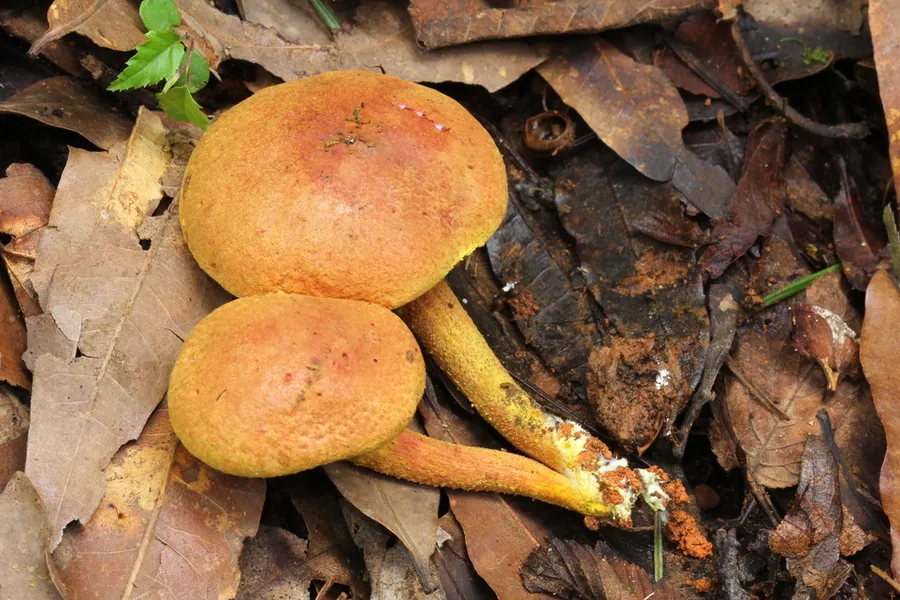
The cap is rounded to convex before flattening with age, and attains a diameter of 1-10 cm. Its margin is curved inward when young, and usually has hanging remnants of the partial veil. The surface is dry and initially coated with fine particles, while later it develops fine hairs or small scales that are pressed down flat on the surface; in maturity the surface usually develops fine cracks or wrinkles. It is bright yellow, later turning to orange-red to brownish red. The flesh is white to pale yellow, and, when cut, will slowly stain pale blue, then dingy yellow to pale brown. The tubes comprising the pore surface are 5-8 cm deep. The yellow stem measures 4.5-14.5 cm long by 0.6-1.6 cm thick, and can be roughly equal in width throughout, or either tapered or thicker near the base. It is solid (i.e., not hollow), and, above the level of the base, the surface is covered with minute hairs pressed flat against the surface. The partial veil, also bright yellow, is cottony and powdery, and remains as a ring on the upper portion of the stem, although in some specimens it merges gradually with the stipe surface and becomes inconspicuous. There is white mycelium at the stipe base. Pulveroboletus ravenelii produces an olive-grey to olive-brown spore print. The spores are elliptical to oval, smooth, and measure 8–10 by 4–5 μm. The hyphal tissue in the hymenophore is inamyloid and bilateral, meaning it diverges downward from the flesh toward the edge of the hymenophore, away from a central strand. The tubes have scattered cystidia on the walls (pleurocystidia) and abundant cystidia on the edges (cheilocystidia).
Habitat dan peran ekologis
The fruit bodies grow on the ground singly, scattered, or in groups in woods under conifers. Preferred mycorrhizal plant hosts include pine, hemlock, and rhododendron. Fruiting occurs from July to October, later on the North American West Coast. On that continent, it is distributed from eastern Canada extending south to the Gulf of Mexico, and west to Texas, Michigan, and California. The bolete was reported from a Mexican beech (Fagus mexicana) forest in Hidalgo, Mexico, in 2010. It has also been recorded from Costa Rica and Colombia. In Asia, it has been found in Indonesia and China. It has also been recorded from northeast Australia.
- Habitat atau konteks temuan
- hutan
- Substrat
- tanah
- Peran atau konteks
- Mitra tumbuhan
Reproduksi
Pulveroboletus ravenelii produces an olive-grey to olive-brown spore print. The spores are elliptical to oval, smooth, and measure 8–10 by 4–5 μm. The hyphal tissue in the hymenophore is inamyloid and bilateral, meaning it diverges downward from the flesh toward the edge of the hymenophore, away from a central strand. The tubes have scattered cystidia on the walls (pleurocystidia) and abundant cystidia on the edges (cheilocystidia). The hyphae in the cap cuticle are arranged as an ixotrichodermium–long and typically multi-celled, with erect hyphae embedded in a gelatinous matrix. Clamp connections are absent from the hyphae.
Catatan identitas dan cakupan
- Nama diterima mengikuti Catalogue of Life Base2026-09-11; uraian mempertahankan konsep dan nama sumber aslinya.
- Original geographic, specimen and life-cycle scope retained; source import awaits individual editorial review.
- Impor dan terjemahan otomatis belum diperiksa editorial per profil. Struktur reproduktif yang disebutkan tidak membuktikan seluruh siklus hidup diketahui.
- Pengukuran pada uraian mengikuti spesimen, kultur, dan metode sumber; angka tidak diperluas ke semua populasi.
Catatan distribusi dalam narasi mengikuti sumbernya. Dokumentasi spesimen atau foto mengikuti catatan sumber. Bukti wilayah Indonesia dan penilaian konservasi tidak disimpulkan dari gambar.
Melihat dengan konteks
Dokumentasi Pulveroboletus ravenelii menurut asosiasi foto pada record takson iNaturalist. Kredit: Alan Rockefeller. Identitas mengikuti sumber; bukan penentuan spesimen independen.
- Jenis
- Fotografi
- Kredit
- (c) Alan Rockefeller, some rights reserved (CC BY), uploaded by Alan Rockefeller
- Lisensi
- CC BY 4.0
- Sumber media
- Buka entri sumber
Dokumentasi tambahan
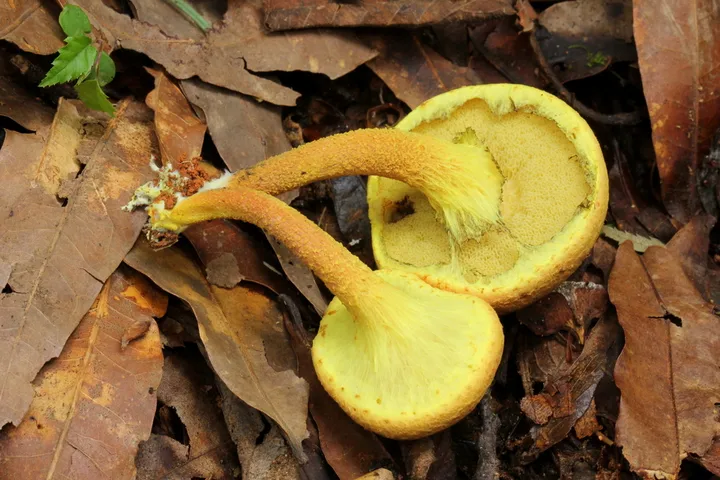
Foto yang diasosiasikan dengan Pulveroboletus ravenelii pada iNaturalist. Identifikasi mengikuti sumber; bukan penentuan spesimen independen.
Kredit dan penggunaan
(c) Alan Rockefeller, some rights reserved (CC BY), uploaded by Alan Rockefeller
Ukuran dan format gambar disesuaikan tanpa pemotongan, retus, atau penambahan skala. Lisensi sumber dipertahankan.
Sumber profil
- [1] Pulveroboletus ravenelii — Wikipedia (en)
- [2] Catalogue of Life Base2026-09-11 — Pulveroboletus ravenelii
- [3] Dokumentasi visual — Pulveroboletus ravenelii
- [4] Dokumentasi visual — Pulveroboletus ravenelii
Rujukan halaman ini
Fungi. Pulveroboletus ravenelii. Rilis data fungi-2026-10-12-expansion-2. https://fungi-atlas.mgadib.chatgpt.site/jamur/pulveroboletus-ravenelii/.
Status: impor sumber; pemeriksaan editorial per profil belum selesai. Untuk klaim biologis, gunakan rujukan pada bagian terkait dan periksa konteks sumber aslinya.