Ciri dan struktur
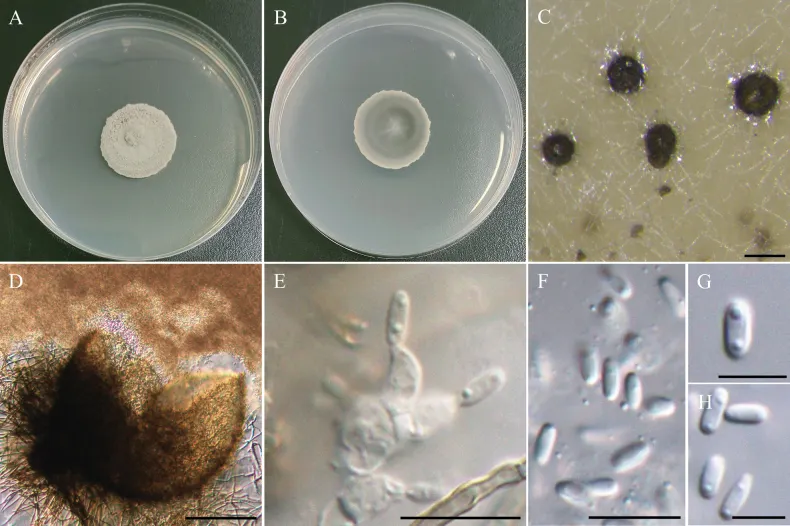
Sexual morph undetermined. Asexual morph Conidiomata 128–219 µm, pycnidial, globose to subglobose, dark brown, ostiolate, with dark brown, septate setae, superficial on WA and carnation leaves. Pycnidial wall textura angularis, septate setae, brown, pseudoparenchymatous cells. Conidiogenous cells hyaline, phialidic, smooth-walled, 3.6–5.0 µm × 2.9–4.1 µm (x̄ = 4.1 × 3.5 µm, n = 30). Conidia hyaline, cylindrical to ellipsoidal, aseptate, with 2 small guttules, 3.7–4.7 µm × 1.5–2.1 µm (x̄ = 4.2 × 1.8 µm, L/W ratio = 2.4, n = 30). Colony exhibit slow growth, reaching 28 mm diam with pale gray, floccose surface, smooth margins, and medium-gray on the reverse side of the colony.
Habitat dan peran ekologis
In the present study, strain NTUPPMCC 22-227 identified as Pyrenochaetopsis paucisetosa, clustering in a strongly supported clade (100%/1.00) with the type strain of Py. paucisetosa (UTHSC DI16-193) in multi-gene phylogeny analysis (Fig. 8; Valenzuela-Lopez et al. 2018). Previous reports indicate that Py. paucisetosa has been isolated from a human toe nail in USA (Valenzuela-Lopez et al. 2018) and from freshwater sediment in Korea (Goh et al. 2020). The culture characteristics of NTUPPMCC 22-227 on PDA were similar to those of the ex-holotype of Py. paucisetosa (UTHSC DI16-193). However, the conidia of Py. paucisetosa NTUPPMCC 22-227 in our study were more elongated than previous reports (x̄ = 4.2 × 1.8 µm versus 3.6 × 1.9 µm) (Fig. 7; Valenzuela-Lopez et al. 2018; Goh et al. 2020). Furthermore, this is the first record of Py. paucisetosa in Taiwan, as well as its first occurrence in paddy field soil.
- Habitat atau konteks temuan
- kultur yang didokumentasikan
- Substrat
- Informasi belum tersedia pada sumber rilis ini.
- Peran atau konteks
- Belum dikategorikan pada rilis ini.
Reproduksi
Sexual morph undetermined. Asexual morph Conidiomata 128–219 µm, pycnidial, globose to subglobose, dark brown, ostiolate, with dark brown, septate setae, superficial on WA and carnation leaves. Pycnidial wall textura angularis, septate setae, brown, pseudoparenchymatous cells. Conidiogenous cells hyaline, phialidic, smooth-walled, 3.6–5.0 µm × 2.9–4.1 µm (x̄ = 4.1 × 3.5 µm, n = 30). Conidia hyaline, cylindrical to ellipsoidal, aseptate, with 2 small guttules, 3.7–4.7 µm × 1.5–2.1 µm (x̄ = 4.2 × 1.8 µm, L/W ratio = 2.4, n = 30).
Catatan identitas dan cakupan
- Nama diterima mengikuti Catalogue of Life Base2026-09-11; uraian mempertahankan konsep dan nama sumber aslinya.
- Preserve original treatment localities, hosts and substrate scope. Materials examined describe documented specimens, not the full global range.
- Impor dan terjemahan otomatis belum diperiksa editorial per profil. Struktur reproduktif yang disebutkan tidak membuktikan seluruh siklus hidup diketahui.
- Pengukuran pada uraian mengikuti spesimen, kultur, dan metode sumber; angka tidak diperluas ke semua populasi.
Catatan distribusi dalam narasi mengikuti sumbernya. Dokumentasi spesimen atau foto mengikuti catatan sumber. Bukti wilayah Indonesia dan penilaian konservasi tidak disimpulkan dari gambar.
Melihat dengan konteks
Morphology of Pyrenochaetopsis paucisetosa NTUPPMCC 22-227. A, B 14-days-old colony on PDA; C Conidiomata; D Squashed conidiomata; E Conidiogenous cells; F–H Conidia. Scale bars: 0.2 mm (C); 0.1 mm (D); 10 µm (E, F); 5 µm (G, H).
- Jenis
- Pelat ilmiah
- Kredit
- Kai-Wen Cheng, Jiue-in Yang, Piroonporn Srimongkol, Marc Stadler, Aphichart Karnchanatat, Hiran A. Ariyawansa
- Lisensi
- CC BY 4.0
- Sumber media
- Buka entri sumber
Sumber profil
- [1] Fungal frontiers in toxic terrain: Revealing culturable fungal communities in Serpentine paddy fields of Taiwan — Pyrenochaetopsis paucisetosa
- [2] Catalogue of Life Base2026-09-11 — Pyrenochaetopsis paucisetosa
- [3] Dokumentasi visual — Pyrenochaetopsis paucisetosa
Rujukan halaman ini
Fungi. Pyrenochaetopsis paucisetosa. Rilis data fungi-2026-10-12-expansion-2. https://fungi-atlas.mgadib.chatgpt.site/jamur/pyrenochaetopsis-paucisetosa/.
Status: impor sumber; pemeriksaan editorial per profil belum selesai. Untuk klaim biologis, gunakan rujukan pada bagian terkait dan periksa konteks sumber aslinya.