01 / Morfologi

Ciri dan struktur

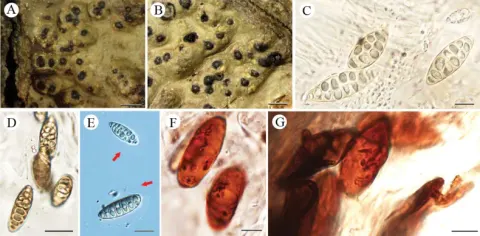
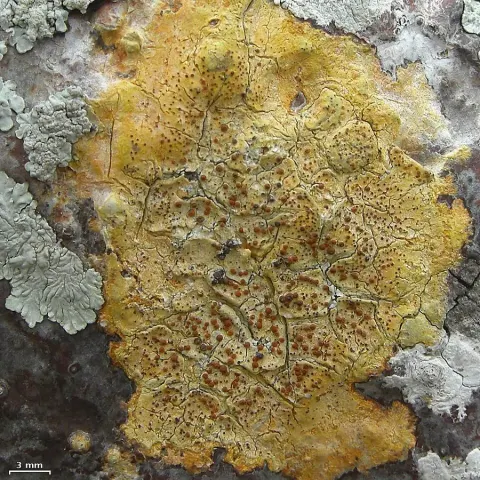
The thallus (the main body of the lichen) is olivaceous to fawn or dark brown, and typically has a smooth surface, including around the perithecia. White pseudocyphellae are present, measuring about 40–120 μm in diameter. Perithecia measure mainly 0.5–0.9 mm across (occasionally as small as 0.4 mm or as large as 1.2 mm) and form convex projections. The contains numerous colourless crystals, and the hymenium lacks anthraquinones. Ascospores are 3-septate and measure mostly 27–33 × 10–13 μm (overall range 24–36 × 8–13 μm). Pycnidia are frequent and appear as dark dots about 100–180 μm in diameter, usually most evident on younger parts of the thallus and often clustered along boundaries between adjacent thalli. Conidia are curved, measuring 10–16 × about 0.8 μm. Spot tests are C–, K+ (yellow), KC–, and Pd+ (faintly yellow); under ultraviolet light the thallus shows a weak yellow fluorescence that may be absent, attributed to an unidentified substance.

Sebagian uraian ditampilkan dalam bahasa sumber; terjemahannya belum tersedia atau belum lolos pemeriksaan.

Rujukan: [1]

Pengukuran mengikuti objek, spesimen atau kultur, dan metode yang disebutkan sumber. Baca uraian asli untuk konteks lengkap.

02 / Kehidupan

Habitat dan peran ekologis

Pyrenula macrospora occurs in temperate areas of the Old World. It has a strongly oceanic distribution, and has been recorded from Asia, Europe, and Macaronesia. It grows on the smooth bark of deciduous trees. In Britain, Pyrenula macrospora has been treated as an "oceanic-widespread" lichen, a biogeographic pattern associated with Atlantic-influenced climates and characterised by concentrations along the western seaboard and relative scarcity away from the Atlantic coast. A bioclimatic-envelope modelling study based on British records (1960–2006) linked the species' predicted occurrence mainly to winter temperature and winter precipitation. Under UKCIP02 (the UK Climate Impacts Programme's 2002 climate-change scenarios) projections for the 2050s, the same study projected an increase in climatically suitable area for P. macrospora, including a possible expansion into more easterly parts of Britain.

Sebagian uraian ditampilkan dalam bahasa sumber; terjemahannya belum tersedia atau belum lolos pemeriksaan.

Rujukan: [1]

Habitat atau konteks temuan
Informasi belum tersedia pada sumber rilis ini.
Substrat
Informasi belum tersedia pada sumber rilis ini.
Peran atau konteks
Pembentuk liken
Temukan hubungan serupa
03 / Siklus hidup

Reproduksi

Perithecia measure mainly 0.5–0.9 mm across (occasionally as small as 0.4 mm or as large as 1.2 mm) and form convex projections. The contains numerous colourless crystals, and the hymenium lacks anthraquinones. Ascospores are 3-septate and measure mostly 27–33 × 10–13 μm (overall range 24–36 × 8–13 μm). Pycnidia are frequent and appear as dark dots about 100–180 μm in diameter, usually most evident on younger parts of the thallus and often clustered along boundaries between adjacent thalli. Conidia are curved, measuring 10–16 × about 0.8 μm. Spot tests are C–, K+ (yellow), KC–, and Pd+ (faintly yellow); under ultraviolet light the thallus shows a weak yellow fluorescence that may be absent, attributed to an unidentified substance.

Sebagian uraian ditampilkan dalam bahasa sumber; terjemahannya belum tersedia atau belum lolos pemeriksaan.

Rujukan: [1]

Sinonim menurut acuan taksonomi rilis: Pyrenula chlorospila var. macrospora; Pyrenula nitida var. macrospora
04 / Batas informasi

Catatan identitas dan cakupan

  • Nama diterima mengikuti Catalogue of Life Base2026-09-11; uraian mempertahankan konsep dan nama sumber aslinya.
  • Original geographic, specimen and life-cycle scope retained; source import awaits individual editorial review.
  • Impor dan terjemahan otomatis belum diperiksa editorial per profil. Struktur reproduktif yang disebutkan tidak membuktikan seluruh siklus hidup diketahui.
  • Pengukuran pada uraian mengikuti spesimen, kultur, dan metode sumber; angka tidak diperluas ke semua populasi.

Catatan distribusi dalam narasi mengikuti sumbernya. Dokumentasi spesimen atau foto mengikuti catatan sumber. Bukti wilayah Indonesia dan penilaian konservasi tidak disimpulkan dari gambar.

05 / Dokumentasi

Melihat dengan konteks

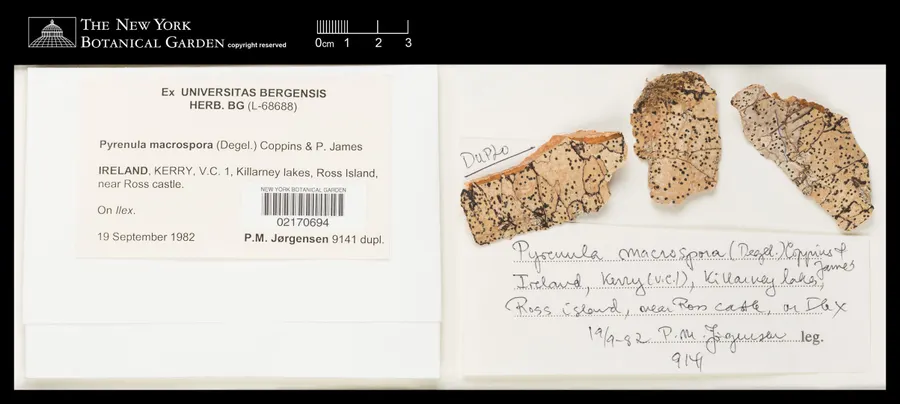
Voucher herbarium Pyrenula macrospora (02170694), The New York Botanical Garden. Identifikasi mengikuti record spesimen sumber. Foto bahan, kemasan, atau label herbarium sebagaimana tersedia pada record institusi; bukan foto lapangan atau penentuan spesimen independen.

Jenis
Voucher herbarium
Kredit
The New York Botanical Garden
Lisensi
CC BY 4.0
Sumber media
Buka entri sumber

Gambar menunjukkan objek menurut identifikasi sumber, bukan verifikasi independen spesimen oleh Fungi. Tidak ada skala baru yang ditambahkan.

06 / Rujukan

Sumber profil

  1. [1] Pyrenula macrospora — Wikipedia (en)Bagian sumber: Frozen revision 1328395466
    Tanggal penghimpunan sumber: 2026-10-12
    Teks sumber: CC BY-SA4.0 · Wikipedia contributors
  2. [2] Catalogue of Life Base2026-09-11 — Pyrenula macrosporaBagian sumber: ColDP NameUsage.tsv ID 792T8; accepted species; source 2073
    Tanggal penghimpunan sumber: 2026-10-12
  3. [3] Dokumentasi visual — Pyrenula macrosporaBagian sumber: Individual media record; identification follows the source, not independent determination
    Tanggal penghimpunan sumber: 2026-10-12
    Media sumber: CC BY 4.0 · The New York Botanical Garden

Adaptasi teks: CC BY-SA 4.0. Wikipedia contributors — Pyrenula macrospora — Wikipedia (en)

Uraian asli dan riwayat sumber

Riwayat atau halaman sumber

Ringkasan sumber

Pyrenula macrospora is a species of corticolous (bark-dwelling crustose lichen in the family Pyrenulaceae. The lichen has a smooth olive-brown to fawn thallus marked with small white spots, and produces curved ascospores within convex fruiting bodies. It grows on the smooth bark of deciduous trees in oceanic climates, where it is found mainly in western coastal regions of Europe, Asia, and Macaronesia.

Revisi sumber

Morfologi sumber

The thallus (the main body of the lichen) is olivaceous to fawn or dark brown, and typically has a smooth surface, including around the perithecia. White pseudocyphellae are present, measuring about 40–120 μm in diameter. Perithecia measure mainly 0.5–0.9 mm across (occasionally as small as 0.4 mm or as large as 1.2 mm) and form convex projections. The contains numerous colourless crystals, and the hymenium lacks anthraquinones. Ascospores are 3-septate and measure mostly 27–33 × 10–13 μm (overall range 24–36 × 8–13 μm). Pycnidia are frequent and appear as dark dots about 100–180 μm in diameter, usually most evident on younger parts of the thallus and often clustered along boundaries between adjacent thalli. Conidia are curved, measuring 10–16 × about 0.8 μm. Spot tests are C–, K+ (yellow), KC–, and Pd+ (faintly yellow); under ultraviolet light the thallus shows a weak yellow fluorescence that may be absent, attributed to an unidentified substance.

Revisi sumber

Ekologi sumber

Pyrenula macrospora occurs in temperate areas of the Old World. It has a strongly oceanic distribution, and has been recorded from Asia, Europe, and Macaronesia. It grows on the smooth bark of deciduous trees. In Britain, Pyrenula macrospora has been treated as an "oceanic-widespread" lichen, a biogeographic pattern associated with Atlantic-influenced climates and characterised by concentrations along the western seaboard and relative scarcity away from the Atlantic coast. A bioclimatic-envelope modelling study based on British records (1960–2006) linked the species' predicted occurrence mainly to winter temperature and winter precipitation. Under UKCIP02 (the UK Climate Impacts Programme's 2002 climate-change scenarios) projections for the 2050s, the same study projected an increase in climatically suitable area for P. macrospora, including a possible expansion into more easterly parts of Britain.

Revisi sumber

Struktur reproduksi sumber

Perithecia measure mainly 0.5–0.9 mm across (occasionally as small as 0.4 mm or as large as 1.2 mm) and form convex projections. The contains numerous colourless crystals, and the hymenium lacks anthraquinones. Ascospores are 3-septate and measure mostly 27–33 × 10–13 μm (overall range 24–36 × 8–13 μm). Pycnidia are frequent and appear as dark dots about 100–180 μm in diameter, usually most evident on younger parts of the thallus and often clustered along boundaries between adjacent thalli. Conidia are curved, measuring 10–16 × about 0.8 μm. Spot tests are C–, K+ (yellow), KC–, and Pd+ (faintly yellow); under ultraviolet light the thallus shows a weak yellow fluorescence that may be absent, attributed to an unidentified substance.

Revisi sumber

Rujukan halaman ini

Fungi. Pyrenula macrospora. Rilis data fungi-2026-10-12-expansion-2. https://fungi-atlas.mgadib.chatgpt.site/jamur/pyrenula-macrospora/.

Status: impor sumber; pemeriksaan editorial per profil belum selesai. Untuk klaim biologis, gunakan rujukan pada bagian terkait dan periksa konteks sumber aslinya.