01 / Morfologi

Ciri dan struktur

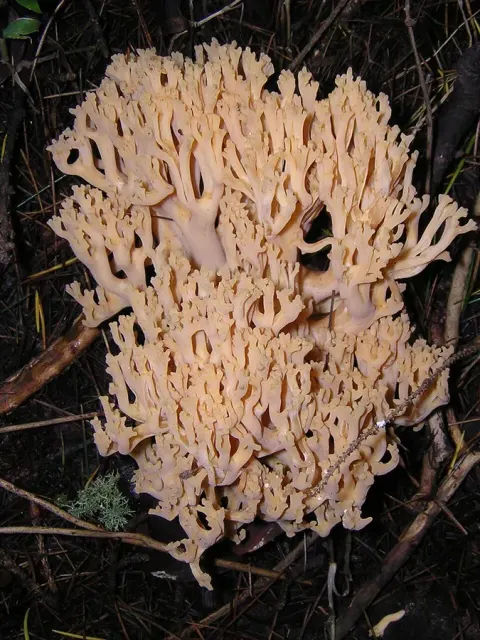
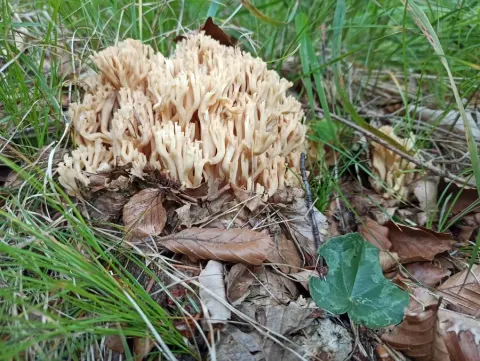
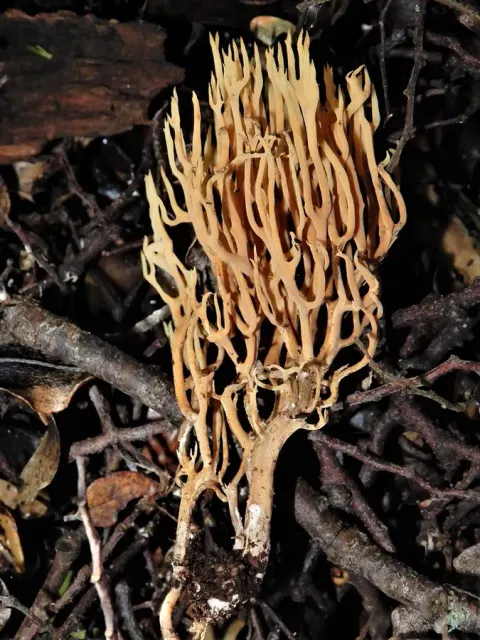
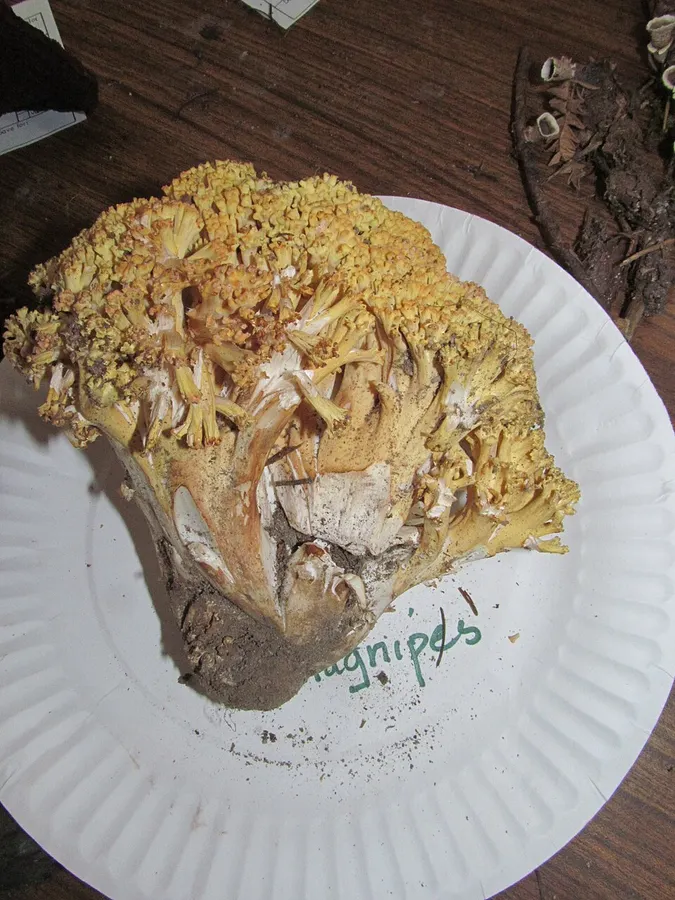
The coral-shaped fruit bodies are relatively large, with dimensions of 9 – 25 cm by 14 – 24 cm. The large stipe, which roots into the soil, is tapered to conical, measuring 7 – 14 cm long by 4 – 6 cm thick; The color of fresh fruit bodies ranges from light yellow to brownish pale orange (with white flesh), while dried specimens tend to be paler, from pale yellow to grayish orange (with pale yellow flesh); the flesh has a slow and mild amyloid reaction. The branches are compact (giving the fruit body a cauliflower-like appearance), with about six branches from the base. The primary branches are thick, up to 3 cm in diameter, while the secondary branches are usually in the range of 0.2 – 1 cm in diameter. Its flesh has a weakly aromatic or fabaceous (bean-like) odor, and a weakly fabaceous or bitter taste. The dimensions of the spores is in the range of 10–14 by 3–4.5 μm (averaging 11.8–3.7 μm). They are cylindrical, and smooth or with very fine cyanophilous (stainable with blue dyes) warts. The basidia (spore-bearing cells) are club-shaped, two- or four-spored with sterigmata up to 14 μm long, and measure 47–80 by 8–11 μm. The variety albidior differs from the main type by having white to yellowish branches. Its spores are somewhat cylindrical to narrowly ellipsoid, and range in size from 10.8–11.9 by 3.6–4.3 μm. Ramaria obtusissima is somewhat similar in appearance. It can be distinguished from R. magnipes by its smaller size, less intense fruit body color, and its shorter spores (9.5–11.5 by 3.5–4.0 μm). R. highlandensis has larger spores (with an average length of 12.4 μm), a smaller stipe, and an aromatic odor.

Sebagian uraian ditampilkan dalam bahasa sumber; terjemahannya belum tersedia atau belum lolos pemeriksaan.

Rujukan: [1]

Pengukuran mengikuti objek, spesimen atau kultur, dan metode yang disebutkan sumber. Baca uraian asli untuk konteks lengkap.

02 / Kehidupan

Habitat dan peran ekologis

The fungus fruits on the ground in mixed forests. It has been collected from the US states of Idaho, Washington, and Tennessee. Variety albidior is found in the Sierra Nevada mountains of California, where it fruits in the spring. Ramaria magnipes is a snowbank fungus, meaning it is often found around the edge of melting snowbanks, or shortly after snowmelt.

Sebagian uraian ditampilkan dalam bahasa sumber; terjemahannya belum tersedia atau belum lolos pemeriksaan.

Rujukan: [1]

Habitat atau konteks temuan
hutan
Substrat
tanah
Peran atau konteks
Belum dikategorikan pada rilis ini.
Temukan hubungan serupa
03 / Siklus hidup

Reproduksi

The dimensions of the spores is in the range of 10–14 by 3–4.5 μm (averaging 11.8–3.7 μm). They are cylindrical, and smooth or with very fine cyanophilous (stainable with blue dyes) warts. The basidia (spore-bearing cells) are club-shaped, two- or four-spored with sterigmata up to 14 μm long, and measure 47–80 by 8–11 μm. The variety albidior differs from the main type by having white to yellowish branches. Its spores are somewhat cylindrical to narrowly ellipsoid, and range in size from 10.8–11.9 by 3.6–4.3 μm. Ramaria obtusissima is somewhat similar in appearance. It can be distinguished from R. magnipes by its smaller size, less intense fruit body color, and its shorter spores (9.5–11.5 by 3.5–4.0 μm).

Sebagian uraian ditampilkan dalam bahasa sumber; terjemahannya belum tersedia atau belum lolos pemeriksaan.

Rujukan: [1]

Sinonim menurut acuan taksonomi rilis: Ramaria magnipes var. albidior
04 / Batas informasi

Catatan identitas dan cakupan

  • Nama diterima mengikuti Catalogue of Life Base2026-09-11; uraian mempertahankan konsep dan nama sumber aslinya.
  • Original geographic, specimen and life-cycle scope retained; source import awaits individual editorial review.
  • Impor dan terjemahan otomatis belum diperiksa editorial per profil. Struktur reproduktif yang disebutkan tidak membuktikan seluruh siklus hidup diketahui.
  • Pengukuran pada uraian mengikuti spesimen, kultur, dan metode sumber; angka tidak diperluas ke semua populasi.

Catatan distribusi dalam narasi mengikuti sumbernya. Dokumentasi spesimen atau foto mengikuti catatan sumber. Bukti wilayah Indonesia dan penilaian konservasi tidak disimpulkan dari gambar.

05 / Dokumentasi

Melihat dengan konteks

Dokumentasi Ramaria magnipes dari Wikimedia Commons. A fruit body of the coral fungus Ramaria magnipes Marr & D.E. Stuntz. Collected in Washington state. Identifikasi mengikuti record berkas sumber.

Jenis
Fotografi
Kredit
Tim Sage
Sumber media
Buka entri sumber

Gambar menunjukkan objek menurut identifikasi sumber, bukan verifikasi independen spesimen oleh Fungi. Tidak ada skala baru yang ditambahkan.

06 / Rujukan

Sumber profil

  1. [1] Ramaria magnipes — Wikipedia (en)Bagian sumber: Frozen revision 1224554253
    Tanggal penghimpunan sumber: 2026-10-12
    Teks sumber: CC BY-SA4.0 · Wikipedia contributors
  2. [2] Catalogue of Life Base2026-09-11 — Ramaria magnipesBagian sumber: ColDP NameUsage.tsv ID 4RBT2; accepted species; source 2073
    Tanggal penghimpunan sumber: 2026-10-12
  3. [3] Dokumentasi visual — Ramaria magnipesBagian sumber: Individual media record; identification follows the source, not independent determination
    Tanggal penghimpunan sumber: 2026-10-12
    Media sumber: CC BY-SA 3.0 · Tim Sage

Adaptasi teks: CC BY-SA 4.0. Wikipedia contributors — Ramaria magnipes — Wikipedia (en)

Uraian asli dan riwayat sumber

Riwayat atau halaman sumber

Ringkasan sumber

The coral-shaped fruit bodies are relatively large, with dimensions of 9 – 25 cm by 14 – 24 cm. The large stipe, which roots into the soil, is tapered to conical, measuring 7 – 14 cm long by 4 – 6 cm thick; The color of fresh fruit bodies ranges from light yellow to brownish pale orange (with white flesh), while dried specimens tend to be paler, from pale yellow to grayish orange (with pale yellow flesh); the flesh has a slow and mild amyloid reaction. The branches are compact (giving the fruit body a cauliflower-like appearance), with about six branches from the base.

Revisi sumber

Morfologi sumber

The coral-shaped fruit bodies are relatively large, with dimensions of 9 – 25 cm by 14 – 24 cm. The large stipe, which roots into the soil, is tapered to conical, measuring 7 – 14 cm long by 4 – 6 cm thick; The color of fresh fruit bodies ranges from light yellow to brownish pale orange (with white flesh), while dried specimens tend to be paler, from pale yellow to grayish orange (with pale yellow flesh); the flesh has a slow and mild amyloid reaction. The branches are compact (giving the fruit body a cauliflower-like appearance), with about six branches from the base. The primary branches are thick, up to 3 cm in diameter, while the secondary branches are usually in the range of 0.2 – 1 cm in diameter. Its flesh has a weakly aromatic or fabaceous (bean-like) odor, and a weakly fabaceous or bitter taste. The dimensions of the spores is in the range of 10–14 by 3–4.5 μm (averaging 11.8–3.7 μm). They are cylindrical, and smooth or with very fine cyanophilous (stainable with blue dyes) warts. The basidia (spore-bearing cells) are club-shaped, two- or four-spored with sterigmata up to 14 μm long, and measure 47–80 by 8–11 μm. The variety albidior differs from the main type by having white to yellowish branches. Its spores are somewhat cylindrical to narrowly ellipsoid, and range in size from 10.8–11.9 by 3.6–4.3 μm. Ramaria obtusissima is somewhat similar in appearance. It can be distinguished from R. magnipes by its smaller size, less intense fruit body color, and its shorter spores (9.5–11.5 by 3.5–4.0 μm). R. highlandensis has larger spores (with an average length of 12.4 μm), a smaller stipe, and an aromatic odor.

Revisi sumber

Ekologi sumber

The fungus fruits on the ground in mixed forests. It has been collected from the US states of Idaho, Washington, and Tennessee. Variety albidior is found in the Sierra Nevada mountains of California, where it fruits in the spring. Ramaria magnipes is a snowbank fungus, meaning it is often found around the edge of melting snowbanks, or shortly after snowmelt.

Revisi sumber

Struktur reproduksi sumber

The dimensions of the spores is in the range of 10–14 by 3–4.5 μm (averaging 11.8–3.7 μm). They are cylindrical, and smooth or with very fine cyanophilous (stainable with blue dyes) warts. The basidia (spore-bearing cells) are club-shaped, two- or four-spored with sterigmata up to 14 μm long, and measure 47–80 by 8–11 μm. The variety albidior differs from the main type by having white to yellowish branches. Its spores are somewhat cylindrical to narrowly ellipsoid, and range in size from 10.8–11.9 by 3.6–4.3 μm. Ramaria obtusissima is somewhat similar in appearance. It can be distinguished from R. magnipes by its smaller size, less intense fruit body color, and its shorter spores (9.5–11.5 by 3.5–4.0 μm).

Revisi sumber

Rujukan halaman ini

Fungi. Ramaria magnipes. Rilis data fungi-2026-10-12-expansion-2. https://fungi-atlas.mgadib.chatgpt.site/jamur/ramaria-magnipes/.

Status: impor sumber; pemeriksaan editorial per profil belum selesai. Untuk klaim biologis, gunakan rujukan pada bagian terkait dan periksa konteks sumber aslinya.