01 / Morfologi

Ciri dan struktur

Reichlingia zwackhii forms a thin, crust-like () growth known as a thallus, measuring up to 80 μm in thickness. Its surface colour ranges from white to pale grey, presenting a texture and slightly cracked () appearance. Like many lichens, it has a green algal partner (), specifically from the genus Trentepohlia. The reproductive structures, known as apothecia, are abundant and frequently densely packed together. They typically have irregular star-shaped () forms, reaching up to 1.2 mm across, although occasionally they may appear rounded or polygonal and significantly smaller, at only 0.2–0.3 mm. Apothecia have a reddish-brown colour, but their surfaces usually bear a thin, white powdery coating (). In microscopic cross-section, apothecia measure between 65 and 95 μm in height. The upper layer of the fruiting body () is red-brown and turns pale green when exposed to potassium hydroxide solution (K+ test). Beneath this, the hymenium—the fertile layer containing reproductive cells—is 40–50 μm tall and colourless or slightly reddish-brown at the top. The layer beneath the hymenium, called the , measures 15–35 μm in height and is colourless or pale straw-coloured. —thread-like supportive filaments within the hymenium—are typically 1–2 μm wide but have thicker, brown-coloured walls (up to 2.5 μm) in the epithecium, occasionally capped at the tips. Spores () produced by Reichlingia zwackhii are cylindrical to , with dimensions of 16–22 (occasionally up to 24) by 5–7 μm, divided into three or four compartments (3-septate). The uppermost spore cell is enlarged. Older spores turn brown and develop a warty surface texture.

Sebagian uraian ditampilkan dalam bahasa sumber; terjemahannya belum tersedia atau belum lolos pemeriksaan.

Rujukan: [1]

Pengukuran mengikuti objek, spesimen atau kultur, dan metode yang disebutkan sumber. Baca uraian asli untuk konteks lengkap.

02 / Kehidupan

Habitat dan peran ekologis

Reichlingia zwackhii grows primarily on moist, mesic bark of mature trees such as beech (Fagus), ash (Fraxinus), and oak (Quercus) within ancient woodland environments. It commonly colonises and visibly invades the thalli (lichen bodies) of the species Phlyctis argena, and more rarely, Phlyctis agelaea, from which it occasionally acquires patchy deposits of norstictic acid. Although typically found as a parasitic or semi-parasitic lichen, R. zwackhii can sometimes grow as an independent organism. In terms of distribution, in the United Kingdom, this species is considered rare but occurs widely across southern and southwestern England, spanning from Cornwall eastwards to Sussex. It is very rare in Scotland, recorded specifically in East Perthshire, and has limited occurrences in southwestern and northwestern Wales, as well as in Ireland.

Sebagian uraian ditampilkan dalam bahasa sumber; terjemahannya belum tersedia atau belum lolos pemeriksaan.

Rujukan: [1]

Habitat atau konteks temuan
hutan
Substrat
Informasi belum tersedia pada sumber rilis ini.
Peran atau konteks
Pembentuk liken
Temukan hubungan serupa
03 / Siklus hidup

Reproduksi

The reproductive structures, known as apothecia, are abundant and frequently densely packed together. They typically have irregular star-shaped () forms, reaching up to 1.2 mm across, although occasionally they may appear rounded or polygonal and significantly smaller, at only 0.2–0.3 mm. Apothecia have a reddish-brown colour, but their surfaces usually bear a thin, white powdery coating (). In microscopic cross-section, apothecia measure between 65 and 95 μm in height. The upper layer of the fruiting body () is red-brown and turns pale green when exposed to potassium hydroxide solution (K+ test). Beneath this, the hymenium—the fertile layer containing reproductive cells—is 40–50 μm tall and colourless or slightly reddish-brown at the top.

Sebagian uraian ditampilkan dalam bahasa sumber; terjemahannya belum tersedia atau belum lolos pemeriksaan.

Rujukan: [1]

Sinonim menurut acuan taksonomi rilis: Arthonia zwackhii
04 / Batas informasi

Catatan identitas dan cakupan

  • Nama diterima mengikuti Catalogue of Life Base2026-09-11; uraian mempertahankan konsep dan nama sumber aslinya.
  • Original geographic, specimen and life-cycle scope retained; source import awaits individual editorial review.
  • Impor dan terjemahan otomatis belum diperiksa editorial per profil. Struktur reproduktif yang disebutkan tidak membuktikan seluruh siklus hidup diketahui.
  • Pengukuran pada uraian mengikuti spesimen, kultur, dan metode sumber; angka tidak diperluas ke semua populasi.

Catatan distribusi dalam narasi mengikuti sumbernya. Dokumentasi spesimen atau foto mengikuti catatan sumber. Bukti wilayah Indonesia dan penilaian konservasi tidak disimpulkan dari gambar.

05 / Dokumentasi

Melihat dengan konteks

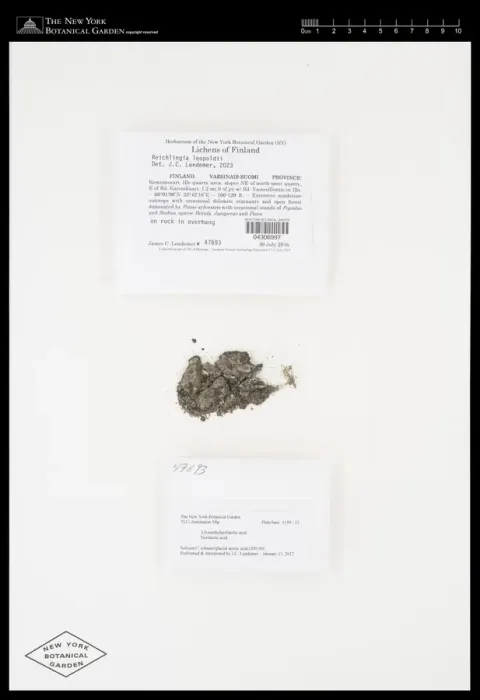
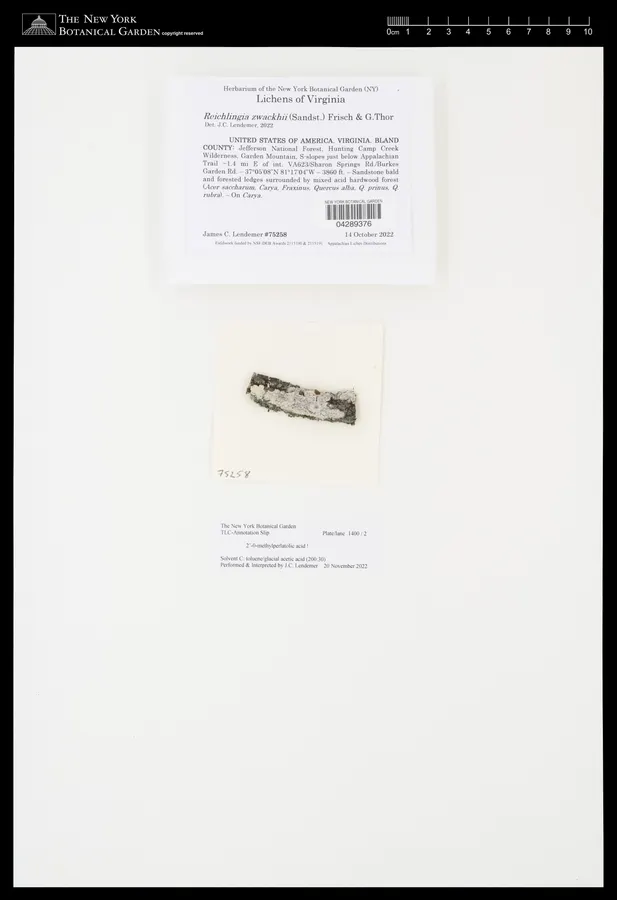
Voucher herbarium Reichlingia zwackhii (04289376), The New York Botanical Garden. Identifikasi mengikuti record spesimen sumber. Foto bahan, kemasan, atau label herbarium sebagaimana tersedia pada record institusi; bukan foto lapangan atau penentuan spesimen independen.

Jenis
Voucher herbarium
Kredit
The New York Botanical Garden
Lisensi
CC BY 4.0
Sumber media
Buka entri sumber

Gambar menunjukkan objek menurut identifikasi sumber, bukan verifikasi independen spesimen oleh Fungi. Tidak ada skala baru yang ditambahkan.

06 / Rujukan

Sumber profil

  1. [1] Reichlingia zwackhii — Wikipedia (en)Bagian sumber: Frozen revision 1319837519
    Tanggal penghimpunan sumber: 2026-10-12
    Teks sumber: CC BY-SA4.0 · Wikipedia contributors
  2. [2] Catalogue of Life Base2026-09-11 — Reichlingia zwackhiiBagian sumber: ColDP NameUsage.tsv ID 4RQLC; accepted species; source 2073
    Tanggal penghimpunan sumber: 2026-10-12
  3. [3] Dokumentasi visual — Reichlingia zwackhiiBagian sumber: Individual media record; identification follows the source, not independent determination
    Tanggal penghimpunan sumber: 2026-10-12
    Media sumber: CC BY 4.0 · The New York Botanical Garden

Adaptasi teks: CC BY-SA 4.0. Wikipedia contributors — Reichlingia zwackhii — Wikipedia (en)

Uraian asli dan riwayat sumber

Riwayat atau halaman sumber

Ringkasan sumber

Reichlingia zwackhii is a species of corticolous (bark-dwelling) lichen in the family Arthoniaceae. It is found in temperate woodland habitats across parts of Europe. It typically grows on the moist bark of mature beech, ash, and oak trees in ancient forests, often appearing as a parasite or semi-parasite on other lichens, although it can occasionally live independently. The lichen is rare but widespread in southern and southwestern England, with very limited occurrences reported in Scotland, Wales, and Ireland.

Revisi sumber

Morfologi sumber

Reichlingia zwackhii forms a thin, crust-like () growth known as a thallus, measuring up to 80 μm in thickness. Its surface colour ranges from white to pale grey, presenting a texture and slightly cracked () appearance. Like many lichens, it has a green algal partner (), specifically from the genus Trentepohlia. The reproductive structures, known as apothecia, are abundant and frequently densely packed together. They typically have irregular star-shaped () forms, reaching up to 1.2 mm across, although occasionally they may appear rounded or polygonal and significantly smaller, at only 0.2–0.3 mm. Apothecia have a reddish-brown colour, but their surfaces usually bear a thin, white powdery coating (). In microscopic cross-section, apothecia measure between 65 and 95 μm in height. The upper layer of the fruiting body () is red-brown and turns pale green when exposed to potassium hydroxide solution (K+ test). Beneath this, the hymenium—the fertile layer containing reproductive cells—is 40–50 μm tall and colourless or slightly reddish-brown at the top. The layer beneath the hymenium, called the , measures 15–35 μm in height and is colourless or pale straw-coloured. —thread-like supportive filaments within the hymenium—are typically 1–2 μm wide but have thicker, brown-coloured walls (up to 2.5 μm) in the epithecium, occasionally capped at the tips. Spores () produced by Reichlingia zwackhii are cylindrical to , with dimensions of 16–22 (occasionally up to 24) by 5–7 μm, divided into three or four compartments (3-septate). The uppermost spore cell is enlarged. Older spores turn brown and develop a warty surface texture.

Revisi sumber

Ekologi sumber

Reichlingia zwackhii grows primarily on moist, mesic bark of mature trees such as beech (Fagus), ash (Fraxinus), and oak (Quercus) within ancient woodland environments. It commonly colonises and visibly invades the thalli (lichen bodies) of the species Phlyctis argena, and more rarely, Phlyctis agelaea, from which it occasionally acquires patchy deposits of norstictic acid. Although typically found as a parasitic or semi-parasitic lichen, R. zwackhii can sometimes grow as an independent organism. In terms of distribution, in the United Kingdom, this species is considered rare but occurs widely across southern and southwestern England, spanning from Cornwall eastwards to Sussex. It is very rare in Scotland, recorded specifically in East Perthshire, and has limited occurrences in southwestern and northwestern Wales, as well as in Ireland.

Revisi sumber

Struktur reproduksi sumber

The reproductive structures, known as apothecia, are abundant and frequently densely packed together. They typically have irregular star-shaped () forms, reaching up to 1.2 mm across, although occasionally they may appear rounded or polygonal and significantly smaller, at only 0.2–0.3 mm. Apothecia have a reddish-brown colour, but their surfaces usually bear a thin, white powdery coating (). In microscopic cross-section, apothecia measure between 65 and 95 μm in height. The upper layer of the fruiting body () is red-brown and turns pale green when exposed to potassium hydroxide solution (K+ test). Beneath this, the hymenium—the fertile layer containing reproductive cells—is 40–50 μm tall and colourless or slightly reddish-brown at the top.

Revisi sumber

Rujukan halaman ini

Fungi. Reichlingia zwackhii. Rilis data fungi-2026-10-12-expansion-2. https://fungi-atlas.mgadib.chatgpt.site/jamur/reichlingia-zwackhii/.

Status: impor sumber; pemeriksaan editorial per profil belum selesai. Untuk klaim biologis, gunakan rujukan pada bagian terkait dan periksa konteks sumber aslinya.