Ciri dan struktur
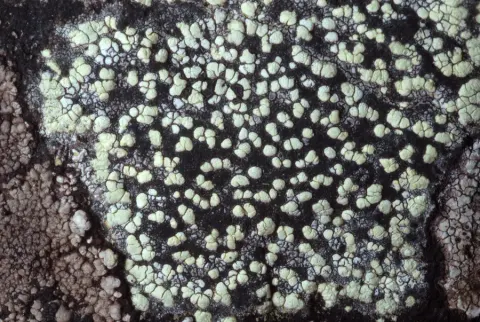
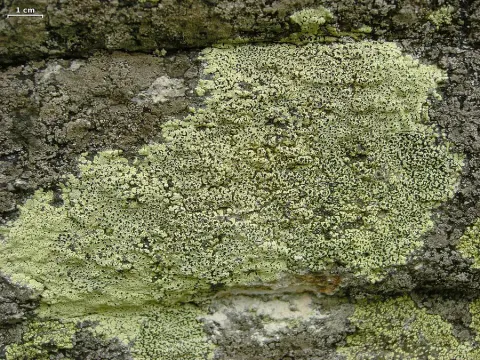
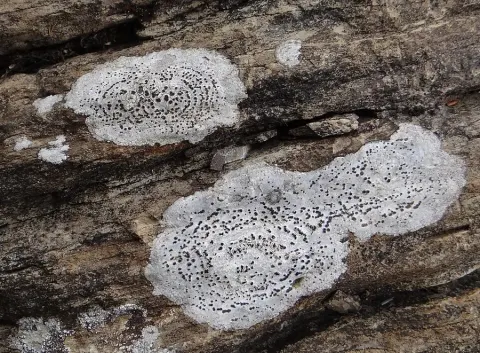
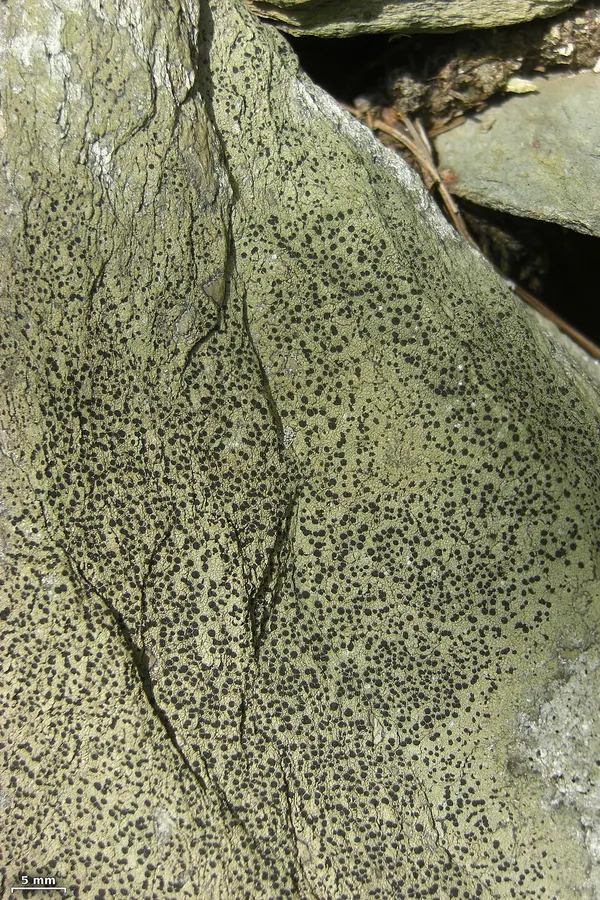
Rhizocarpon cinereovirens forms tiny crusts that seldom exceed a centimetre in diameter. The thallus breaks into minute plates () about 0.3–0.4 mm across; these range from flat, wafer-thin patches to slightly blistered cushions up to 0.8 mm thick and are usually snow-white or pale grey, occasionally light brown. A black, fibrous —an advancing web of fungal hyphae—may appear only in small fringes at the colony's edge or be entirely absent. Reproduction occurs in black apothecia that sit flush with or slightly above the thallus. Each is 0.4–0.6 mm across, initially flat but becoming gently domed. Like many members of the genus, the apothecia are in form: the pale outer rim derived from the thallus is missing, so the only margin is the fungal wall (). That wall is scarcely raised—about 0.04 mm thick—and internally shows radiating hyphae that are pale brown beneath a darker skin. The transparent hymenium above reaches 70–90 μm in height. Both the and the exciple contain fine crystals that dissolve in K, a practical character separating the species from lookalikes such as R. discoense. Overlying it is an olive-green to blue-black that turns green-blue with potassium hydroxide (K+ reaction) and reddish-brown with nitric acid (N+). The supporting is medium to dark brown. Thread-like just 2.5 μm wide weave through the hymenium; they branch freely, seldom swell at the tips, and carry a sharply defined green-blue cap that remains intact when K is applied. Each club-shaped ascus (40–70 × 25–30 μm) produces eight colourless ascospores. Mature spores measure 11–18 × 5.5–8.5 μm and are divided once across the middle (1-septate).
Habitat dan peran ekologis
Rhizocarpon cinereovirens is a sporadic species of exposed, nutrient-poor sites. It colonises hard siliceous rock and metal-rich spoil, thriving where surfaces are scoured by wind or salt spray. Populations occur both on windswept montane summits and in low-level coastal heath. In Asia it has been collected on siliceous rock at roughly 600 m in Jilin Province, north-eastern China—the first confirmed record from the continent. With records now spanning eastern Asia, north-west Europe, and north-east North America, R. cinereovirens shows a disjunct but broadly boreal–subalpine range. Across the British Isles R. cinereovirens is scattered but widespread, with records from upland and coastal districts in both Wales and Scotland as well as the Isle of Man. Specimens showing the same pale, bullate thallus and immarginate apothecia have also been reported in Scandinavia and the north-eastern United States (Maine), suggesting a broadly North Atlantic range. It can be mistaken for R. discoense, which differs chemically, or for R. infernulum, which lacks norstictic acid and has less intricately branched apothecial filaments.
- Habitat atau konteks temuan
- Informasi belum tersedia pada sumber rilis ini.
- Substrat
- Informasi belum tersedia pada sumber rilis ini.
- Peran atau konteks
- Pembentuk liken
Reproduksi
Reproduction occurs in black apothecia that sit flush with or slightly above the thallus. Each is 0.4–0.6 mm across, initially flat but becoming gently domed. Like many members of the genus, the apothecia are in form: the pale outer rim derived from the thallus is missing, so the only margin is the fungal wall (). That wall is scarcely raised—about 0.04 mm thick—and internally shows radiating hyphae that are pale brown beneath a darker skin. The transparent hymenium above reaches 70–90 μm in height. Both the and the exciple contain fine crystals that dissolve in K, a practical character separating the species from lookalikes such as R. discoense. Overlying it is an olive-green to blue-black that turns green-blue with potassium hydroxide (K+ reaction) and reddish-brown with nitric acid (N+).
Catatan identitas dan cakupan
- Nama diterima mengikuti Catalogue of Life Base2026-09-11; uraian mempertahankan konsep dan nama sumber aslinya.
- Original geographic, specimen and life-cycle scope retained; source import awaits individual editorial review.
- Impor dan terjemahan otomatis belum diperiksa editorial per profil. Struktur reproduktif yang disebutkan tidak membuktikan seluruh siklus hidup diketahui.
- Pengukuran pada uraian mengikuti spesimen, kultur, dan metode sumber; angka tidak diperluas ke semua populasi.
Catatan distribusi dalam narasi mengikuti sumbernya. Dokumentasi spesimen atau foto mengikuti catatan sumber. Bukti wilayah Indonesia dan penilaian konservasi tidak disimpulkan dari gambar.
Melihat dengan konteks
Dokumentasi Rhizocarpon cinereovirens dari Wikimedia Commons. White Oak Mountain, Smokies, North Carolina, 20110505 (specimen determined by J. Lendemer at NYBG) Identifikasi mengikuti record berkas sumber.
- Jenis
- Fotografi
- Kredit
- Jason Hollinger
- Lisensi
- CC BY 2.0
- Sumber media
- Buka entri sumber
Sumber profil
- [1] Rhizocarpon cinereovirens — Wikipedia (en)
- [2] Catalogue of Life Base2026-09-11 — Rhizocarpon cinereovirens
- [3] Dokumentasi visual — Rhizocarpon cinereovirens
Rujukan halaman ini
Fungi. Rhizocarpon cinereovirens. Rilis data fungi-2026-10-12-expansion-2. https://fungi-atlas.mgadib.chatgpt.site/jamur/rhizocarpon-cinereovirens/.
Status: impor sumber; pemeriksaan editorial per profil belum selesai. Untuk klaim biologis, gunakan rujukan pada bagian terkait dan periksa konteks sumber aslinya.