Ciri dan struktur
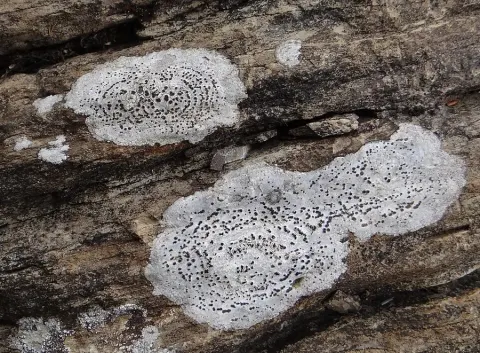
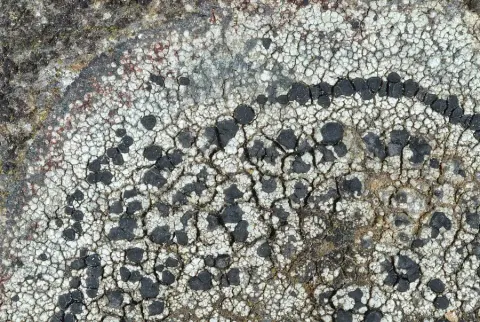
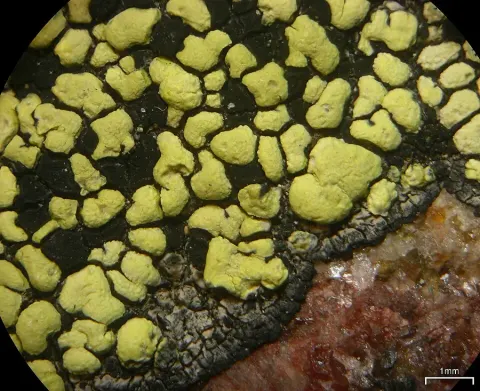
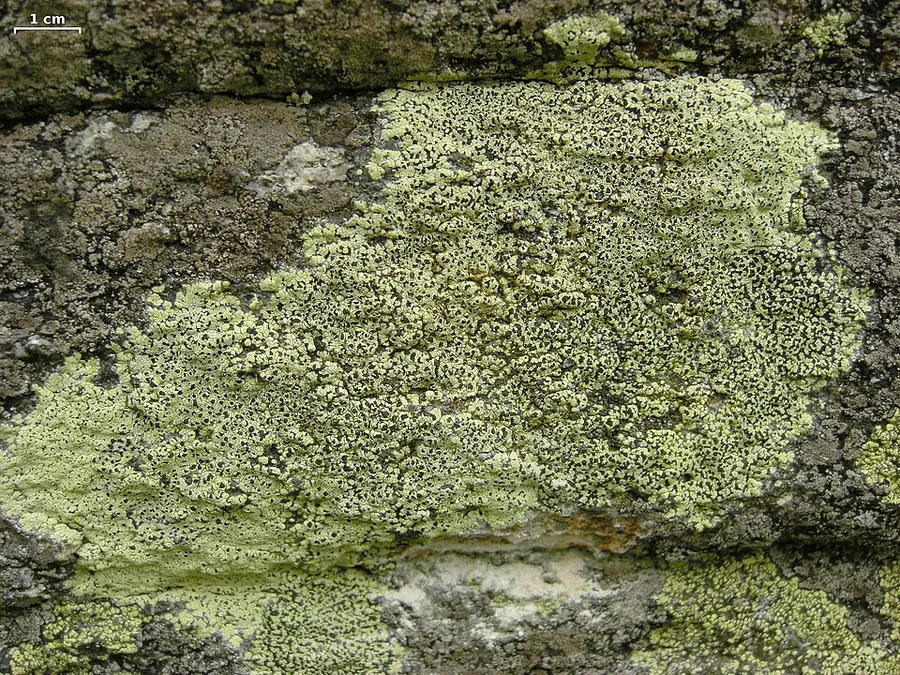
Rhizocarpon lecanorinum forms a bright yellow–green crust that reaches about 4 cm across, though neighbouring thalli commonly merge to make extensive, continuous patches. The surface is divided into small, tile-like (1–2 mm in diameter), which are , smooth, and sit on a distinct black (a narrow border of fungal tissue). Areoles begin rounded and slightly convex; as black fruiting (apothecia) develop beside them, the areoles curve around the discs so the apothecia appear rimmed by yellow thallus—a pseudo- margin. The internal white layer (medulla) gives an iodine-positive blue reaction (I+ blue). Apothecia are small (to about 1 mm across), black and not frosted (non-), broadly circular and flat to shallowly concave. The () persists but is often thin and indistinct; its inner part is colourless while the outer rim is brown-black and unreactive to potassium hydroxide solution (K–). The upper hymenial surface () is pale olive-brown and may turn greener with K, the spore-bearing layer (hymenium) is colourless to faintly green, and the layer beneath () is thin, brown-black, and K–; no crystals are present in the apothecia. Ascospores are dark brown and (partitioned into many chambers like brickwork), measuring 34–57 × 15–24 μm with about 15–38 cells visible in optical section. Spot tests on the medulla are K+ (yellow) and Pd+ (orange), indicating stictic acid (often in low concentration) together with rhizocarpic acid.
Habitat dan peran ekologis
Field studies comparing Rhizocarpon lecanorinum with the map lichen R. geographicum found that neighbouring thalli of R. lecanorinum commonly merge without leaving visible boundaries, producing continuous carpets of areoles. By contrast, thalli of R. geographicum (especially subsp. prospectans) remain sharply delimited from one another and form a mosaic. The coalescing habit in R. lecanorinum has been interpreted as evidence of somatic compatibility among very closely related—or even clonal—individuals, whereas the mosaic pattern in R. geographicum is consistent with somatic incompatibility between distinct genotypes. In the same comparisons, R. geographicum typically produced many pycnidia, while R. lecanorinum bore scarce pycnidia but developed apothecia even at small thallus sizes and high colony density. A facultative parasitic relationship has been observed in which Schaereria fuscocinerea invades thalli of R. lecanorinum, spreads outward through the host, and replaces the host's cortex and algal layer with its own tissues; co-occurring R. geographicum resisted such invasion. Occasional parasitism by Protoparmelia badia on R. lecanorinum has also been observed.
- Habitat atau konteks temuan
- Informasi belum tersedia pada sumber rilis ini.
- Substrat
- Informasi belum tersedia pada sumber rilis ini.
- Peran atau konteks
- Pembentuk liken
Reproduksi
Apothecia are small (to about 1 mm across), black and not frosted (non-), broadly circular and flat to shallowly concave. The () persists but is often thin and indistinct; its inner part is colourless while the outer rim is brown-black and unreactive to potassium hydroxide solution (K–). The upper hymenial surface () is pale olive-brown and may turn greener with K, the spore-bearing layer (hymenium) is colourless to faintly green, and the layer beneath () is thin, brown-black, and K–; no crystals are present in the apothecia. Ascospores are dark brown and (partitioned into many chambers like brickwork), measuring 34–57 × 15–24 μm with about 15–38 cells visible in optical section. Spot tests on the medulla are K+ (yellow) and Pd+ (orange), indicating stictic acid (often in low concentration) together with rhizocarpic acid.
Catatan identitas dan cakupan
- Nama diterima mengikuti Catalogue of Life Base2026-09-11; uraian mempertahankan konsep dan nama sumber aslinya.
- Original geographic, specimen and life-cycle scope retained; source import awaits individual editorial review.
- Impor dan terjemahan otomatis belum diperiksa editorial per profil. Struktur reproduktif yang disebutkan tidak membuktikan seluruh siklus hidup diketahui.
- Pengukuran pada uraian mengikuti spesimen, kultur, dan metode sumber; angka tidak diperluas ke semua populasi.
Catatan distribusi dalam narasi mengikuti sumbernya. Dokumentasi spesimen atau foto mengikuti catatan sumber. Bukti wilayah Indonesia dan penilaian konservasi tidak disimpulkan dari gambar.
Melihat dengan konteks
Dokumentasi Rhizocarpon lecanorinum dari Wikimedia Commons. Jane Bald, Tennessee border, 20110622 Identifikasi mengikuti record berkas sumber.
- Jenis
- Fotografi
- Kredit
- Jason Hollinger
- Lisensi
- CC BY 2.0
- Sumber media
- Buka entri sumber
Sumber profil
- [1] Rhizocarpon lecanorinum — Wikipedia (en)
- [2] Catalogue of Life Base2026-09-11 — Rhizocarpon lecanorinum
- [3] Dokumentasi visual — Rhizocarpon lecanorinum
Rujukan halaman ini
Fungi. Rhizocarpon lecanorinum. Rilis data fungi-2026-10-12-expansion-2. https://fungi-atlas.mgadib.chatgpt.site/jamur/rhizocarpon-lecanorinum/.
Status: impor sumber; pemeriksaan editorial per profil belum selesai. Untuk klaim biologis, gunakan rujukan pada bagian terkait dan periksa konteks sumber aslinya.