Ciri dan struktur
Basidiomata small to medium-sized 0.8–2.5(4.5) cm diam., subglobose to ovoid with a rudimentary elongated basal attachment, with greyish white to pale brown rhizoids at the base and going up along the surface of basidiomata to about half of the height. Peridium surface (outer peridium) fibrillose to arachnoid, off-white to pinkish white (7A2–3 to 9A2), dull, moist, cracked in places. Peridium very thin, 0.1–0.2(0.4) mm thick. Hymenophore cartilaginous, completely enclosed, whitish orange to reddish orange (7A3–4 to 8A5–6) at first becoming orangey red to red (9D–E8 to 10D–E8) with age, then dark red when very old, irregular; Stipe-columella absent. Taste fungoid. Odour absent when young, very strongly fruity alcoholic when old. Macrochemical reactions: hymenophore turned dark purplish (15F8) to greyish violet (19D3) with 5% KOH, slightly greyish violet (19D3) with NH 4 OH. Basidiospores [404/8/8] (11.5–)12–13.6–15(–16) × (10–)10.5–11.7–13(–14), Q = (1–)1.04–1.16–1.3(–1.4), from the holotype, (12–)12–13.5–15.2(–16) × (10–)10–11.6–13.2(–14) µm, Q = (1–)1–1.02–1.33(–1.4), N = 50, ellipsoid to broadly ellipsoid with longitudinal ridges, stellate in polar-view, thick-walled (1–1.5 µm thick), yellowish to orangey hyaline to reddish yellow at first, reddish to brownish yellow with age in water, slightly purplish and slightly more reddish to brownish in 5% KOH, slightly purplish hyaline in NH 4 OH, slightly dextrinoid to dextrinoid in Melzer’s reagent; ornamentation (7)8–9 solid ridges regularly and longitudinally arranged under light microscope, sometimes anastomosing under SEM, 2–3 µm tall and 2–2.5 µm wide at the base; hilar appendage prominent, 2.5–5 µm long with a terminal hilum.
Habitat dan peran ekologis
Subepigeal, solitary to gregarious (4–7 basidiomata), or fasciculate by 2–5 basidiomata, on sandy soil in dipterocarp forest dominated by Dipterocarpus tuberculatus, D. intricatus, D. obtusifolius, Shorea obtusa, S. siamensis and Eucalyptus sp. Currently found only from Ubon Ratchathani province, northeastern Thailand.
- Habitat atau konteks temuan
- hutan
- Substrat
- Informasi belum tersedia pada sumber rilis ini.
- Peran atau konteks
- Belum dikategorikan pada rilis ini.
Reproduksi
Basidiomata small to medium-sized 0.8–2.5(4.5) cm diam., subglobose to ovoid with a rudimentary elongated basal attachment, with greyish white to pale brown rhizoids at the base and going up along the surface of basidiomata to about half of the height. Peridium surface (outer peridium) fibrillose to arachnoid, off-white to pinkish white (7A2–3 to 9A2), dull, moist, cracked in places. Peridium very thin, 0.1–0.2(0.4) mm thick. Hymenophore cartilaginous, completely enclosed, whitish orange to reddish orange (7A3–4 to 8A5–6) at first becoming orangey red to red (9D–E8 to 10D–E8) with age, then dark red when very old, irregular; Stipe-columella absent. Taste fungoid. Odour absent when young, very strongly fruity alcoholic when old.
Catatan identitas dan cakupan
- Nama diterima mengikuti Catalogue of Life Base2026-09-11; uraian mempertahankan konsep dan nama sumber aslinya.
- Preserve original treatment localities, hosts and substrate scope. Materials examined describe documented specimens, not the full global range.
- Impor dan terjemahan otomatis belum diperiksa editorial per profil. Struktur reproduktif yang disebutkan tidak membuktikan seluruh siklus hidup diketahui.
- Pengukuran pada uraian mengikuti spesimen, kultur, dan metode sumber; angka tidak diperluas ke semua populasi.
Catatan distribusi dalam narasi mengikuti sumbernya. Dokumentasi spesimen atau foto mengikuti catatan sumber. Bukti wilayah Indonesia dan penilaian konservasi tidak disimpulkan dari gambar.
Melihat dengan konteks
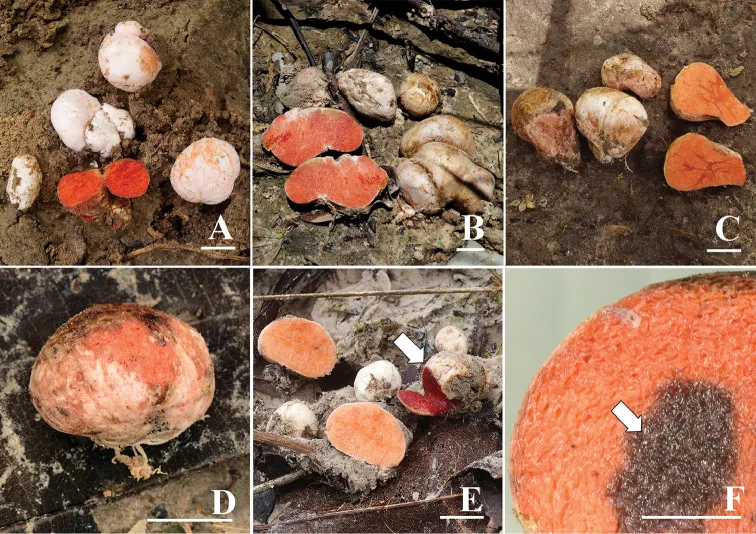
Basidiomata of Rhodactina rostratispora A S. Vadthanarat 170 (holotype) B S. Vadthanarat 206 C S. Vadthanarat 208 D O. Raspé 1055 E S. Vadthanarat 406, showing one basidioma (white arrow) that had a strong fruity alcoholic smell F Hymenophore turned dark purple to greyish violet with 5% KOH (white arrow). Scale bars: A–E = 1 cm; F =0.5 cm.
- Jenis
- Pelat ilmiah
- Kredit
- Santhiti Vadthanarat, Olivier Raspé, Saisamorn Lumyong
- Lisensi
- CC BY 4.0
- Sumber media
- Buka entri sumber
Dokumentasi tambahan
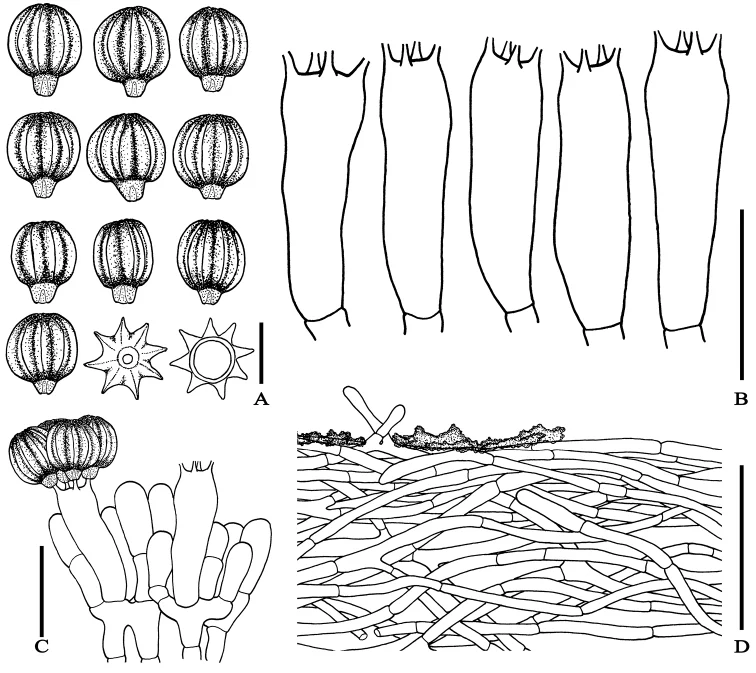
Microscopic features of Rhodactina rostratispora A Basidiospores in side view, polar view and optical section B Basidia C Hymenium showing basidia and basidioles D Peridiopellis covered with some encrustations. All drawings were made from the type. Scale bars: A = 10 µm; B–C = 20 µm; D = 50 µm.
Kredit dan penggunaan
Santhiti Vadthanarat, Olivier Raspé, Saisamorn Lumyong
Ukuran dan format gambar disesuaikan tanpa pemotongan, retus, atau penambahan skala. Lisensi sumber dipertahankan.
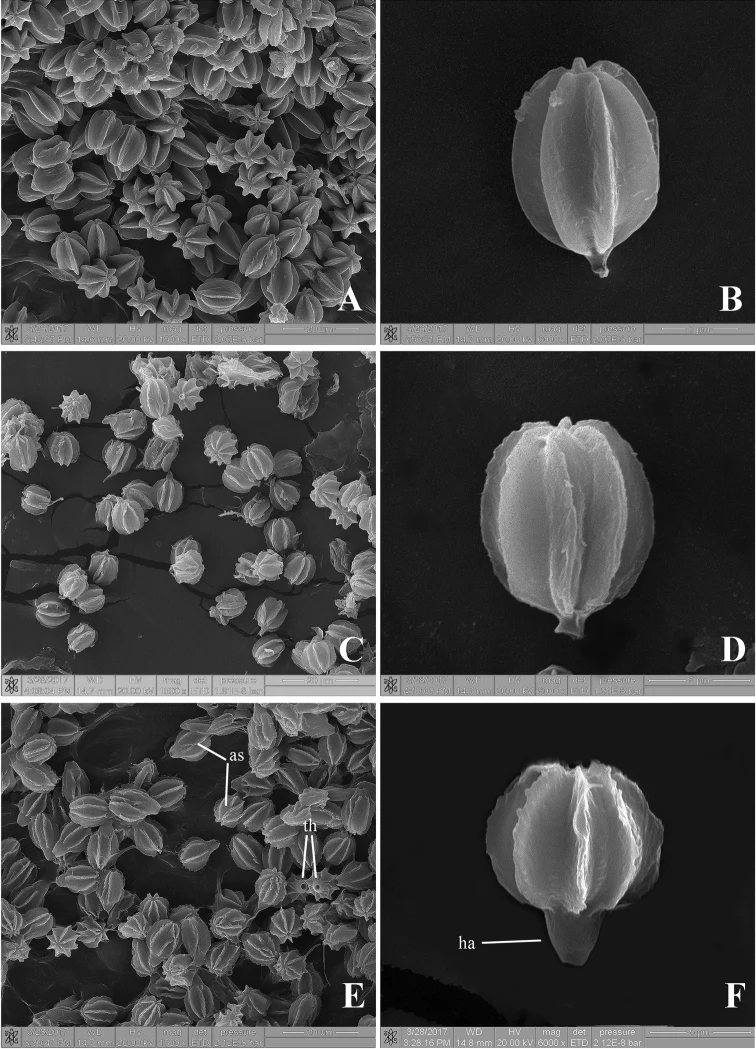
Scanning electron micrographs of basidiospores A–B Rhodactina himalayensis (CMU25117) showing the basidiospores with 6–7 longitudinal ridges C–D Rhodactina incarnata (CMU25116, holotype) showing the basidiospores with 8–9 longitudinal ridges E–F Rhodactina rostratispora (O. Raspé 1055) showing the basidiospores with 8–9 longitudinal ridges, the wide and prominent hilar appendage (ha), a terminal hilum (th) and anastomosing ridges in some spores (as).
Kredit dan penggunaan
Santhiti Vadthanarat, Olivier Raspé, Saisamorn Lumyong
Ukuran dan format gambar disesuaikan tanpa pemotongan, retus, atau penambahan skala. Lisensi sumber dipertahankan.
Sumber profil
- [1] Phylogenetic affinities of the sequestrate genus Rhodactina (Boletaceae), with a new species, R. rostratispora from Thailand — Rhodactina rostratispora
- [2] Catalogue of Life Base2026-09-11 — Rhodactina rostratispora
- [3] Dokumentasi visual — Rhodactina rostratispora
- [4] Dokumentasi visual — Rhodactina rostratispora
- [5] Dokumentasi visual — Rhodactina rostratispora
Rujukan halaman ini
Fungi. Rhodactina rostratispora. Rilis data fungi-2026-10-12-expansion-2. https://fungi-atlas.mgadib.chatgpt.site/jamur/rhodactina-rostratispora/.
Status: impor sumber; pemeriksaan editorial per profil belum selesai. Untuk klaim biologis, gunakan rujukan pada bagian terkait dan periksa konteks sumber aslinya.