Ciri dan struktur
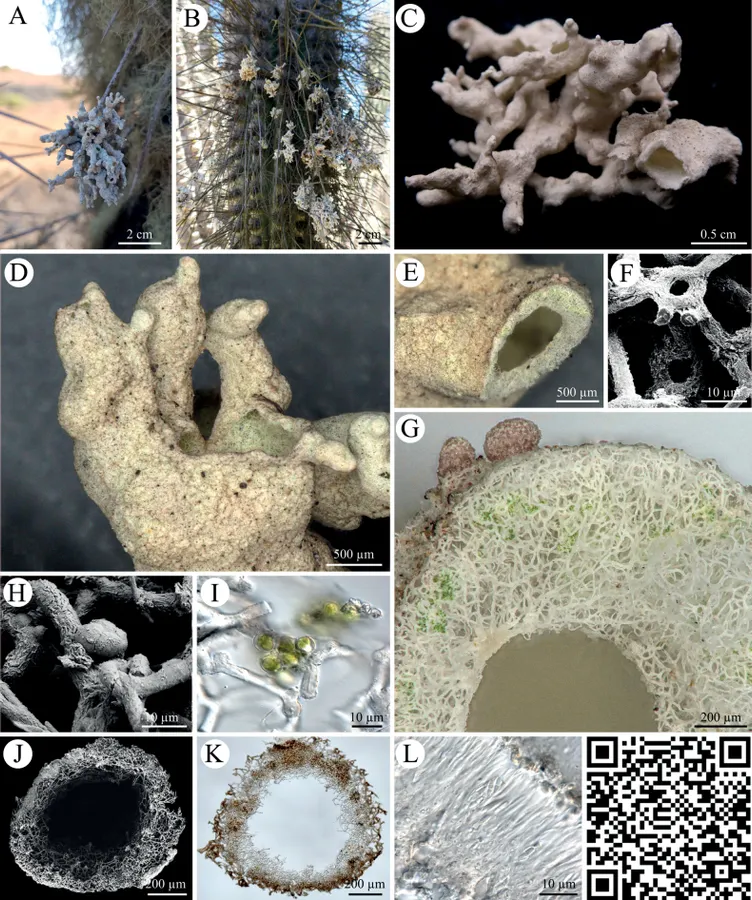
Thallus usually 2 cm large but specimens up to 7 cm were observed, gray to brownish gray, sub- fruticose, byssoid-spongiose or cottony-granular. Lobes tubular, up to 20 mm long or longer, cylindrical and up to 5 mm broad or flattened and up to 6 mm broad, partly fenestrate in older parts. Young thalli at first as erect tufts developing to hollow tubes covered with white to light pink or brownish apothecia which are laminal, up to 0.5 mm broad, frequently compound, sessile or shortly stipitate. Hymenium 35–45 µm high, paraphyses branched, hypothecium colorless. Asci 26–35 × 8–10 µm, spores 1-septate at maturity, 7.5–10 × 1.5–3 µm. Excipulum of (often dichotomously) branched, radiating hyphae with strongly gelatinized walls, colorless, not sharply delimited from the paraphyses. Single hyphae often form loop structures in inner thallus parts. Thallus hyphae 3–9 µm wide, lumina ca. 1 µm thick. Cell lumina elongated or short, the ends sometimes characteristically enlarged adjacent to septa. Cells of the Symbiochloris photobionts (= ‘micareoid’) of 8–10 µm in diameter, arranged in nests of several cells.
Habitat dan peran ekologis
The endemic species grows epiphytically on downwards pointing needles mainly of the cactus Eulychnia sp. along the Coastal Range of the Atacama Desert of Chile where fog frequently occurs.
- Habitat atau konteks temuan
- Informasi belum tersedia pada sumber rilis ini.
- Substrat
- Informasi belum tersedia pada sumber rilis ini.
- Peran atau konteks
- Pembentuk liken
Reproduksi
Thallus usually 2 cm large but specimens up to 7 cm were observed, gray to brownish gray, sub- fruticose, byssoid-spongiose or cottony-granular. Lobes tubular, up to 20 mm long or longer, cylindrical and up to 5 mm broad or flattened and up to 6 mm broad, partly fenestrate in older parts. Young thalli at first as erect tufts developing to hollow tubes covered with white to light pink or brownish apothecia which are laminal, up to 0.5 mm broad, frequently compound, sessile or shortly stipitate. Hymenium 35–45 µm high, paraphyses branched, hypothecium colorless. Asci 26–35 × 8–10 µm, spores 1-septate at maturity, 7.5–10 × 1.5–3 µm. Excipulum of (often dichotomously) branched, radiating hyphae with strongly gelatinized walls, colorless, not sharply delimited from the paraphyses.
Catatan identitas dan cakupan
- Nama diterima mengikuti Catalogue of Life Base2026-09-11; uraian mempertahankan konsep dan nama sumber aslinya.
- Preserve original treatment localities, hosts and substrate scope. Materials examined describe documented specimens, not the full global range.
- Impor dan terjemahan otomatis belum diperiksa editorial per profil. Struktur reproduktif yang disebutkan tidak membuktikan seluruh siklus hidup diketahui.
- Pengukuran pada uraian mengikuti spesimen, kultur, dan metode sumber; angka tidak diperluas ke semua populasi.
Catatan distribusi dalam narasi mengikuti sumbernya. Dokumentasi spesimen atau foto mengikuti catatan sumber. Bukti wilayah Indonesia dan penilaian konservasi tidak disimpulkan dari gambar.
Melihat dengan konteks
Roccellinastrum spongoideum A, B photographs showing R. spongoideum on the downfacing cactus needles of different Eulychnia cacti in the National Park Pan de Azucar C photograph of byssoid lichen thallus D, E close-up of byssoid thallus showing the coarse hyphal structure F SEM image of hyphal loops G close-up of a cross section with a loose hyphal network, patchy arrangement of photobionts and pink apothecia H SEM image of four ‘micareoid’ photobionts on fungal hyphae I light microscopy of micareoid photobionts with large vacuole-like structures J, K SEM image and light microscopy of the lichen thallus L microscopic cross section through apothecium with two-celled spores divided by a septum. QR code redirects to 3D scan of R. spongoideum. PW: Lichen.
- Jenis
- Pelat ilmiah
- Kredit
- Patrick Jung, Lina Werner, Laura Briegel-Williams, Dina Emrich, Michael Lakatos
- Lisensi
- CC BY 4.0
- Sumber media
- Buka entri sumber
Sumber profil
- [1] Roccellinastrum, Cenozosia and Heterodermia: Ecology and phylogeny of fog lichens and their photobionts from the coastal Atacama Desert — Roccellinastrum spongoideum
- [2] Catalogue of Life Base2026-09-11 — Roccellinastrum spongoideum
- [3] Dokumentasi visual — Roccellinastrum spongoideum
Rujukan halaman ini
Fungi. Roccellinastrum spongoideum. Rilis data fungi-2026-10-12-expansion-2. https://fungi-atlas.mgadib.chatgpt.site/jamur/roccellinastrum-spongoideum/.
Status: impor sumber; pemeriksaan editorial per profil belum selesai. Untuk klaim biologis, gunakan rujukan pada bagian terkait dan periksa konteks sumber aslinya.