01 / Morfologi

Ciri dan struktur

Species characterised by granular-isidiate thallus, pale grey to grey-beige apothecia, 0–1-septate, ovoid, ellipsoidal or oblong ascospores measuring 7–13 × 3.5–4.5 μm and the presence of micareic acid. Thallus crustose, granular-isidiate, indeterminate, endosubstratal to rarely episubstratal in non-isidiate parts and then as a thin greenish film over the substrate or minutely areolate, isidiate; prothallus not seen; areoles up to 0.05 mm in diam., green, soon developing isidia; isidia abundantly branched and coralloid, crowded and forming an almost continuous layer locally over the substrate, but in younger parts of thalli separated, green to olive green (Sedifolia-grey, K+ violet), up to 250 μm tall and 25 μm wide, with a distinct and complete hyphal layer; apothecia rarely developed, white to beige, some patchily grey, up to 0.45 mm in diam., convex; excipulum poorly developed, as a narrow, hyaline zone, hyphae radiating, branched and anastomosing; hymenium up to 50 μm tall, hyaline; epihymenium and hypothecium hyaline; paraphyses of one type, 1–1.5 μm thick, sparse, mostly apically branched and anastomosed, hyaline throughout; asci cylindrical-clavate, 30–45 × 12–15 μm, 8-spored; ascospores, 0–1-septate, ovoid, ellipsoidal or oblong, 11–14 × 3.5–4.5 μm; pycnidia not seen; crystalline granules (studied in polarised light) present rather sparsely in hymenium (as strands between asci and paraphyses) and abundantly in isidia, soluble in K. Photobiont chlorococcoid, micareoid, cells globose to ellipsoidal, 4–7 μm in diam.

Sebagian uraian ditampilkan dalam bahasa sumber; terjemahannya belum tersedia atau belum lolos pemeriksaan.

Rujukan: [1]

Pengukuran mengikuti objek, spesimen atau kultur, dan metode yang disebutkan sumber. Baca uraian asli untuk konteks lengkap.

02 / Kehidupan

Habitat dan peran ekologis

The species grows on wood (decomposing logs) and acidic bark of trees in various forest communities in well preserved forest. To date, it is known from Belgium, Germany, France, Poland and Romania.

Sebagian uraian ditampilkan dalam bahasa sumber; terjemahannya belum tersedia atau belum lolos pemeriksaan.

Rujukan: [1]

Habitat atau konteks temuan
hutan
Substrat
kayu
Peran atau konteks
Pembentuk liken
Temukan hubungan serupa
03 / Siklus hidup

Reproduksi

Species characterised by granular-isidiate thallus, pale grey to grey-beige apothecia, 0–1-septate, ovoid, ellipsoidal or oblong ascospores measuring 7–13 × 3.5–4.5 μm and the presence of micareic acid. Thallus crustose, granular-isidiate, indeterminate, endosubstratal to rarely episubstratal in non-isidiate parts and then as a thin greenish film over the substrate or minutely areolate, isidiate; prothallus not seen; areoles up to 0.05 mm in diam., green, soon developing isidia; isidia abundantly branched and coralloid, crowded and forming an almost continuous layer locally over the substrate, but in younger parts of thalli separated, green to olive green (Sedifolia-grey, K+ violet), up to 250 μm tall and 25 μm wide, with a distinct and complete hyphal layer; apothecia rarely developed, white to beige, some patchily grey, up to 0.45 mm in diam., convex; excipulum poorly developed, as a narrow, hyaline zone, hyphae radiating, branched and anastomosing; hymenium up to 50 μm tall, hyaline; epihymenium and hypothecium hyaline; paraphyses of one type, 1–1.5 μm thick, sparse, mostly apically branched and anastomosed, hyaline throughout; asci cylindrical-clavate, 30–45 × 12–15 μm, 8-spored; ascospores, 0–1-septate, ovoid, ellipsoidal or oblong, 11–14 × 3.5–4.5 μm; pycnidia not seen; crystalline granules (studied in polarised light) present rather sparsely in hymenium (as strands between asci and paraphyses) and abundantly in isidia, soluble in K.

Sebagian uraian ditampilkan dalam bahasa sumber; terjemahannya belum tersedia atau belum lolos pemeriksaan.

Rujukan: [1]

04 / Batas informasi

Catatan identitas dan cakupan

  • Nama diterima mengikuti Catalogue of Life Base2026-09-11; uraian mempertahankan konsep dan nama sumber aslinya.
  • Preserve original treatment localities, hosts and substrate scope. Materials examined describe documented specimens, not the full global range.
  • Impor dan terjemahan otomatis belum diperiksa editorial per profil. Struktur reproduktif yang disebutkan tidak membuktikan seluruh siklus hidup diketahui.
  • Pengukuran pada uraian mengikuti spesimen, kultur, dan metode sumber; angka tidak diperluas ke semua populasi.

Catatan distribusi dalam narasi mengikuti sumbernya. Dokumentasi spesimen atau foto mengikuti catatan sumber. Bukti wilayah Indonesia dan penilaian konservasi tidak disimpulkan dari gambar.

05 / Dokumentasi

Melihat dengan konteks

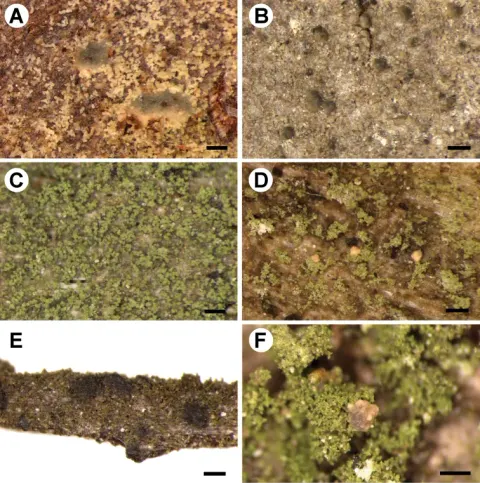
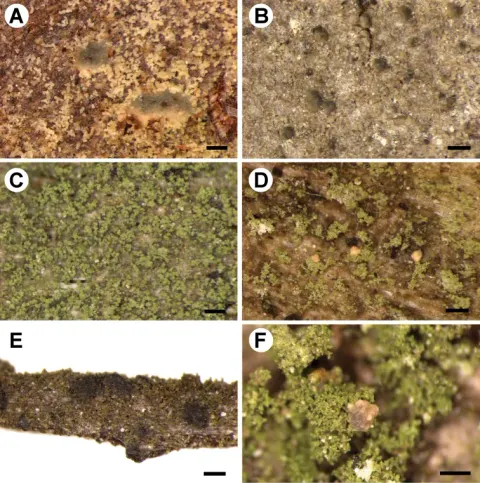
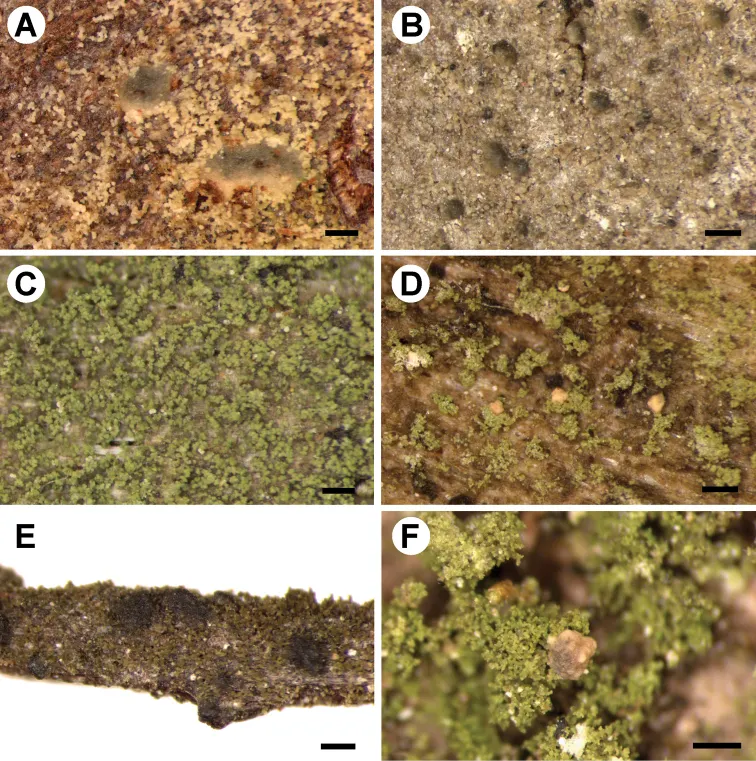
Morphology of newly described Micarea species A M. aeruginoprasina (holotype) B M. azorica (holotype) C M. isidioprasina (holotype) D M. microsorediata (holotype) E M. nigra (holotype) F M. pauli (holotype). Scale bars: 200 µm (A−C, E); 300 µm (D, F).

Jenis
Pelat ilmiah
Kredit
Beata Guzow-Krzemińska, Emmanuël Sérusiaux, Pieter P. G. van den Boom, A. Maarten Brand, Annina Launis, Anna Łubek, Martin Kukwa
Lisensi
CC BY 4.0
Sumber media
Buka entri sumber

Gambar menunjukkan objek menurut identifikasi sumber, bukan verifikasi independen spesimen oleh Fungi. Tidak ada skala baru yang ditambahkan.

06 / Rujukan

Sumber profil

  1. [1] Understanding the evolution of phenotypical characters in the Micarea prasina group (Pilocarpaceae) and descriptions of six new species within the group — Micarea isidioprasinaBagian sumber: PMC6685933_section_28
    Tanggal penghimpunan sumber: 2026-10-12
    Teks sumber: CC BY 4.0 · Guzow-Krzemińska B, Sérusiaux E, van den Boom PPG, Brand AM, Launis A, Łubek A, Kukwa M.
  2. [2] Catalogue of Life Base2026-09-11 — Micarea isidioprasinaBagian sumber: ColDP NameUsage.tsv ID 42LR9; accepted species; source 2073
    Tanggal penghimpunan sumber: 2026-10-12
  3. [3] Dokumentasi visual — Micarea isidioprasinaBagian sumber: Individual media record; identification follows the source, not independent determination
    Tanggal penghimpunan sumber: 2026-10-12
    Media sumber: CC BY 4.0 · Beata Guzow-Krzemińska, Emmanuël Sérusiaux, Pieter P. G. van den Boom, A. Maarten Brand, Annina Launis, Anna Łubek, Martin Kukwa

Adaptasi teks: CC BY 4.0. Guzow-Krzemińska B, Sérusiaux E, van den Boom PPG, Brand AM, Launis A, Łubek A, Kukwa M. — Understanding the evolution of phenotypical characters in the Micarea prasina group (Pilocarpaceae) and descriptions of six new species within the group — Micarea isidioprasina

Uraian asli dan riwayat sumber

Riwayat atau halaman sumber

Ringkasan sumber

Species characterised by granular-isidiate thallus, pale grey to grey-beige apothecia, 0–1-septate, ovoid, ellipsoidal or oblong ascospores measuring 7–13 × 3.5–4.5 μm and the presence of micareic acid. Thallus crustose, granular-isidiate, indeterminate, endosubstratal to rarely episubstratal in non-isidiate parts and then as a thin greenish film over the substrate or minutely areolate, isidiate; prothallus not seen; areoles up to 0.05 mm in diam., green, soon developing isidia; isidia abundantly branched and coralloid, crowded and forming an almost continuous layer locally over the substrate, but in younger parts of thalli separated, green to olive green (Sedifolia-grey, K+ violet), up to 250 μm tall and 25 μm wide, with a distinct and complete hyphal layer; apothecia rarely developed, white to beige, some patchily grey, up to 0.45 mm in diam., convex; excipulum poorly developed, as a narrow, hyaline zone, hyphae radiating, branched and anastomosing; hymenium up to 50 μm tall, hyaline; epihymenium and hypothecium hyaline; paraphyses of one type, 1–1.5 μm thick, sparse, mostly apically branched and anastomosed, hyaline throughout; asci cylindrical-clavate, 30–45 × 12–15 μm, 8-spored; ascospores, 0–1-septate, ovoid, ellipsoidal or oblong, 11–14 × 3.5–4.5 μm; pycnidia not seen; crystalline granules (studied in polarised light) present rather sparsely in hymenium (as strands between asci and paraphyses) and abundantly in isidia, soluble in K.

Revisi sumber

Morfologi sumber

Species characterised by granular-isidiate thallus, pale grey to grey-beige apothecia, 0–1-septate, ovoid, ellipsoidal or oblong ascospores measuring 7–13 × 3.5–4.5 μm and the presence of micareic acid. Thallus crustose, granular-isidiate, indeterminate, endosubstratal to rarely episubstratal in non-isidiate parts and then as a thin greenish film over the substrate or minutely areolate, isidiate; prothallus not seen; areoles up to 0.05 mm in diam., green, soon developing isidia; isidia abundantly branched and coralloid, crowded and forming an almost continuous layer locally over the substrate, but in younger parts of thalli separated, green to olive green (Sedifolia-grey, K+ violet), up to 250 μm tall and 25 μm wide, with a distinct and complete hyphal layer; apothecia rarely developed, white to beige, some patchily grey, up to 0.45 mm in diam., convex; excipulum poorly developed, as a narrow, hyaline zone, hyphae radiating, branched and anastomosing; hymenium up to 50 μm tall, hyaline; epihymenium and hypothecium hyaline; paraphyses of one type, 1–1.5 μm thick, sparse, mostly apically branched and anastomosed, hyaline throughout; asci cylindrical-clavate, 30–45 × 12–15 μm, 8-spored; ascospores, 0–1-septate, ovoid, ellipsoidal or oblong, 11–14 × 3.5–4.5 μm; pycnidia not seen; crystalline granules (studied in polarised light) present rather sparsely in hymenium (as strands between asci and paraphyses) and abundantly in isidia, soluble in K. Photobiont chlorococcoid, micareoid, cells globose to ellipsoidal, 4–7 μm in diam.

Revisi sumber

Ekologi sumber

The species grows on wood (decomposing logs) and acidic bark of trees in various forest communities in well preserved forest. To date, it is known from Belgium, Germany, France, Poland and Romania.

Revisi sumber

Struktur reproduksi sumber

Species characterised by granular-isidiate thallus, pale grey to grey-beige apothecia, 0–1-septate, ovoid, ellipsoidal or oblong ascospores measuring 7–13 × 3.5–4.5 μm and the presence of micareic acid. Thallus crustose, granular-isidiate, indeterminate, endosubstratal to rarely episubstratal in non-isidiate parts and then as a thin greenish film over the substrate or minutely areolate, isidiate; prothallus not seen; areoles up to 0.05 mm in diam., green, soon developing isidia; isidia abundantly branched and coralloid, crowded and forming an almost continuous layer locally over the substrate, but in younger parts of thalli separated, green to olive green (Sedifolia-grey, K+ violet), up to 250 μm tall and 25 μm wide, with a distinct and complete hyphal layer; apothecia rarely developed, white to beige, some patchily grey, up to 0.45 mm in diam., convex; excipulum poorly developed, as a narrow, hyaline zone, hyphae radiating, branched and anastomosing; hymenium up to 50 μm tall, hyaline; epihymenium and hypothecium hyaline; paraphyses of one type, 1–1.5 μm thick, sparse, mostly apically branched and anastomosed, hyaline throughout; asci cylindrical-clavate, 30–45 × 12–15 μm, 8-spored; ascospores, 0–1-septate, ovoid, ellipsoidal or oblong, 11–14 × 3.5–4.5 μm; pycnidia not seen; crystalline granules (studied in polarised light) present rather sparsely in hymenium (as strands between asci and paraphyses) and abundantly in isidia, soluble in K.

Revisi sumber

Rujukan halaman ini

Fungi. Micarea isidioprasina. Rilis data fungi-2026-10-12-expansion-2. https://fungi-atlas.mgadib.chatgpt.site/jamur/micarea-isidioprasina/.

Status: impor sumber; pemeriksaan editorial per profil belum selesai. Untuk klaim biologis, gunakan rujukan pada bagian terkait dan periksa konteks sumber aslinya.