Ciri dan struktur
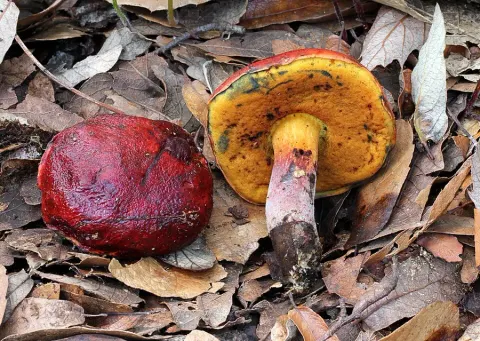
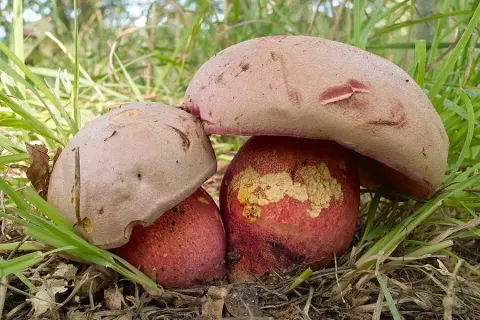
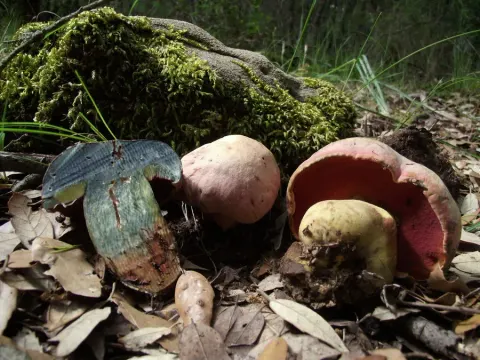
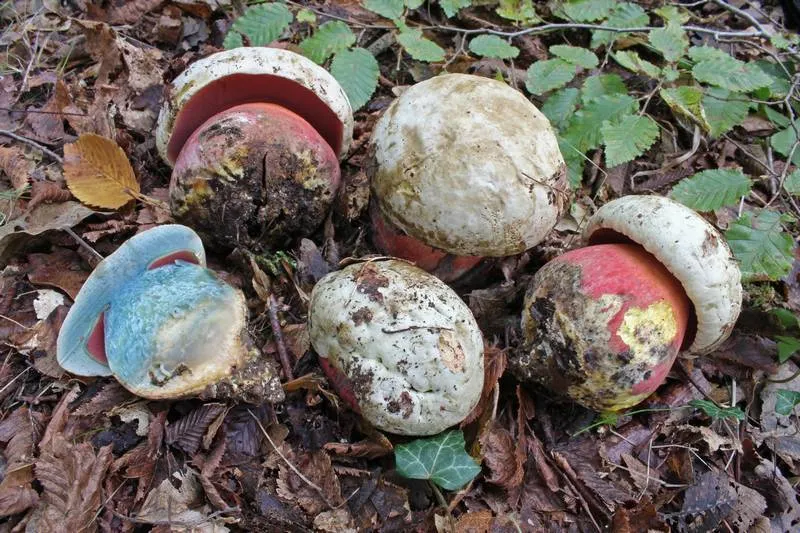
The compact cap can reach an impressive 30 cm, exceptionally 40 cm, and very rarely 50 cm in diameter. It is arguably the largest bolete found in Europe. At first it is hemispherical with an inrolled margin, but becomes convex at maturity as the fruit body expands, while in older specimens the margin might be slightly undulating. When young, the pileus is greyish white to silvery-white or buff, but older specimens tend to develop olivaceous, ochraceous or brownish tinges. The surface of the cap is finely tomentose, becoming smooth at maturity and is often slightly viscid in wet weather. The cuticle is tightly attached to the flesh and does not peel. The spore print is olivaceous green. The spores are fusiform (spindle-shaped) when viewed under a microscope and measure 10–16 × 4.5–7.5 μm. The cap cuticle is composed of interwoven septate hyphae, which are often finely incrusted.
Habitat dan peran ekologis
Rubroboletus satanas is widely distributed throughout the temperate zone, but is rare in most of its reported localities. In Europe, it mostly occurs in the southern regions and is rare or absent in northern countries. It fruits in the summer and early autumn in warm, broad-leaved and mixed forests, forming ectomycorrhizal associations with oak (Quercus) and sweet chestnut (Castanea), with a preference for calcareous (chalky) soils. Other frequently reported hosts are hornbeam (Carpinus), beech (Fagus) and lime and linden trees (Tilia). It is rare in Scandinavia, occurring primarily on a few islands in the Baltic Sea where conditions are favourable, with highly calcareous soil. as well as Crimea and Ukraine, with its distribution possibly extending as far south as Iran. but these sightings are instead of the closely related species Rubroboletus eastwoodiae.
- Habitat atau konteks temuan
- hutan
- Substrat
- Informasi belum tersedia pada sumber rilis ini.
- Peran atau konteks
- Mitra tumbuhan
Reproduksi
The compact cap can reach an impressive 30 cm, exceptionally 40 cm, and very rarely 50 cm in diameter. It is arguably the largest bolete found in Europe. At first it is hemispherical with an inrolled margin, but becomes convex at maturity as the fruit body expands, while in older specimens the margin might be slightly undulating. When young, the pileus is greyish white to silvery-white or buff, but older specimens tend to develop olivaceous, ochraceous or brownish tinges. The surface of the cap is finely tomentose, becoming smooth at maturity and is often slightly viscid in wet weather. The cuticle is tightly attached to the flesh and does not peel. The spore print is olivaceous green. The spores are fusiform (spindle-shaped) when viewed under a microscope and measure 10–16 × 4.5–7.5 μm.
Catatan identitas dan cakupan
- Nama diterima mengikuti Catalogue of Life Base2026-09-11; uraian mempertahankan konsep dan nama sumber aslinya.
- Original geographic, specimen and life-cycle scope retained; source import awaits individual editorial review.
- Impor dan terjemahan otomatis belum diperiksa editorial per profil. Struktur reproduktif yang disebutkan tidak membuktikan seluruh siklus hidup diketahui.
- Pengukuran pada uraian mengikuti spesimen, kultur, dan metode sumber; angka tidak diperluas ke semua populasi.
Catatan distribusi dalam narasi mengikuti sumbernya. Dokumentasi spesimen atau foto mengikuti catatan sumber. Bukti wilayah Indonesia dan penilaian konservasi tidak disimpulkan dari gambar.
Melihat dengan konteks
Dokumentasi Rubroboletus satanas menurut asosiasi foto pada record takson iNaturalist. Kredit: Davide Puddu. Identitas mengikuti sumber; bukan penentuan spesimen independen.
- Jenis
- Fotografi
- Kredit
- (c) Davide Puddu, some rights reserved (CC BY), uploaded by Davide Puddu
- Lisensi
- CC BY 4.0
- Sumber media
- Buka entri sumber
Sumber profil
- [1] Rubroboletus satanas — Wikipedia (en)
- [2] Catalogue of Life Base2026-09-11 — Rubroboletus satanas
- [3] Dokumentasi visual — Rubroboletus satanas
Rujukan halaman ini
Fungi. Rubroboletus satanas. Rilis data fungi-2026-10-12-expansion-2. https://fungi-atlas.mgadib.chatgpt.site/jamur/rubroboletus-satanas/.
Status: impor sumber; pemeriksaan editorial per profil belum selesai. Untuk klaim biologis, gunakan rujukan pada bagian terkait dan periksa konteks sumber aslinya.