Ciri dan struktur
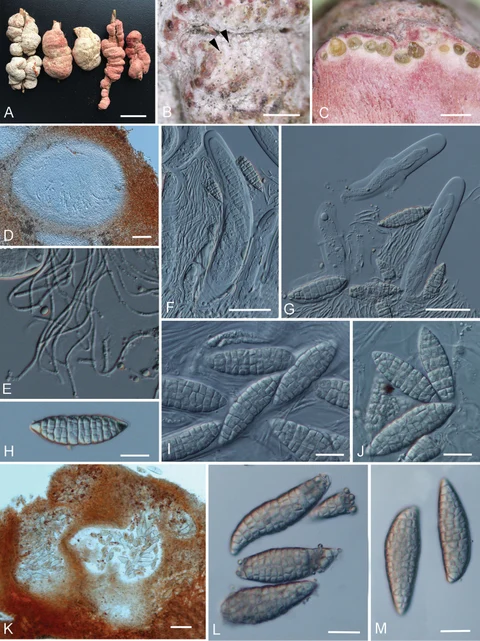
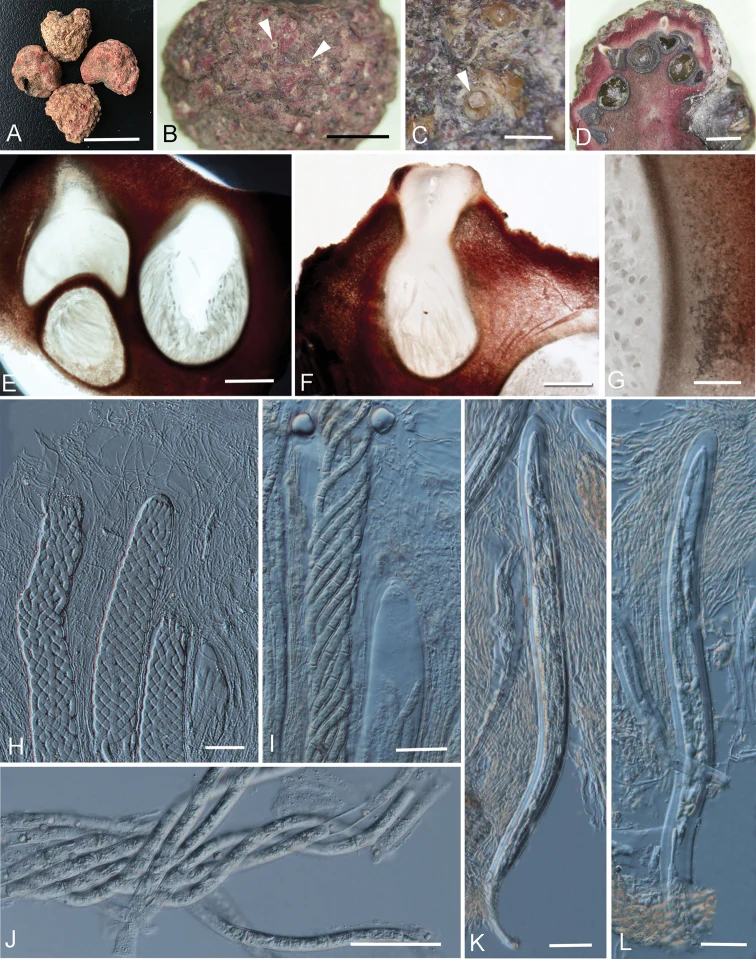
Parasitic on living branches of bamboo. Sexual morph: Ascostromata 0.7–1.5 cm long × 0.7–1.3 cm wide, solitary, superficial, globose to subglobose, fleshy, reddish, with locules lining the periphery, with dark ostiolate points appearing on the surface. Ascostromatic tissue thick, pinkish, composed of wider woven hyphae of textura intricata. Locules in vertical section 800–1800 µm high × 1000–2000 µm diam. (x̄ = 1289.4 ×1368.8 µm, n = 20), globose to subglobose, immersed in the periphery layer of ascostromata, with 250–500 µm wide × 450–550 µm high ostioles. Peridium 20–35 µm thick, composed of several layers of hyaline to dark brown, small cells of textura angularis to textura intricata. Hamathecium of interthecial, hyaline septate, branched pseudoparaphyses, 1–3 µm wide. Asci 660–800 × 45–55 µm (x̄ = 751.6 × 49.5 µm, n = 20), 8-spored, thick-walled, bitunicate, fissitunicate, cylindrical, short-pedicellate, with an ocular chamber. Ascospores 600–750 × 5.5–11 µm (x̄ = 728.8 × 9.1 µm, n = 20), spirally arranged in asci, filiform, hyaline, with 15–18 transverse septa, smooth-walled. Asexual morph: Undetermined.
Habitat dan peran ekologis
Parasitic on living branches of bamboo. Sexual morph: Ascostromata 0.7–1.5 cm long × 0.7–1.3 cm wide, solitary, superficial, globose to subglobose, fleshy, reddish, with locules lining the periphery, with dark ostiolate points appearing on the surface. Ascostromatic tissue thick, pinkish, composed of wider woven hyphae of textura intricata. Locules in vertical section 800–1800 µm high × 1000–2000 µm diam. (x̄ = 1289.4 ×1368.8 µm, n = 20), globose to subglobose, immersed in the periphery layer of ascostromata, with 250–500 µm wide × 450–550 µm high ostioles. Peridium 20–35 µm thick, composed of several layers of hyaline to dark brown, small cells of textura angularis to textura intricata. Hamathecium of interthecial, hyaline septate, branched pseudoparaphyses, 1–3 µm wide. Asci 660–800 × 45–55 µm (x̄ = 751.6 × 49.5 µm, n = 20), 8-spored, thick-walled, bitunicate, fissitunicate, cylindrical, short-pedicellate, with an ocular chamber. Ascospores 600–750 × 5.5–11 µm (x̄ = 728.8 × 9.1 µm, n = 20), spirally arranged in asci, filiform, hyaline, with 15–18 transverse septa, smooth-walled. Asexual morph: Undetermined. CHINA, Yunnan, Dali, on living branches of Fargesia spathacea Franch, 13 May 2017, Dong-Qin Dai, DDQ00411 (HKAS102255, holotype), Ibid. (HMAS 290447, isotype), Ibid.
- Habitat atau konteks temuan
- Informasi belum tersedia pada sumber rilis ini.
- Substrat
- Informasi belum tersedia pada sumber rilis ini.
- Peran atau konteks
- Belum dikategorikan pada rilis ini.
Reproduksi
Parasitic on living branches of bamboo. Sexual morph: Ascostromata 0.7–1.5 cm long × 0.7–1.3 cm wide, solitary, superficial, globose to subglobose, fleshy, reddish, with locules lining the periphery, with dark ostiolate points appearing on the surface. Ascostromatic tissue thick, pinkish, composed of wider woven hyphae of textura intricata. Locules in vertical section 800–1800 µm high × 1000–2000 µm diam. (x̄ = 1289.4 ×1368.8 µm, n = 20), globose to subglobose, immersed in the periphery layer of ascostromata, with 250–500 µm wide × 450–550 µm high ostioles. Peridium 20–35 µm thick, composed of several layers of hyaline to dark brown, small cells of textura angularis to textura intricata. Hamathecium of interthecial, hyaline septate, branched pseudoparaphyses, 1–3 µm wide.
Catatan identitas dan cakupan
- Nama diterima mengikuti Catalogue of Life Base2026-09-11; uraian mempertahankan konsep dan nama sumber aslinya.
- Preserve original treatment localities, hosts and substrate scope. Materials examined describe documented specimens, not the full global range.
- Impor dan terjemahan otomatis belum diperiksa editorial per profil. Struktur reproduktif yang disebutkan tidak membuktikan seluruh siklus hidup diketahui.
- Pengukuran pada uraian mengikuti spesimen, kultur, dan metode sumber; angka tidak diperluas ke semua populasi.
Catatan distribusi dalam narasi mengikuti sumbernya. Dokumentasi spesimen atau foto mengikuti catatan sumber. Bukti wilayah Indonesia dan penilaian konservasi tidak disimpulkan dari gambar.
Melihat dengan konteks
Rubroshiraia bambusae (HKAS102255, holotype) A fruiting bodies B, C surface of ascostromata showing the openings of ostiole D vertical section of ascostromata E, F vertical section of locule G peridium of locule H asci and pseudoparaphyses I asci and asci ocular chamber J ascospores K, L immature asci. Scale bars: 1 cm (A), 25 mm (B), 2 mm (C, D), 500 μm (E, F), 200 μm (G), 50 μm (H–L).
- Jenis
- Pelat ilmiah
- Kredit
- Dong-Qin Dai, Nalin N. Wijayawardene, Li-Zhou Tang, Chao Liu, Li-Hong Han, Hong-Long Chu, Hai-Bo Wang, Chun-Fang Liao, Er-Fu Yang, Rui-Fang Xu, Yun-Min Li, Kevin D. Hyde, D. Jayarama Bhat, Paul F. Cannon
- Lisensi
- CC BY 4.0
- Sumber media
- Buka entri sumber
Sumber profil
- [1] Rubroshiraia gen. nov., a second hypocrellin-producing genus in Shiraiaceae (Pleosporales) — Rubroshiraia bambusae
- [2] Catalogue of Life Base2026-09-11 — Rubroshiraia bambusae
- [3] Dokumentasi visual — Rubroshiraia bambusae
Rujukan halaman ini
Fungi. Rubroshiraia bambusae. Rilis data fungi-2026-10-12-expansion-2. https://fungi-atlas.mgadib.chatgpt.site/jamur/rubroshiraia-bambusae/.
Status: impor sumber; pemeriksaan editorial per profil belum selesai. Untuk klaim biologis, gunakan rujukan pada bagian terkait dan periksa konteks sumber aslinya.