Ciri dan struktur
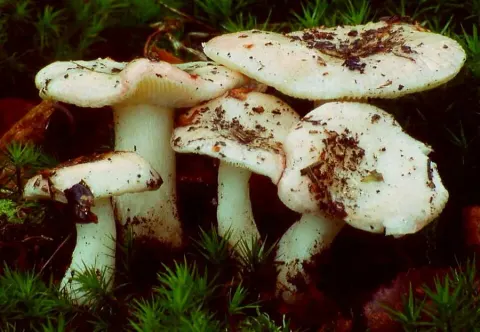
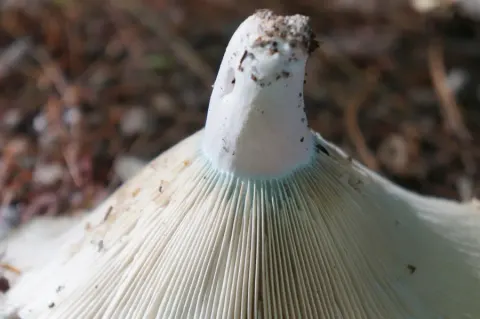
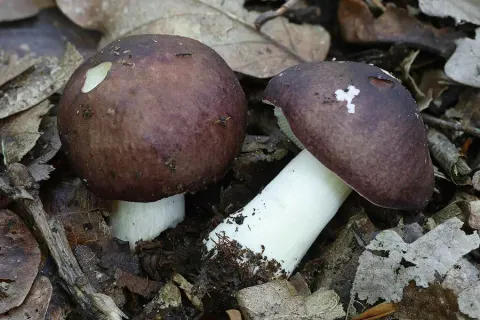
Pileus medium-sized, 20–50 mm diam., plano-convex to convex when young, applanate with depressed center to infundibuliform when mature, often lobate, margin with short striation, sometimes cracking in age; cuticle smooth, pruinose, viscid and shiny when wet, cuticle peeling approximately to half of the pileus radius or sometimes almost to the center, color variable, typically darker at the disk, greyish red (11D5), brownish violet (11D6) to bluish red (12A6-A8, 12B7), few with yellowish brown spots, margin pink (11A5) to greyish rose (11B5). Lamellae 2–3 mm deep, brittle, adnate, approximately 11–19 per cm near the pileus margin, moderately distant to crowded, yellowish white to pale cream; lamellulae absent; edge entire and concolorous. Stipe 17–34 × 5–9 mm, centrally attached or eccentric, cylindrical to slightly tapered towards the base, surface dry, longitudinally striate, whitish with a pinkish flush; solid when young, becoming hollow in age. Context 1–3 mm thick near the stipe, white, unchanging after cutting, turning greenish with FeSO 4, turning quickly yellow with KOH, pale violet with PDAB; taste mild; odor slightly fruity. Spore print pale cream to white. Basidiospores (n = 60, 3, 3) (6–)6.5–7.1–7.7(–8.8) × (5–)5.3–5.7–6(–6.6) µm, broadly ellipsoid, Q = (1.11–)1.17–1.25–1.33(–1.49), ornamentation thin, 0.4–1 µm high ridges forming an incomplete reticulum (2–7 in a 3 µm circle) with some dispersed isolated warts (0–2 warts in a 3 µm circle), suprahilar spot not amyloid, smooth. Basidia (25.1–)30–35.3–40.5(–48) × (7–)8.5–9.4–10.5(–11.5) µm, 4-spored, narrowly clavate, with guttate or granular contents.
Habitat dan peran ekologis
gregarious to scattered on soil in mixed forest with Quercus aliena, Pinus densiflora, and Populus sp.
- Habitat atau konteks temuan
- hutan
- Substrat
- tanah
- Peran atau konteks
- Belum dikategorikan pada rilis ini.
Reproduksi
Pileus medium-sized, 20–50 mm diam., plano-convex to convex when young, applanate with depressed center to infundibuliform when mature, often lobate, margin with short striation, sometimes cracking in age; cuticle smooth, pruinose, viscid and shiny when wet, cuticle peeling approximately to half of the pileus radius or sometimes almost to the center, color variable, typically darker at the disk, greyish red (11D5), brownish violet (11D6) to bluish red (12A6-A8, 12B7), few with yellowish brown spots, margin pink (11A5) to greyish rose (11B5). Lamellae 2–3 mm deep, brittle, adnate, approximately 11–19 per cm near the pileus margin, moderately distant to crowded, yellowish white to pale cream; lamellulae absent; edge entire and concolorous.
Catatan identitas dan cakupan
- Nama diterima mengikuti Catalogue of Life Base2026-09-11; uraian mempertahankan konsep dan nama sumber aslinya.
- Preserve original treatment localities, hosts and substrate scope. Materials examined describe documented specimens, not the full global range.
- Impor dan terjemahan otomatis belum diperiksa editorial per profil. Struktur reproduktif yang disebutkan tidak membuktikan seluruh siklus hidup diketahui.
- Pengukuran pada uraian mengikuti spesimen, kultur, dan metode sumber; angka tidak diperluas ke semua populasi.
Catatan distribusi dalam narasi mengikuti sumbernya. Dokumentasi spesimen atau foto mengikuti catatan sumber. Bukti wilayah Indonesia dan penilaian konservasi tidak disimpulkan dari gambar.
Melihat dengan konteks
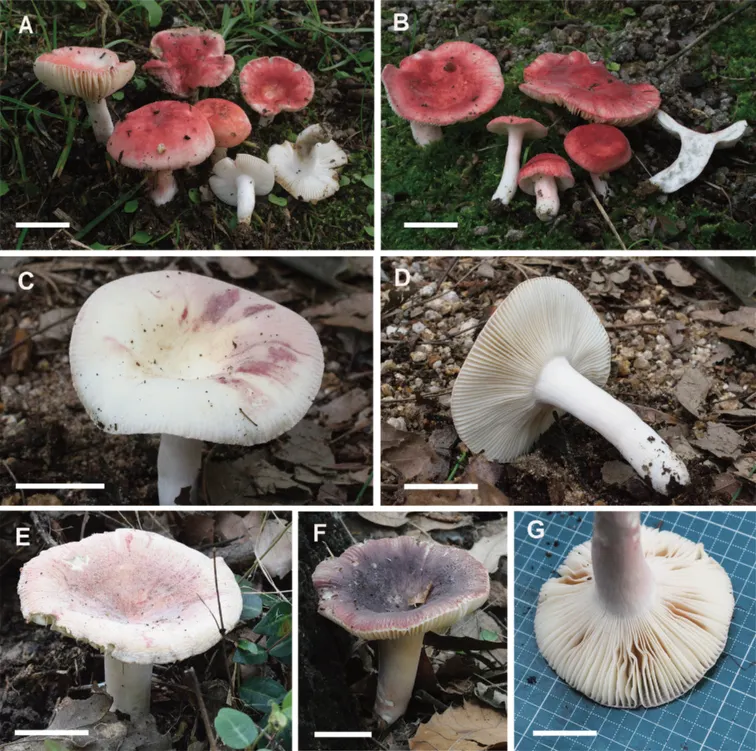
Basidiomes of Korean Amoeninae from this study. A, B Russula bella (A-SFC20170802-03, B-SFC20170819-05) C–E R. orientipurpurea (SFC20170819-08) F, G Russula sp. (SFC20160726-13). Scale bars: 20 mm.
- Jenis
- Pelat ilmiah
- Kredit
- Komsit Wisitrassameewong, Myung Soo Park, Hyun Lee, Aniket Ghosh, Kanad Das, Bart Buyck, Brian P. Looney, Miroslav Caboň, Slavomír Adamčík, Changmu Kim, Chang Sun Kim, Young Woon Lim
- Lisensi
- CC BY 4.0
- Sumber media
- Buka entri sumber
Dokumentasi tambahan
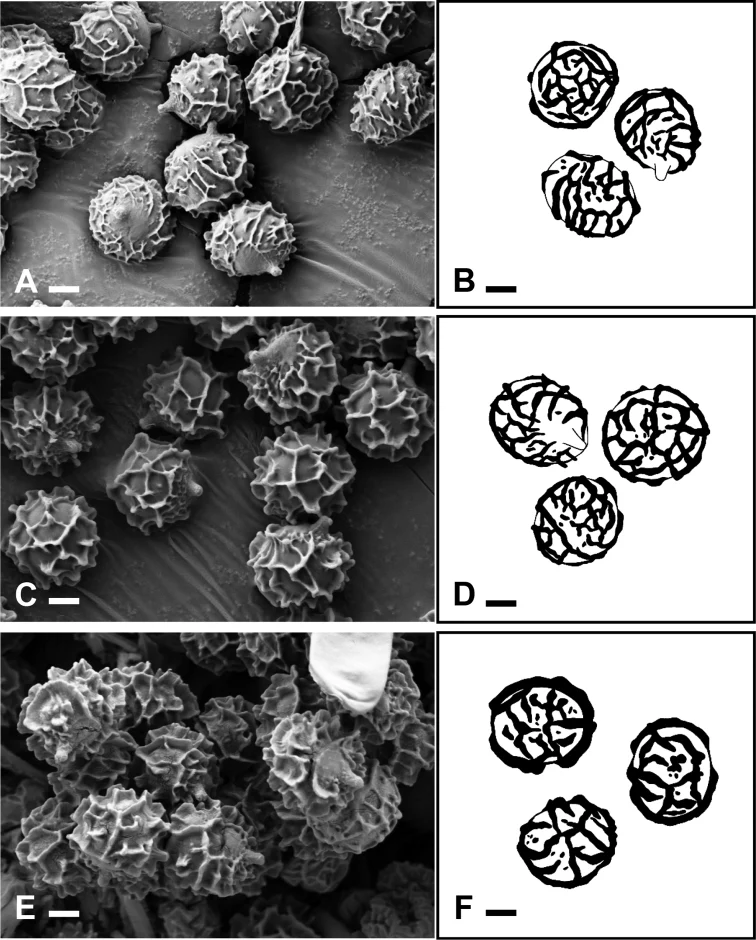
Basidiospores with scanning electron microscopy images (A, C, E) and drawing images (B, D, F) A, B Russula bella (SFC20170819-05) C, D R. orientipurpurea; (SFC20170821-22b) E, F Russula sp. (SFC20160726-13). Scale bars: 2 µm.
Kredit dan penggunaan
Komsit Wisitrassameewong, Myung Soo Park, Hyun Lee, Aniket Ghosh, Kanad Das, Bart Buyck, Brian P. Looney, Miroslav Caboň, Slavomír Adamčík, Changmu Kim, Chang Sun Kim, Young Woon Lim
Ukuran dan format gambar disesuaikan tanpa pemotongan, retus, atau penambahan skala. Lisensi sumber dipertahankan.
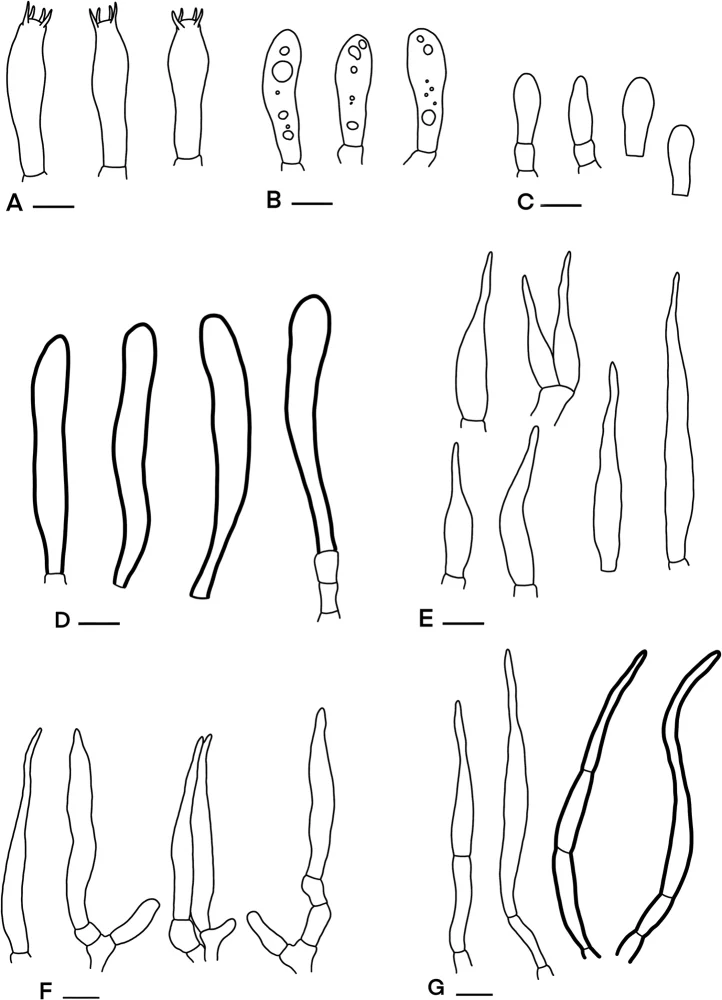
Microscopic features of Russula bella (SFC20170819-05) A basidia B basidiola C clavate marginal cells D hymenial cystidia on lamellae sides E subulate marginal cells F hyphal termination at pileus margin G hyphal termination at pileus centre. Scale bars: 10 µm.
Kredit dan penggunaan
Komsit Wisitrassameewong, Myung Soo Park, Hyun Lee, Aniket Ghosh, Kanad Das, Bart Buyck, Brian P. Looney, Miroslav Caboň, Slavomír Adamčík, Changmu Kim, Chang Sun Kim, Young Woon Lim
Ukuran dan format gambar disesuaikan tanpa pemotongan, retus, atau penambahan skala. Lisensi sumber dipertahankan.
Sumber profil
- [1] Taxonomic revision of Russula subsection Amoeninae from South Korea — Russula bella
- [2] Catalogue of Life Base2026-09-11 — Russula bella
- [3] Dokumentasi visual — Russula bella
- [4] Dokumentasi visual — Russula bella
- [5] Dokumentasi visual — Russula bella
Rujukan halaman ini
Fungi. Russula bella. Rilis data fungi-2026-10-12-expansion-2. https://fungi-atlas.mgadib.chatgpt.site/jamur/russula-bella/.
Status: impor sumber; pemeriksaan editorial per profil belum selesai. Untuk klaim biologis, gunakan rujukan pada bagian terkait dan periksa konteks sumber aslinya.