Ciri dan struktur
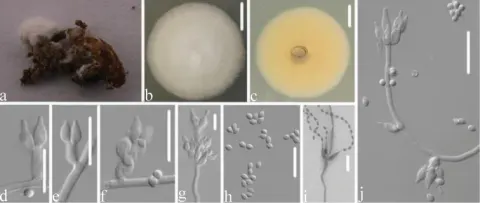
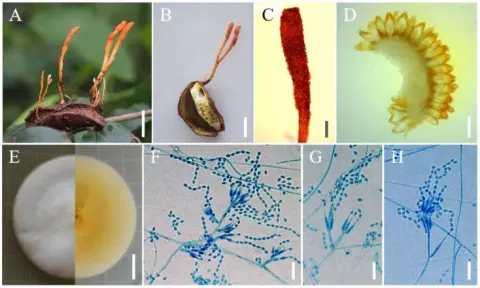
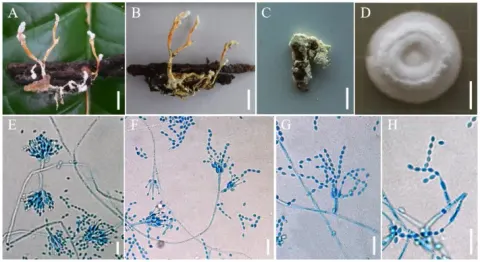
Differs from Samsoniella inthanonensis and S. aurantia by having smaller, fusiform to ovoid conidia and a host in the family Vespidae. Colonies on PDA, 6.2–6.4 cm diam. in 14 d at 25 °C, white, consisting of a basal felt and cottony, floccose hyphal overgrowth, reverse yellowish. Prostrate hyphae smooth, septate, hyaline, 1.1–1.6 μm diam. Erect conidiophores usually arising from aerial hyphae, Isaria -like with phialides in whorls of three to four. Phialides 6.5–10.6 × 1.2–2.0 μm, with a cylindrical basal portion, tapering to a distinct neck. Conidia in chains, hyaline, fusiform to ovoid, 1-celled, 1.9–2.5 × 1.5–2.1 μm. Chlamydospores and synnemata not observed. Size and shape of phialides and conidia similar in culture and on natural substratum. Sexual state not observed.
Habitat dan peran ekologis
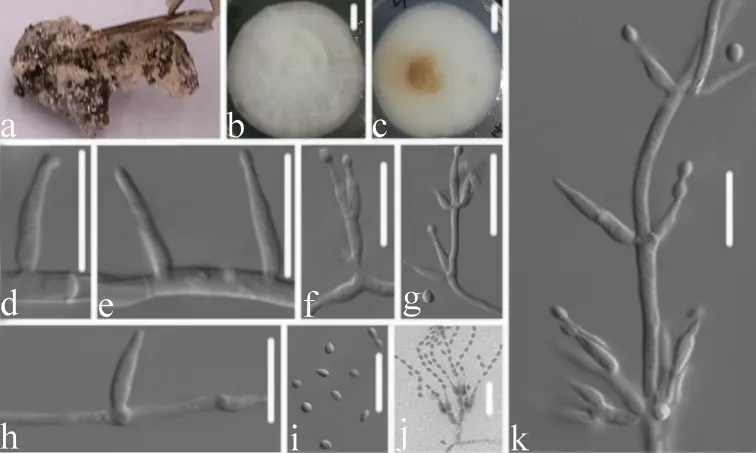
Colonies on PDA, 6.2–6.4 cm diam. in 14 d at 25 °C, white, consisting of a basal felt and cottony, floccose hyphal overgrowth, reverse yellowish. Prostrate hyphae smooth, septate, hyaline, 1.1–1.6 μm diam. Erect conidiophores usually arising from aerial hyphae, Isaria -like with phialides in whorls of three to four. Phialides 6.5–10.6 × 1.2–2.0 μm, with a cylindrical basal portion, tapering to a distinct neck. Conidia in chains, hyaline, fusiform to ovoid, 1-celled, 1.9–2.5 × 1.5–2.1 μm. Chlamydospores and synnemata not observed. Size and shape of phialides and conidia similar in culture and on natural substratum. Sexual state not observed.
- Habitat atau konteks temuan
- kultur yang didokumentasikan
- Substrat
- Informasi belum tersedia pada sumber rilis ini.
- Peran atau konteks
- Belum dikategorikan pada rilis ini.
Reproduksi
Differs from Samsoniella inthanonensis and S. aurantia by having smaller, fusiform to ovoid conidia and a host in the family Vespidae. Colonies on PDA, 6.2–6.4 cm diam. in 14 d at 25 °C, white, consisting of a basal felt and cottony, floccose hyphal overgrowth, reverse yellowish. Prostrate hyphae smooth, septate, hyaline, 1.1–1.6 μm diam. Erect conidiophores usually arising from aerial hyphae, Isaria -like with phialides in whorls of three to four. Phialides 6.5–10.6 × 1.2–2.0 μm, with a cylindrical basal portion, tapering to a distinct neck. Conidia in chains, hyaline, fusiform to ovoid, 1-celled, 1.9–2.5 × 1.5–2.1 μm. Chlamydospores and synnemata not observed. Size and shape of phialides and conidia similar in culture and on natural substratum.
Catatan identitas dan cakupan
- Nama diterima mengikuti Catalogue of Life Base2026-09-11; uraian mempertahankan konsep dan nama sumber aslinya.
- Preserve original treatment localities, hosts and substrate scope. Materials examined describe documented specimens, not the full global range.
- Impor dan terjemahan otomatis belum diperiksa editorial per profil. Struktur reproduktif yang disebutkan tidak membuktikan seluruh siklus hidup diketahui.
- Pengukuran pada uraian mengikuti spesimen, kultur, dan metode sumber; angka tidak diperluas ke semua populasi.
Catatan distribusi dalam narasi mengikuti sumbernya. Dokumentasi spesimen atau foto mengikuti catatan sumber. Bukti wilayah Indonesia dan penilaian konservasi tidak disimpulkan dari gambar.
Melihat dengan konteks
Samsoniella hymenopterorum A infected insect (Hymenoptera) B, C top (B) and underside (C) of a colony cultured on PDA medium at 14 d D–H, J phialides and conidia in chains K conidiophore and phialides I conidia. Scale bars: 10 mm (B, C); 10 μm (D–K).
- Jenis
- Pelat ilmiah
- Kredit
- Wan-Hao Chen, Yan-Feng Han, Jian-Dong Liang, Wei-Yi Tian, Zong-Qi Liang
- Lisensi
- CC BY 4.0
- Sumber media
- Buka entri sumber
Sumber profil
- [1] Morphological and phylogenetic characterisations reveal three new species of Samsoniella (Cordycipitaceae, Hypocreales) from Guizhou, China — Samsoniella hymenopterorum
- [2] Catalogue of Life Base2026-09-11 — Samsoniella hymenopterorum
- [3] Dokumentasi visual — Samsoniella hymenopterorum
Rujukan halaman ini
Fungi. Samsoniella hymenopterorum. Rilis data fungi-2026-10-12-expansion-2. https://fungi-atlas.mgadib.chatgpt.site/jamur/samsoniella-hymenopterorum/.
Status: impor sumber; pemeriksaan editorial per profil belum selesai. Untuk klaim biologis, gunakan rujukan pada bagian terkait dan periksa konteks sumber aslinya.