01 / Morfologi

Ciri dan struktur

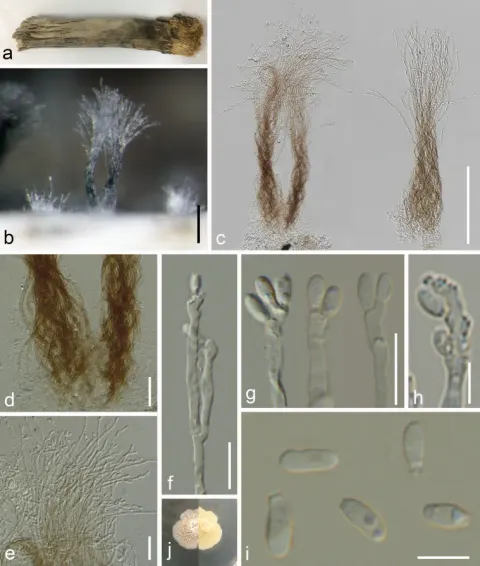
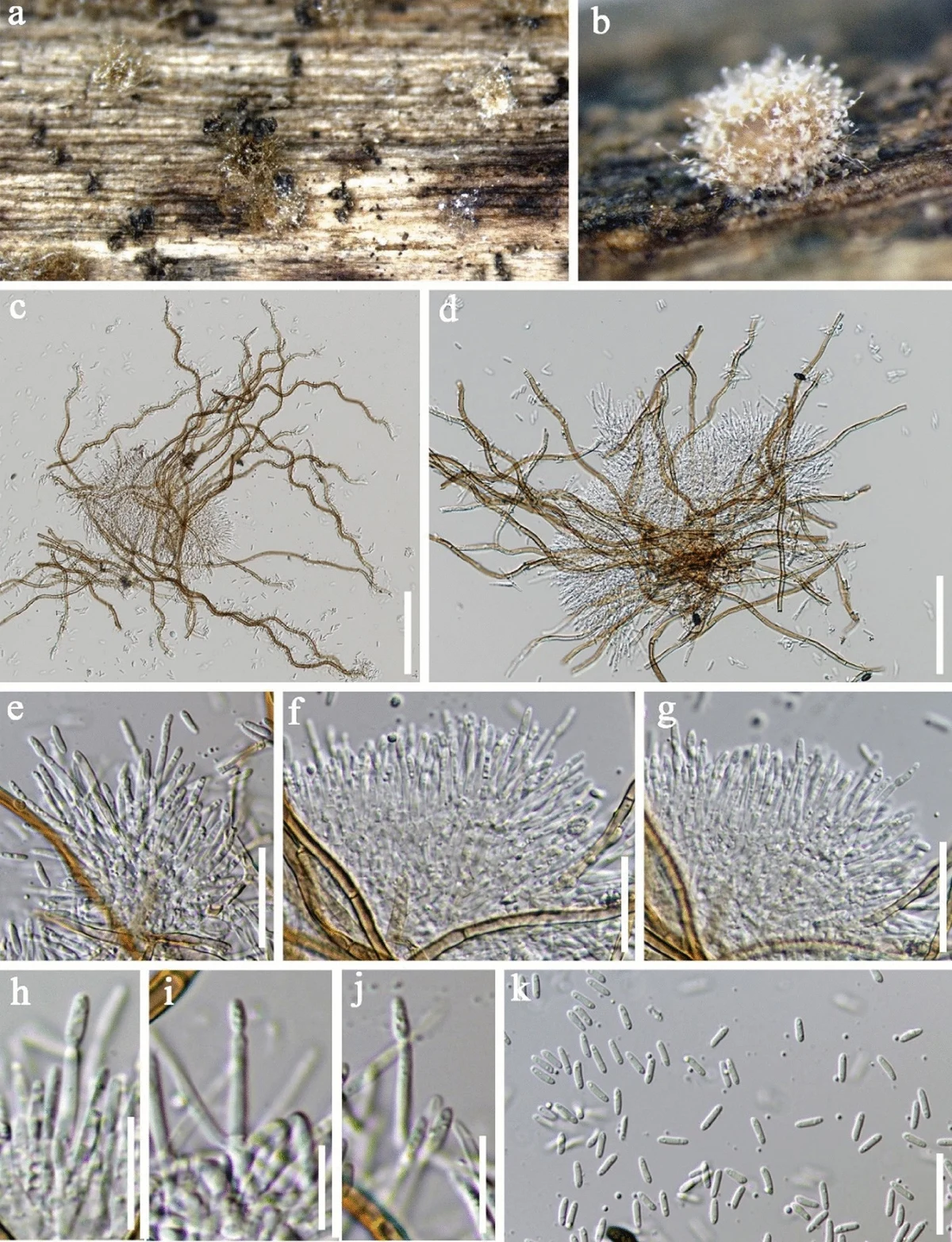
Colonies of S. kiliense have distinct characteristics, such as its colour, when grown on different medium. When the colonies are grown on glucose peptone agar at a temperature of 30 C, colonies can reach a diameter of 50 mm in one week. The colonies have a flat topography with a grey to an orange coloration. At the microscopic level, predominant features include balls of ellipsoidal conidia accumulated at the ends of long slender phialides and have oval chlamydospores. The conidiophores are long, straight, slightly tapering phialides, arising as side-branches on hyphae. At the end of the phialides are accumulated balls of slimy conidia with an ellipsoidall shape measuring 3-6 x 1.5 mm. Colonies that are grown on sabouraud dextrose agar have a white coloration that later becomes pink during further incubation. Microscopically, the growth mostly has fasciculate mycelium giving rise to slender phialides. When the colonies are grown on oatmeal agar at a temperature of 2 C for 10 days, the isolates form poorly differentiated phialides, and single-cells, thick-walled uncoloured chlamydospores with chromophilic walls measuring 4-8 μm in diameter on the ends of hyphae and intervening in filaments. After 7 days of incubation, the chlamydospores become apparent although sclerotia remain absent.

Sebagian uraian ditampilkan dalam bahasa sumber; terjemahannya belum tersedia atau belum lolos pemeriksaan.

Rujukan: [1]

Pengukuran mengikuti objek, spesimen atau kultur, dan metode yang disebutkan sumber. Baca uraian asli untuk konteks lengkap.

02 / Kehidupan

Habitat dan peran ekologis

Sarocladium kiliense is a fungus that can be found throughout the world and have been seen in various European countries and warmer countries such as Egypt, India, and Nigeria. It is commonly isolated from the soil and seen in cereal fields, hay, apples, endosperm of rye grains, tomatoes, ground nuts, pineapples, and the soils of grass lands. In addition, Sarocladium kiliense have also been found to be an aerial contaminant. Isolates that are grown at higher temperatures have larger colonies than isolates grown at lower temperatures. When colonies are grown on glucose peptone agar at a temperature of 30 C, colonies can reach a diameter of 50 mm in one week. Colonies that are grown at 20 C on malt extract agar (MEA) form smaller colonies measuring 1.8-2.3 cm in diameter.

Sebagian uraian ditampilkan dalam bahasa sumber; terjemahannya belum tersedia atau belum lolos pemeriksaan.

Rujukan: [1]

Habitat atau konteks temuan
kultur yang didokumentasikan
Substrat
Informasi belum tersedia pada sumber rilis ini.
Peran atau konteks
Belum dikategorikan pada rilis ini.
Temukan hubungan serupa
03 / Siklus hidup

Reproduksi

Colonies of S. kiliense have distinct characteristics, such as its colour, when grown on different medium. When the colonies are grown on glucose peptone agar at a temperature of 30 C, colonies can reach a diameter of 50 mm in one week. The colonies have a flat topography with a grey to an orange coloration. At the microscopic level, predominant features include balls of ellipsoidal conidia accumulated at the ends of long slender phialides and have oval chlamydospores. The conidiophores are long, straight, slightly tapering phialides, arising as side-branches on hyphae. At the end of the phialides are accumulated balls of slimy conidia with an ellipsoidall shape measuring 3-6 x 1.5 mm.

Sebagian uraian ditampilkan dalam bahasa sumber; terjemahannya belum tersedia atau belum lolos pemeriksaan.

Rujukan: [1]

Sinonim menurut acuan taksonomi rilis: Acremonium kiliense; Cephalosporium acremonium var. cereum; Cephalosporium acremonium var. funiculosum; Cephalosporium candidum; Cephalosporium candidum var. arachnoides; Cephalosporium incarnatum; Cephalosporium incarnatum var. macrosporum; Cephalosporium infestans; Cephalosporium kiliense; Cephalosporium madurae
04 / Batas informasi

Catatan identitas dan cakupan

  • Nama diterima mengikuti Catalogue of Life Base2026-09-11; uraian mempertahankan konsep dan nama sumber aslinya.
  • Original geographic, specimen and life-cycle scope retained; source import awaits individual editorial review.
  • Impor dan terjemahan otomatis belum diperiksa editorial per profil. Struktur reproduktif yang disebutkan tidak membuktikan seluruh siklus hidup diketahui.
  • Pengukuran pada uraian mengikuti spesimen, kultur, dan metode sumber; angka tidak diperluas ke semua populasi.

Catatan distribusi dalam narasi mengikuti sumbernya. Dokumentasi spesimen atau foto mengikuti catatan sumber. Bukti wilayah Indonesia dan penilaian konservasi tidak disimpulkan dari gambar.

05 / Dokumentasi

Melihat dengan konteks

Pelat Sarocladium kiliense (KUN-HKAS 125792), Gambar 34 Bao dkk. (2023): koloni pada substrat, konidiomata, konidiofor, sel pembentuk konidia, dan konidia.

Jenis
Pelat ilmiah
Kredit
Bao, Dan-Feng; Hyde, Kevin D.; Maharachchikumbura, Sajeewa S. N.; Perera, Rekhani H.; Thiyagaraja, Vinodhini; Hongsanan, Sinang; Wanasinghe, Dhanushka N.; Shen, Hong-Wei; Tian, Xing-Guo; Yang, Li-Quan; Nalumpang, Sarunya; Luo, Zong-Long
Lisensi
CC BY 4.0
Sumber media
Buka entri sumber

Gambar menunjukkan objek menurut identifikasi sumber, bukan verifikasi independen spesimen oleh Fungi. Tidak ada skala baru yang ditambahkan.

06 / Rujukan

Sumber profil

  1. [1] Sarocladium kiliense — Wikipedia (en)Bagian sumber: Frozen revision 1367071301
    Tanggal penghimpunan sumber: 2026-10-12
    Teks sumber: CC BY-SA4.0 · Wikipedia contributors
  2. [2] Catalogue of Life Base2026-09-11 — Sarocladium kilienseBagian sumber: ColDP NameUsage.tsv ID 6XNKG; accepted species; source 2073
    Tanggal penghimpunan sumber: 2026-10-12
  3. [3] Dokumentasi visual — Sarocladium kilienseBagian sumber: Identitas mengikuti sumber dokumentasi; bukan penentuan spesimen independen.
    Tanggal penghimpunan sumber: 2026-10-17
    Media sumber: CC BY 4.0 · Bao, Dan-Feng; Hyde, Kevin D.; Maharachchikumbura, Sajeewa S. N.; Perera, Rekhani H.; Thiyagaraja, Vinodhini; Hongsanan, Sinang; Wanasinghe, Dhanushka N.; Shen, Hong-Wei; Tian, Xing-Guo; Yang, Li-Quan; Nalumpang, Sarunya; Luo, Zong-Long

Adaptasi teks: CC BY-SA 4.0. Wikipedia contributors — Sarocladium kiliense — Wikipedia (en)

Uraian asli dan riwayat sumber

Riwayat atau halaman sumber

Ringkasan sumber

Sarocladium kiliense is a saprobic fungus that is occasionally encountered as an opportunistic pathogen of humans, particularly in immunocompromised individuals. The fungus is frequently found in soil and has been linked with skin and systemic infections. This species is also known to cause disease in the green alga, Cladophora glomerata as well as various fruit and vegetable crops grown in warmer climates.

Revisi sumber

Morfologi sumber

Colonies of S. kiliense have distinct characteristics, such as its colour, when grown on different medium. When the colonies are grown on glucose peptone agar at a temperature of 30 C, colonies can reach a diameter of 50 mm in one week. The colonies have a flat topography with a grey to an orange coloration. At the microscopic level, predominant features include balls of ellipsoidal conidia accumulated at the ends of long slender phialides and have oval chlamydospores. The conidiophores are long, straight, slightly tapering phialides, arising as side-branches on hyphae. At the end of the phialides are accumulated balls of slimy conidia with an ellipsoidall shape measuring 3-6 x 1.5 mm. Colonies that are grown on sabouraud dextrose agar have a white coloration that later becomes pink during further incubation. Microscopically, the growth mostly has fasciculate mycelium giving rise to slender phialides. When the colonies are grown on oatmeal agar at a temperature of 2 C for 10 days, the isolates form poorly differentiated phialides, and single-cells, thick-walled uncoloured chlamydospores with chromophilic walls measuring 4-8 μm in diameter on the ends of hyphae and intervening in filaments. After 7 days of incubation, the chlamydospores become apparent although sclerotia remain absent.

Revisi sumber

Ekologi sumber

Sarocladium kiliense is a fungus that can be found throughout the world and have been seen in various European countries and warmer countries such as Egypt, India, and Nigeria. It is commonly isolated from the soil and seen in cereal fields, hay, apples, endosperm of rye grains, tomatoes, ground nuts, pineapples, and the soils of grass lands. In addition, Sarocladium kiliense have also been found to be an aerial contaminant. Isolates that are grown at higher temperatures have larger colonies than isolates grown at lower temperatures. When colonies are grown on glucose peptone agar at a temperature of 30 C, colonies can reach a diameter of 50 mm in one week. Colonies that are grown at 20 C on malt extract agar (MEA) form smaller colonies measuring 1.8-2.3 cm in diameter.

Revisi sumber

Struktur reproduksi sumber

Colonies of S. kiliense have distinct characteristics, such as its colour, when grown on different medium. When the colonies are grown on glucose peptone agar at a temperature of 30 C, colonies can reach a diameter of 50 mm in one week. The colonies have a flat topography with a grey to an orange coloration. At the microscopic level, predominant features include balls of ellipsoidal conidia accumulated at the ends of long slender phialides and have oval chlamydospores. The conidiophores are long, straight, slightly tapering phialides, arising as side-branches on hyphae. At the end of the phialides are accumulated balls of slimy conidia with an ellipsoidall shape measuring 3-6 x 1.5 mm.

Revisi sumber

Rujukan halaman ini

Fungi. Sarocladium kiliense. Rilis data fungi-2026-10-12-expansion-2. https://fungi-atlas.mgadib.chatgpt.site/jamur/sarocladium-kiliense/.

Status: impor sumber; pemeriksaan editorial per profil belum selesai. Untuk klaim biologis, gunakan rujukan pada bagian terkait dan periksa konteks sumber aslinya.