Ciri dan struktur
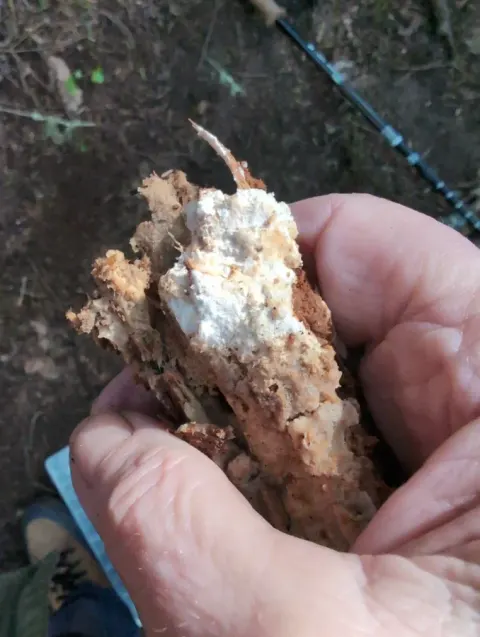
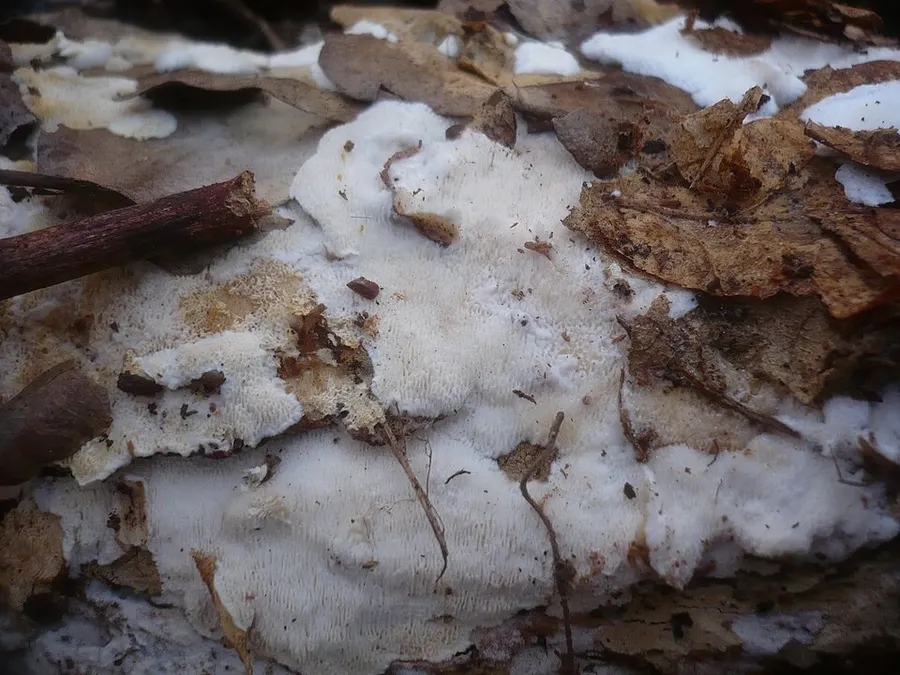
Hymenophore annual, adherent, membranous, effused forming linear areas 5-22 x 1-4 cm; 1-2 mm thick. Hymenial surface at first snow white, glancing, drying white or pallid cream, even, not creviced; margin thinning out, white, fibrillose, to 5 mm wide, adherent. Pores not in strata, angular, when old a few in the central area becoming elongated, 3-6 per mm, 100-200 µm diameter, to 2 mm deep; dissepiments entire, equal, 50-110 µm thick, apices tufted with delicate hyphae. Context white, 50-200 µm thick, floccose, of closely intertwined hyphae embedding scattered crystals; skeletal hyphae 2.5-3 µm diameter, walls 0.5-1 µm thick, sparsely branched, aseptate; generative hyphae 1.5-2 µm diameter, walls 0.2 µm thick, branched, septate, with clamp connections. Hymenial layer to 15 I µm deep, a close palisade of basidia, paraphyses, and paraphysate hyphae. Basidia clavate or subclavate, 8-12 x 3.5-4 µm, bearing 4 spores; sterigmata erect, slender, to 4 µm long. Paraphyses subclavate, 6-10 x 3-3.5 µm. Paraphysate hyphae capitate, apices to 5 µm diameter, projecting to 20 µm, scattered or crowded in dissepiments and especially near apices, some crystal encrusted. Spores allantoid, many lunate, 2.5-4 x 1-1.5 µm, walls smooth, hyaline, 0.1 µm thick.
Habitat dan peran ekologis
DISTRIBUTION: Europe, North America, Australia, Tasmania, New Zealand. HABITAT: Bark and decorticated wood of fallen branches, associated with a white rot.
- Habitat atau konteks temuan
- Informasi belum tersedia pada sumber rilis ini.
- Substrat
- Informasi belum tersedia pada sumber rilis ini.
- Peran atau konteks
- Belum dikategorikan pada rilis ini.
Reproduksi
Hymenophore annual, adherent, membranous, effused forming linear areas 5-22 x 1-4 cm; 1-2 mm thick. Hymenial surface at first snow white, glancing, drying white or pallid cream, even, not creviced; margin thinning out, white, fibrillose, to 5 mm wide, adherent. Pores not in strata, angular, when old a few in the central area becoming elongated, 3-6 per mm, 100-200 µm diameter, to 2 mm deep; dissepiments entire, equal, 50-110 µm thick, apices tufted with delicate hyphae. Context white, 50-200 µm thick, floccose, of closely intertwined hyphae embedding scattered crystals; skeletal hyphae 2.5-3 µm diameter, walls 0.5-1 µm thick, sparsely branched, aseptate; generative hyphae 1.5-2 µm diameter, walls 0.2 µm thick, branched, septate, with clamp connections.
Catatan identitas dan cakupan
- Nama diterima mengikuti Catalogue of Life Base2026-09-11; uraian mempertahankan konsep dan nama sumber aslinya.
- Historical description as cited by BiotaNZ. Preserve explicit New Zealand/locality, host and specimen qualifiers. Distribution is the cited source scope, not a current global range.
- Impor dan terjemahan otomatis belum diperiksa editorial per profil. Struktur reproduktif yang disebutkan tidak membuktikan seluruh siklus hidup diketahui.
- Pengukuran pada uraian mengikuti spesimen, kultur, dan metode sumber; angka tidak diperluas ke semua populasi.
Catatan distribusi dalam narasi mengikuti sumbernya. Dokumentasi spesimen atau foto mengikuti catatan sumber. Bukti wilayah Indonesia dan penilaian konservasi tidak disimpulkan dari gambar.
Melihat dengan konteks
Dokumentasi Sidera lenis dari Wikimedia Commons. The crust fungus Sidera lenis (P. Karst.) Miettinen. Photographed in Kobel, Jois, Bezirk Neusiedl am See, Burgenland, Austria. Identifikasi mengikuti record berkas sumber.
- Jenis
- Fotografi
- Kredit
- Gerhard Koller
- Lisensi
- CC BY-SA 3.0
- Sumber media
- Buka entri sumber
Sumber profil
- [1] Cunningham, G.H. 1965: Polyporaceae of New Zealand. New Zealand Department of Scientific and Industrial Research, Bulletin. 164. — Poria lenis
- [2] Catalogue of Life Base2026-09-11 — Sidera lenis
- [3] Dokumentasi visual — Sidera lenis
Rujukan halaman ini
Fungi. Sidera lenis. Rilis data fungi-2026-10-12-expansion-2. https://fungi-atlas.mgadib.chatgpt.site/jamur/sidera-lenis/.
Status: impor sumber; pemeriksaan editorial per profil belum selesai. Untuk klaim biologis, gunakan rujukan pada bagian terkait dan periksa konteks sumber aslinya.