Ciri dan struktur
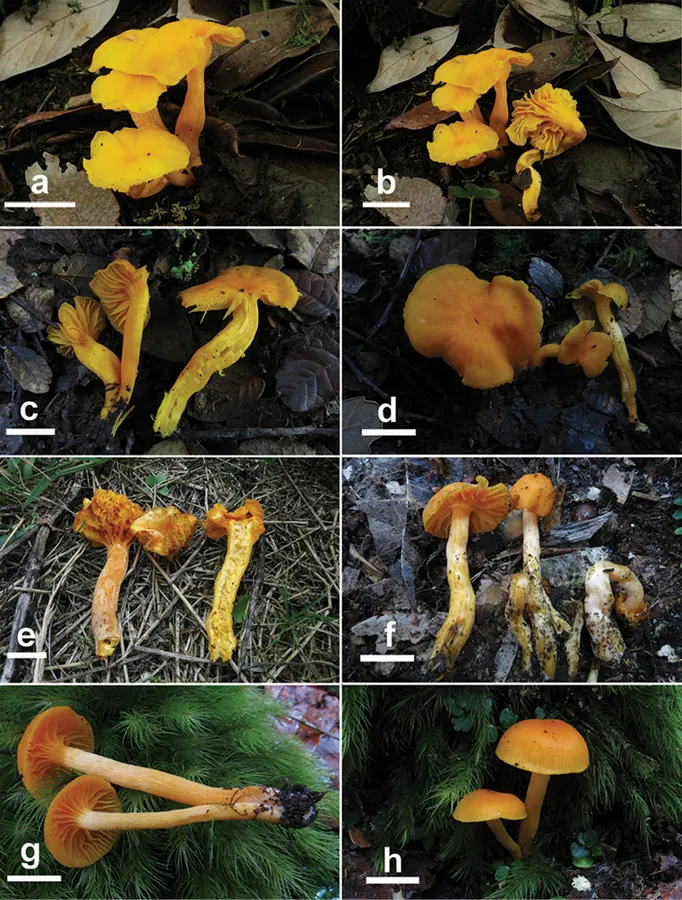
Differs from the other members of the tribe Chromosereae by its larger and more robust basidiomata, concolorous yellow pileus, lamellae and the subsurface of stipe, usually furcate and interveined lamellae and lamellulae, white fibrillose stipe surface, long basidia (up to 80 μm), ratio of basidia to basidiospore length over 5 and even up to 8. Basidiomata small to medium-sized. Pileus 2.5–6 cm diam., convex to applanate, usually slightly depressed in the centre, smooth, dry but subviscid when wet, light yellow to vivid yellow (3A5–8) or to deep yellow (4A5–8), or light orange to dark orange (5A5–8), becoming paler when dry; margin even, straight or upturned and occasionally split when mature. Lamellae up to 7 mm wide, adnate to sinuate or decurrent, distant, 17–22 lamellae per pileus, with 1–3 lamellulae between two complete lamellae, usually furcate, often interveined or anastomosing at lamella base, thick, concolorous with the pileus; lamellar base and lamellulae irregular and occasionally the whole hymenophore irregular; lamellar edge even and concolorous. Context concolorous with lamellae and pileus, unchanged when cut. Stipe 4–6.5 × 0.6–1.2 cm, central or occasionally eccentric, subcylindrical, moderately to densely covered with white tiny adpressed fibres. Odour indistinct. Basidiospores 8–10(–10.5) × (4.5–)5–7(–7.5) μm, Q = (1.3–)1.5–1.8, Q m = 1.6–1.7, ellipsoid to ellipsoid-oblong, ovoid, not constricted, thin-walled, hyaline, smooth. Basidia 41–80 × 4–10 μm, strongly elongated, narrow clavate, 4-spored, thin-walled; sterigmata up to 10 μm long; ratio of basidia to basidiospore length over 5 and up to 8.
Habitat dan peran ekologis
Gregarious, caespitose, or scattered in broad-leaf forest in subtropical temperate transition zone, so far known only from Sichuan and Hunan Provinces in China.
- Habitat atau konteks temuan
- hutan
- Substrat
- Informasi belum tersedia pada sumber rilis ini.
- Peran atau konteks
- Belum dikategorikan pada rilis ini.
Reproduksi
Differs from the other members of the tribe Chromosereae by its larger and more robust basidiomata, concolorous yellow pileus, lamellae and the subsurface of stipe, usually furcate and interveined lamellae and lamellulae, white fibrillose stipe surface, long basidia (up to 80 μm), ratio of basidia to basidiospore length over 5 and even up to 8. Basidiomata small to medium-sized. Pileus 2.5–6 cm diam., convex to applanate, usually slightly depressed in the centre, smooth, dry but subviscid when wet, light yellow to vivid yellow (3A5–8) or to deep yellow (4A5–8), or light orange to dark orange (5A5–8), becoming paler when dry; margin even, straight or upturned and occasionally split when mature.
Catatan identitas dan cakupan
- Nama diterima mengikuti Catalogue of Life Base2026-09-11; uraian mempertahankan konsep dan nama sumber aslinya.
- Preserve original treatment localities, hosts and substrate scope. Materials examined describe documented specimens, not the full global range.
- Impor dan terjemahan otomatis belum diperiksa editorial per profil. Struktur reproduktif yang disebutkan tidak membuktikan seluruh siklus hidup diketahui.
- Pengukuran pada uraian mengikuti spesimen, kultur, dan metode sumber; angka tidak diperluas ke semua populasi.
Catatan distribusi dalam narasi mengikuti sumbernya. Dokumentasi spesimen atau foto mengikuti catatan sumber. Bukti wilayah Indonesia dan penilaian konservasi tidak disimpulkan dari gambar.
Melihat dengan konteks
Basidiomata of Sinohygrocybe tomentosipes (a–b GDGM43351 c–d GDGM43352 e GDGM43347 f GDGM50075 g–h GDGM50149). Scale bars: 2 cm.
- Jenis
- Pelat ilmiah
- Kredit
- Chao-Qun Wang, Ming Zhang, Tai-Hui Li, Xi-Shen Liang, Ya-Heng Shen
- Lisensi
- CC BY 4.0
- Sumber media
- Buka entri sumber
Dokumentasi tambahan
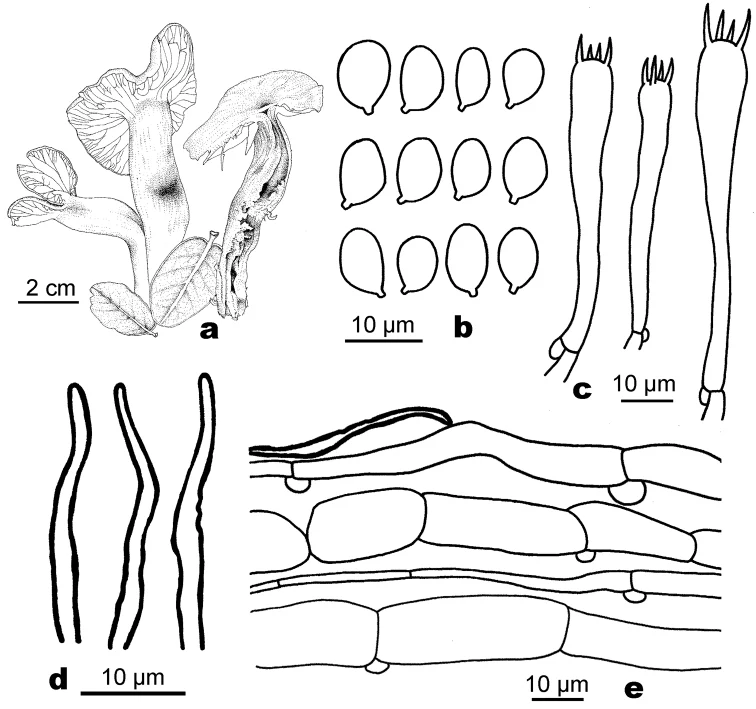
Line drawings of Sinohygrocybe tomentosipes. a Basidiomata b Basidiospores c Basidia d Elements of pileipellis cells e Elements of gill trama.
Kredit dan penggunaan
Chao-Qun Wang, Ming Zhang, Tai-Hui Li, Xi-Shen Liang, Ya-Heng Shen
Ukuran dan format gambar disesuaikan tanpa pemotongan, retus, atau penambahan skala. Lisensi sumber dipertahankan.
Sumber profil
- [1] Additions to tribe Chromosereae (Basidiomycota, Hygrophoraceae) from China, including Sinohygrocybe gen. nov. and a first report of Gloioxanthomyces nitidus — Sinohygrocybe tomentosipes
- [2] Catalogue of Life Base2026-09-11 — Sinohygrocybe tomentosipes
- [3] Dokumentasi visual — Sinohygrocybe tomentosipes
- [4] Dokumentasi visual — Sinohygrocybe tomentosipes
Rujukan halaman ini
Fungi. Sinohygrocybe tomentosipes. Rilis data fungi-2026-10-12-expansion-2. https://fungi-atlas.mgadib.chatgpt.site/jamur/sinohygrocybe-tomentosipes/.
Status: impor sumber; pemeriksaan editorial per profil belum selesai. Untuk klaim biologis, gunakan rujukan pada bagian terkait dan periksa konteks sumber aslinya.