Ciri dan struktur
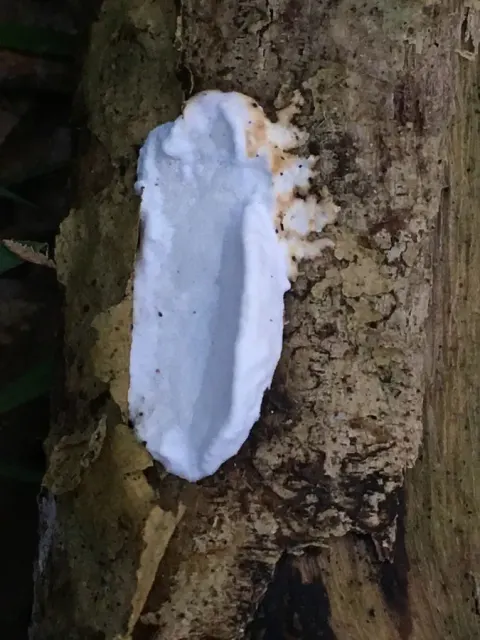
Finland. Åland: Lemland, Nåtö, Fraxinus excelsior (fallen branch), 9 Oct 2012 Korhonen 90 (H 7008662). Basidiocarps annual; resupinate to half-resupinate; bone hard when dry, breaking apart neatly; resupinate basidiocarps up to 10+ cm wide; pilei nodulous to shelf-shaped, often laterally fused and fleshy, protruding up to 1.3 cm; sterile margin often quite pronounced especially in resupinate part; upper surface slightly rough, matted, white to cream coloured when young, turning ochraceous and finally blackish with age; pore surface sometimes with a greenish-grey or turquoise tint emerging within the tubes especially in the pileate part but sometimes in scattered blotches; context sometimes faintly zonate in longitudinal section; tube layer up to 2 mm thick; pores (6–)7–8(–10) per mm. Hyphal structure: skeletal hyphae in context / subiculum (1.0–)2.0–3.0(–4.0) µm wide, in trama (1.0–)2.0–3.9(–5.0) µm wide, generative hyphae in trama 1.0–2.2(–2.9) µm wide. Basidiospores (2.8–)2.9–3.2(–4.0)×(0.4–)0.5–0.6(–0.7) µm, L=3.04 µm, W=0.56 µm, Q’=(4.1–)4.8–6.3(–7.8), Q=5.47, n=390/13. S. nemoralis shares its wide distribution in Eurasia with similar-looking S. semipileata. Both species tend to form rather large, half-resupinate basidiocarps with fleshy pilei. S. nemoralis has slightly larger spores and pores than S. semipileata, but the distinction is probably too small for definitive identification. In Europe, S. nemoralis does not reach as far to the northeast as S. semipileata and appears to be missing in continental Finland. At its north-eastern outpost in Åland Islands, S. nemoralis is rather common, especially in old coppice meadows where it prefers the wood of Fraxinus.
Habitat dan peran ekologis
Temperate Eurasia, found in Europe, Iran and Japan; on angiosperm wood, especially Fraxinus, preferring coarse substrates like thick branches or even logs.
- Habitat atau konteks temuan
- Informasi belum tersedia pada sumber rilis ini.
- Substrat
- Informasi belum tersedia pada sumber rilis ini.
- Peran atau konteks
- Belum dikategorikan pada rilis ini.
Reproduksi
Finland. Åland: Lemland, Nåtö, Fraxinus excelsior (fallen branch), 9 Oct 2012 Korhonen 90 (H 7008662). Basidiocarps annual; resupinate to half-resupinate; bone hard when dry, breaking apart neatly; resupinate basidiocarps up to 10+ cm wide; pilei nodulous to shelf-shaped, often laterally fused and fleshy, protruding up to 1.3 cm; sterile margin often quite pronounced especially in resupinate part; upper surface slightly rough, matted, white to cream coloured when young, turning ochraceous and finally blackish with age; pore surface sometimes with a greenish-grey or turquoise tint emerging within the tubes especially in the pileate part but sometimes in scattered blotches; context sometimes faintly zonate in longitudinal section; tube layer up to 2 mm thick; pores (6–)7–8(–10) per mm.
Catatan identitas dan cakupan
- Nama diterima mengikuti Catalogue of Life Base2026-09-11; uraian mempertahankan konsep dan nama sumber aslinya.
- Preserve original treatment localities, hosts and substrate scope. Materials examined describe documented specimens, not the full global range.
- Impor dan terjemahan otomatis belum diperiksa editorial per profil. Struktur reproduktif yang disebutkan tidak membuktikan seluruh siklus hidup diketahui.
- Pengukuran pada uraian mengikuti spesimen, kultur, dan metode sumber; angka tidak diperluas ke semua populasi.
Catatan distribusi dalam narasi mengikuti sumbernya. Dokumentasi spesimen atau foto mengikuti catatan sumber. Bukti wilayah Indonesia dan penilaian konservasi tidak disimpulkan dari gambar.
Melihat dengan konteks
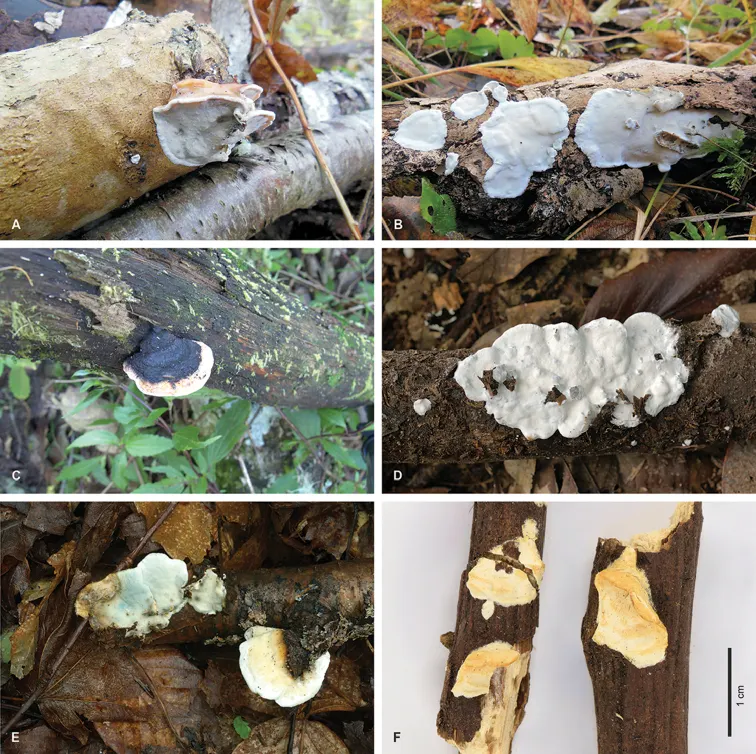
Fruiting bodies of the Skeletocutis nivea complex. A S. nemoralis, Korhonen 86 B S. nemoralis, Korhonen 89 C S. nivea, epitype D S. nivea, Miettinen 16350 E S. semipileata with a characteristic bluish colour on pore surface, epitype F S. unguina, holotype.
- Jenis
- Pelat ilmiah
- Kredit
- Aku Korhonen, Jaya Seelan Sathiya Seelan, Otto Miettinen
- Lisensi
- CC BY 4.0
- Sumber media
- Buka entri sumber
Dokumentasi tambahan
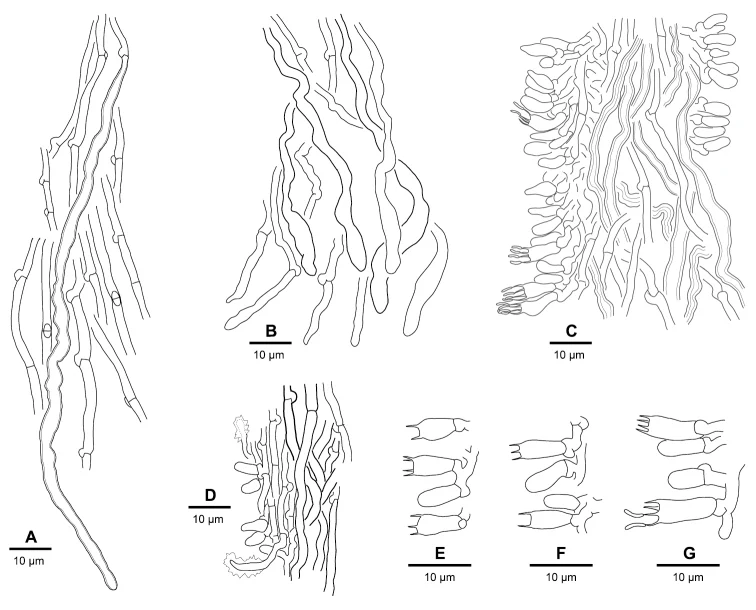
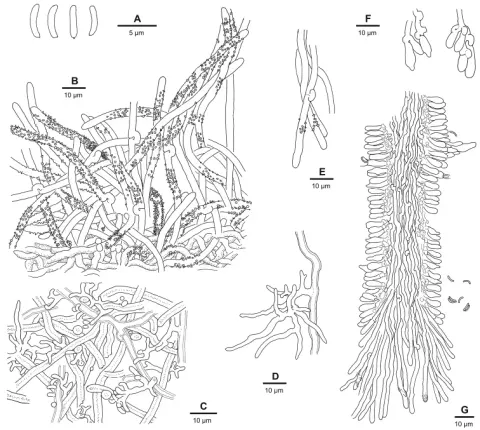
Microscopic structures of the Skeletocutis nivea complex. A S. lepida, tramal skeletal hypha amongst generative hyphae (holotype) B S. semipileata, ends of generative and skeletal hyphae in trama (Miettinen 17135) C S. nemoralis, tube trama and hymenium (holotype) D S. nivea, tube trama and hymenium with encrusted generocystidia (epitype) E S. nivea, basidia (Miettinen 16350) F S. semipileata, basidia (epitype) G S. cummata, the largest basidia in the the S. nivea complex (Niemelä 9088).
Kredit dan penggunaan
Aku Korhonen, Jaya Seelan Sathiya Seelan, Otto Miettinen
Ukuran dan format gambar disesuaikan tanpa pemotongan, retus, atau penambahan skala. Lisensi sumber dipertahankan.
Sumber profil
- [1] Cryptic species diversity in polypores: the Skeletocutis nivea species complex — Skeletocutis nemoralis
- [2] Catalogue of Life Base2026-09-11 — Skeletocutis nemoralis
- [3] Dokumentasi visual — Skeletocutis nemoralis
- [4] Dokumentasi visual — Skeletocutis nemoralis
Rujukan halaman ini
Fungi. Skeletocutis nemoralis. Rilis data fungi-2026-10-12-expansion-2. https://fungi-atlas.mgadib.chatgpt.site/jamur/skeletocutis-nemoralis/.
Status: impor sumber; pemeriksaan editorial per profil belum selesai. Untuk klaim biologis, gunakan rujukan pada bagian terkait dan periksa konteks sumber aslinya.