Ciri dan struktur
Colonies effuse, dark brown to black, hairy. Hyphae superficial, branched, septate, 1–3 µm wide, straw-coloured, smooth. Conidiophores arising singly, erect or ascending, straight to flexuous, mostly flexuous at their tips, septate, up to 300 µm long, 5–8 µm thick, brown to dark brown, paler towards the apex, with rough surface, with scattered scars in upper parts of the conidiophores. Conidia solitary, straight or slightly curved, obclavate to obpyriform, mostly 1–septate, (20–)30–42(–50) × (6–)7–8(–10) µm, 2–3.5 µm wide at the base, brown, paler towards the ends, verrucose when seen by LM and SEM.
Habitat dan peran ekologis
On colonies of Armatella spp. on various plants in India, Myanmar and Sri Lanka (Ellis 1971).
- Habitat atau konteks temuan
- Informasi belum tersedia pada sumber rilis ini.
- Substrat
- Informasi belum tersedia pada sumber rilis ini.
- Peran atau konteks
- Belum dikategorikan pada rilis ini.
Reproduksi
Colonies effuse, dark brown to black, hairy. Hyphae superficial, branched, septate, 1–3 µm wide, straw-coloured, smooth. Conidiophores arising singly, erect or ascending, straight to flexuous, mostly flexuous at their tips, septate, up to 300 µm long, 5–8 µm thick, brown to dark brown, paler towards the apex, with rough surface, with scattered scars in upper parts of the conidiophores. Conidia solitary, straight or slightly curved, obclavate to obpyriform, mostly 1–septate, (20–)30–42(–50) × (6–)7–8(–10) µm, 2–3.5 µm wide at the base, brown, paler towards the ends, verrucose when seen by LM and SEM.
Catatan identitas dan cakupan
- Nama diterima mengikuti Catalogue of Life Base2026-09-11; uraian mempertahankan konsep dan nama sumber aslinya.
- Preserve original treatment localities, hosts and substrate scope. Materials examined describe documented specimens, not the full global range.
- Impor dan terjemahan otomatis belum diperiksa editorial per profil. Struktur reproduktif yang disebutkan tidak membuktikan seluruh siklus hidup diketahui.
- Pengukuran pada uraian mengikuti spesimen, kultur, dan metode sumber; angka tidak diperluas ke semua populasi.
Catatan distribusi dalam narasi mengikuti sumbernya. Dokumentasi spesimen atau foto mengikuti catatan sumber. Bukti wilayah Indonesia dan penilaian konservasi tidak disimpulkan dari gambar.
Melihat dengan konteks
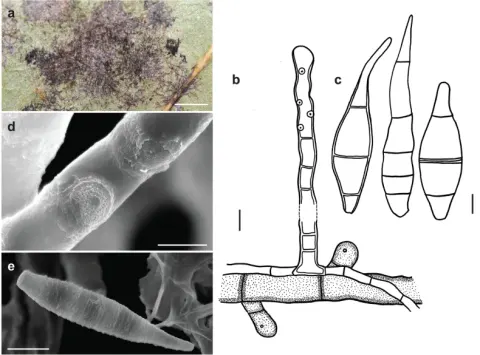
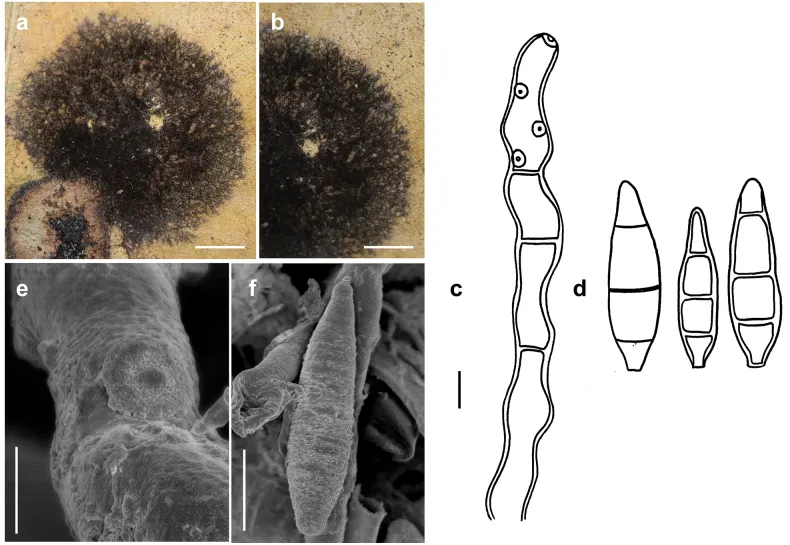
Spiropes armatellae (MB 167) a, b conidiophores growing intermingled with hyphae of Meliola sp. on leaves of Angylocalyx oligophyllus c conidiophore with scars d conidia shown in optical section. The thickness of the wall is shown in the two drawings on the right-hand side e, f as seen by SEM e part of a conidiophore with scar f conidium. Scale bars: 0.3 mm (a); 0.2 mm (b); 5 μm (c, d); 2 μm (e); 7 μm (f).
- Jenis
- Pelat ilmiah
- Kredit
- Miguel A. Bermúdez-Cova, Tina A. Hofmann, Nourou S. Yorou, Meike Piepenbring
- Lisensi
- CC BY 4.0
- Sumber media
- Buka entri sumber
Dokumentasi tambahan
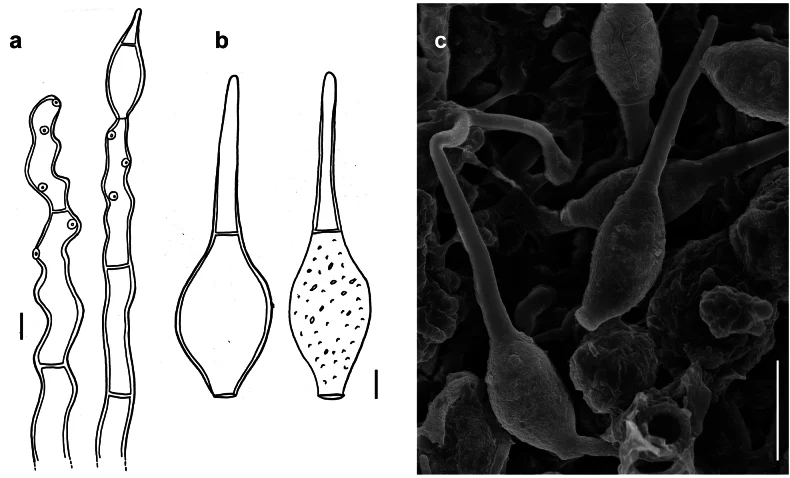
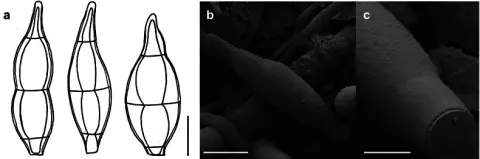
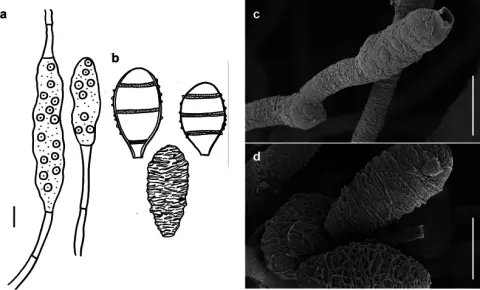
Spiropes armatellae (IMI 161265) a conidiophores with young conidium b, c conidia b shown in optical section. The thickness of the wall is indicated only in the drawing on the left-hand side c as seen by SEM. Scale bars: 5 μm (a); 2.5 μm (b); 10 μm (c).
Kredit dan penggunaan
Miguel A. Bermúdez-Cova, Tina A. Hofmann, Nourou S. Yorou, Meike Piepenbring
Ukuran dan format gambar disesuaikan tanpa pemotongan, retus, atau penambahan skala. Lisensi sumber dipertahankan.
Sumber profil
- [1] Systematic revision of species of Atractilina and Spiropes hyperparasitic on Meliolales (Ascomycota) in the tropics — Spiropes armatellae
- [2] Catalogue of Life Base2026-09-11 — Spiropes armatellae
- [3] Dokumentasi visual — Spiropes armatellae
- [4] Dokumentasi visual — Spiropes armatellae
Rujukan halaman ini
Fungi. Spiropes armatellae. Rilis data fungi-2026-10-12-expansion-2. https://fungi-atlas.mgadib.chatgpt.site/jamur/spiropes-armatellae/.
Status: impor sumber; pemeriksaan editorial per profil belum selesai. Untuk klaim biologis, gunakan rujukan pada bagian terkait dan periksa konteks sumber aslinya.