Isolated from kulit mati dari Prunus cerasoides. Morph seksual tidak ditentukan. Morph asexual Hyphae thin, sederhana hingga bercabang, kadang membentuk bundel, ber dinding halus, subyalin, bersepta, kadang menyusut di dekat septa, 0.9–3.1 µm (\(\bar{x} \) = 1.8 µm, n = 30) lebar. Chlamydospores abundant, bersendirian atau berantai, globosa sampai subglobosa, ber dinding halus, berpigmentasi, subyalin hingga berwarna zaitun ringan, 3.1–7.8 × 2.4–5.7 µm (\(\bar{x} \) = 5.2 × 3.9 µm, n = 30). Produces multiple morphs (synanamorphs) dari Diplococcium and Phialocephala.
Profil ini diimpor dari uraian spesies pada sumber berlisensi dan sebagian teks diterjemahkan otomatis. Pemeriksaan editorial per profil belum selesai. Bagian yang belum diterjemahkan atau belum lolos pemeriksaan terjemahan tetap ditampilkan dalam bahasa sumber. Angka dan nama ilmiah dipertahankan.
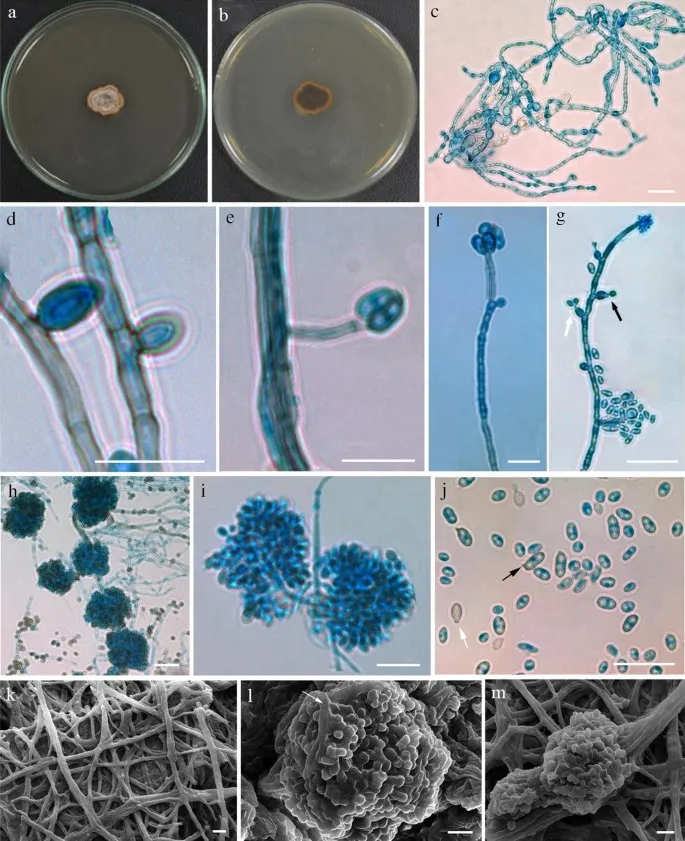
Srinivasanomyces kangrensis (AMH 10175, holotype). a Colony morphology on PDA (front view). b Reverse view of colony. c Vegetative hyphae and chlamydospores. d Conidia produced from lateral hyphae. e, f Conidiophores produced from lateral hyphae with conidia. g Arrow showing conidia produced from phialide. h Tufts of slimy gleosporic mass of conidia with densely produced phialides. i Magnified view of gleosporic mass of conidia (arrow showing reduced phialides). j Conidia (arrow shows truncate and oblique base). k SEM of hyphae. l SEM of magnified view gleosporic mass of conidia (arrow showing densely produced phialides). m SEM of tufts of slimy gleosporic mass of conidia. Scale bars: c – j = 20 μm, k – m = 5 μm Penulis dan sumber artikel: Hyde, Kevin D.; Dong, Yang; Phookamsak, Rungtiwa; Jeewon, Rajesh; Bhat, D. Jayarama; Jones, E. B. Gareth; Liu, Ning-Guo; A… (kredit lengkap di bawah) · CC BY 4.0 · Ukuran dan format gambar disesuaikan; lisensi asli dipertahankan.
01 / Morfologi
Ciri dan struktur
Isolated from dead bark of Prunus cerasoides. Sexual morph Undetermined. Asexual morph Hyphae thin, simple to branched, sometimes forming bundles, smooth-walled, subhyaline, septate, sometimes constricted near septa, 0.9–3.1 µm (\(\bar{x} \) = 1.8 µm, n = 30) wide. Chlamydospores abundant, solitary or in chains, globose to subglobose, smooth-walled, pigmented, subhyaline to light olivaceous, 3.1–7.8 × 2.4–5.7 µm (\(\bar{x} \) = 5.2 × 3.9 µm, n = 30). Produces multiple morphs (synanamorphs) of Diplococcium and Phialocephala. Conidiophores produced from lateral hyphae, indeterminate, intercalary, simple to densely branched, septate, smooth-walled, subhyaline to light olivaceous. Conidiogenous cells subhyaline to light olivaceous, lateral to terminal, phialidic, densely produced, monoblastic to polyblastic. Phialides variable, solitary or in dense clusters forming globose conidial heads 12.3–45.9 × 8.1–37.6 µm (\(\bar{x} \) = 18.7 × 16.1 µm, n = 30), subhyaline to light olivaceous, smooth-walled, collarette, cylindrical to ampulliform, 3.7–58.5 × 0.8–3 µm (\(\bar{x} \) = 13.7 × 1.4 µm, n = 30). Conidia produced in gleosporic mass, sometimes directly from superficial lateral hyphae, width 1.9–2.3 µm (\(\bar{x} \) = 2.1, n = 10), subhyaline to light olivaceous, smooth-walled, pyriform to obpyriform, globose to subglobose, fusoid, clavate, solitary to catenate, 1–2 guttules. Culture characteristics: Colonies on PDA reaching to 15–20 mm diam. after 3 weeks at 25 °C; colonies from above greyish white (7B1) to fawn/light brown (7D4), flat, circular, margin irregular smooth, slightly cottony; colony from reverse, dark brown (8F4).
Sebagian uraian ditampilkan dalam bahasa sumber; terjemahannya belum tersedia atau belum lolos pemeriksaan.
Isolated from dead bark of Prunus cerasoides. Sexual morph Undetermined. Asexual morph Hyphae thin, simple to branched, sometimes forming bundles, smooth-walled, subhyaline, septate, sometimes constricted near septa, 0.9–3.1 µm (\(\bar{x} \) = 1.8 µm, n = 30) wide. Chlamydospores abundant, solitary or in chains, globose to subglobose, smooth-walled, pigmented, subhyaline to light olivaceous, 3.1–7.8 × 2.4–5.7 µm (\(\bar{x} \) = 5.2 × 3.9 µm, n = 30). Produces multiple morphs (synanamorphs) of Diplococcium and Phialocephala. Conidiophores produced from lateral hyphae, indeterminate, intercalary, simple to densely branched, septate, smooth-walled, subhyaline to light olivaceous. Conidiogenous cells subhyaline to light olivaceous, lateral to terminal, phialidic, densely produced, monoblastic to polyblastic.
Sebagian uraian ditampilkan dalam bahasa sumber; terjemahannya belum tersedia atau belum lolos pemeriksaan.
Nama diterima mengikuti Catalogue of Life Base2026-09-11; uraian mempertahankan konsep dan nama sumber aslinya.
Preserve original monograph treatment localities, hosts and specimen/substrate scope. Materials examined document specimens, not the full global range.
Impor dan terjemahan otomatis belum diperiksa editorial per profil. Struktur reproduktif yang disebutkan tidak membuktikan seluruh siklus hidup diketahui.
Pengukuran pada uraian mengikuti spesimen, kultur, dan metode sumber; angka tidak diperluas ke semua populasi.
Catatan distribusi dalam narasi mengikuti sumbernya. Dokumentasi spesimen atau foto mengikuti catatan sumber. Bukti wilayah Indonesia dan penilaian konservasi tidak disimpulkan dari gambar.
05 / Dokumentasi
Melihat dengan konteks
Srinivasanomyces kangrensis (AMH 10175, holotype). a Colony morphology on PDA (front view). b Reverse view of colony. c Vegetative hyphae and chlamydospores. d Conidia produced from lateral hyphae. e, f Conidiophores produced from lateral hyphae with conidia. g Arrow showing conidia produced from phialide. h Tufts of slimy gleosporic mass of conidia with densely produced phialides. i Magnified view of gleosporic mass of conidia (arrow showing reduced phialides). j Conidia (arrow shows truncate and oblique base). k SEM of hyphae. l SEM of magnified view gleosporic mass of conidia (arrow showing densely produced phialides). m SEM of tufts of slimy gleosporic mass of conidia. Scale bars: c – j = 20 μm, k – m = 5 μm
Jenis
Pelat ilmiah
Kredit
Penulis dan sumber artikel: Hyde, Kevin D.; Dong, Yang; Phookamsak, Rungtiwa; Jeewon, Rajesh; Bhat, D. Jayarama; Jones, E. B. Gareth; Liu, Ning-Guo; Abeywickrama, Pranami D.; Mapook, Ausana; Wei, Deping; Perera, Rekhani H.; Manawasinghe, Ishara S.; Pem, Dhandevi; Bundhun, Digvijayini; Karunarathna, Anuruddha; Ekanayaka, Anusha H.; Bao, Dan-Feng; Li, Junfu; Samarakoon, Milan C.; Chaiwan, Napalai; Lin, Chuan-Gen; Phutthacharoen, Kunthida; Zhang, Sheng-Nan; Senanayake, Indunil C.; Goonasekara, Ishani D.; Thambugala, Kasun M.; Phukhamsakda, Chayanard; Tennakoon, Danushka S.; Jiang, Hong-Bo; Yang, Jing; Zeng, Ming; Huanraluek, Naruemon; Liu, Jian-Kui (Jack); Wijesinghe, Subodini N.; Tian, Qing; Tibpromma, Saowaluck; Brahmanage, Rashika S.; Boonmee, Saranyaphat; Huang, Shi-Ke; Thiyagaraja, Vinodhini; Lu, Yong-Zhong; Jayawardena, Ruvishika S.; Dong, Wei; Yang, Er-Fu; Singh, Sanjay K.; Singh, Shiv Mohan; Rana, Shiwali; Lad, Sneha S.; Anand, Garima; Devadatha, Bandarupalli; Niranjan, M.; Sarma, V. Venkateswara; Liimatainen, Kare; Aguirre-Hudson, Begoña; Niskanen, Tuula; Overall, Andy; Alvarenga, Renato Lúcio Mendes; Gibertoni, Tatiana Baptista; Pfliegler, Walter P.; Horváth, Enikő; Imre, Alexandra; Alves, Amanda Lucia; da Silva Santos, Ana Carla; Tiago, Patricia Vieira; Bulgakov, Timur S.; Wanasinghe, Dhanushaka N.; Bahkali, Ali H.; Doilom, Mingkwan; Elgorban, Abdallah M.; Maharachchikumbura, Sajeewa S. N.; Rajeshkumar, Kunhiraman C.; Haelewaters, Danny; Mortimer, Peter E.; Zhao, Qi; Lumyong, Saisamorn; Xu, Jianchu; Sheng, Jun
Isolated from dead bark of Prunus cerasoides.
Sexual morph Undetermined.
Asexual morph Hyphae thin, simple to branched, sometimes forming bundles, smooth-walled, subhyaline, septate, sometimes constricted near septa, 0.9–3.1 µm (\(\bar{x} \) = 1.8 µm, n = 30) wide.
Chlamydospores abundant, solitary or in chains, globose to subglobose, smooth-walled, pigmented, subhyaline to light olivaceous, 3.1–7.8 × 2.4–5.7 µm (\(\bar{x} \) = 5.2 × 3.9 µm, n = 30).
Produces multiple morphs (synanamorphs) of Diplococcium and Phialocephala.
Isolated from dead bark of Prunus cerasoides.
Sexual morph Undetermined.
Asexual morph Hyphae thin, simple to branched, sometimes forming bundles, smooth-walled, subhyaline, septate, sometimes constricted near septa, 0.9–3.1 µm (\(\bar{x} \) = 1.8 µm, n = 30) wide.
Chlamydospores abundant, solitary or in chains, globose to subglobose, smooth-walled, pigmented, subhyaline to light olivaceous, 3.1–7.8 × 2.4–5.7 µm (\(\bar{x} \) = 5.2 × 3.9 µm, n = 30).
Produces multiple morphs (synanamorphs) of Diplococcium and Phialocephala.
Conidiophores produced from lateral hyphae, indeterminate, intercalary, simple to densely branched, septate, smooth-walled, subhyaline to light olivaceous.
Conidiogenous cells subhyaline to light olivaceous, lateral to terminal, phialidic, densely produced, monoblastic to polyblastic.
Phialides variable, solitary or in dense clusters forming globose conidial heads 12.3–45.9 × 8.1–37.6 µm (\(\bar{x} \) = 18.7 × 16.1 µm, n = 30), subhyaline to light olivaceous, smooth-walled, collarette, cylindrical to ampulliform, 3.7–58.5 × 0.8–3 µm (\(\bar{x} \) = 13.7 × 1.4 µm, n = 30).
Conidia produced in gleosporic mass, sometimes directly from superficial lateral hyphae, width 1.9–2.3 µm (\(\bar{x} \) = 2.1, n = 10), subhyaline to light olivaceous, smooth-walled, pyriform to obpyriform, globose to subglobose, fusoid, clavate, solitary to catenate, 1–2 guttules.
Culture characteristics: Colonies on PDA reaching to 15–20 mm diam. after 3 weeks at 25 °C; colonies from above greyish white (7B1) to fawn/light brown (7D4), flat, circular, margin irregular smooth, slightly cottony; colony from reverse, dark brown (8F4).
Isolated from dead bark of Prunus cerasoides.
Sexual morph Undetermined.
Asexual morph Hyphae thin, simple to branched, sometimes forming bundles, smooth-walled, subhyaline, septate, sometimes constricted near septa, 0.9–3.1 µm (\(\bar{x} \) = 1.8 µm, n = 30) wide.
Chlamydospores abundant, solitary or in chains, globose to subglobose, smooth-walled, pigmented, subhyaline to light olivaceous, 3.1–7.8 × 2.4–5.7 µm (\(\bar{x} \) = 5.2 × 3.9 µm, n = 30).
Produces multiple morphs (synanamorphs) of Diplococcium and Phialocephala.
Conidiophores produced from lateral hyphae, indeterminate, intercalary, simple to densely branched, septate, smooth-walled, subhyaline to light olivaceous.
Conidiogenous cells subhyaline to light olivaceous, lateral to terminal, phialidic, densely produced, monoblastic to polyblastic.
Status: impor sumber; pemeriksaan editorial per profil belum selesai. Untuk klaim biologis, gunakan rujukan pada bagian terkait dan periksa konteks sumber aslinya.
Stachybotrys chartarum ⁇ spesies jamur yang berasal dari kelompok hypocreales. Ini adalah jamur hitam yang memiliki efek buruk pada kesehatan manusia. Gatunek ten telah menarik banyak perhatian karena menghasilkan beberapa racun mycotoxin…
Saprobic on daun mati dari Agave sisalana. Morph seksual: tidak ditentukan. Morph asexual: Koloni superficial pada substrat inang, gregarious, terlihat sebagai banyak massa konidia hitam. Conidiophores 35–70 × 2.5–5 µm (av. 48 × 4 μm, n =…
Koloni setelah 7 d di 25 °C, pada OA mencapai 75–80 mm diam, mycelium udara floksosa, olivaceous ke olivaceous pucat, putih ke pink dekat tepi, margin biasa; besi kebalik abu-abu. Pada MEA mencapai diameter 65–70 mm, margin reguler, floks…