Ciri dan struktur
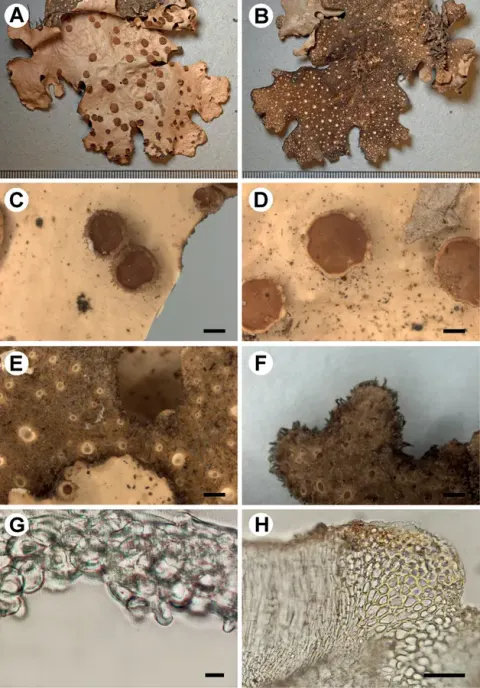
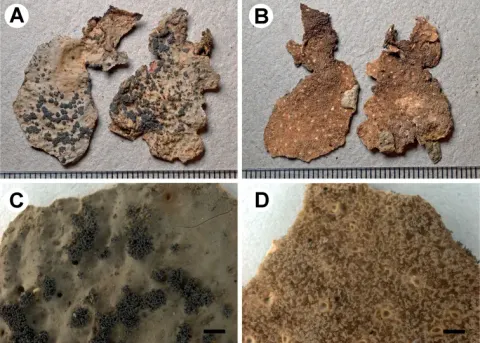
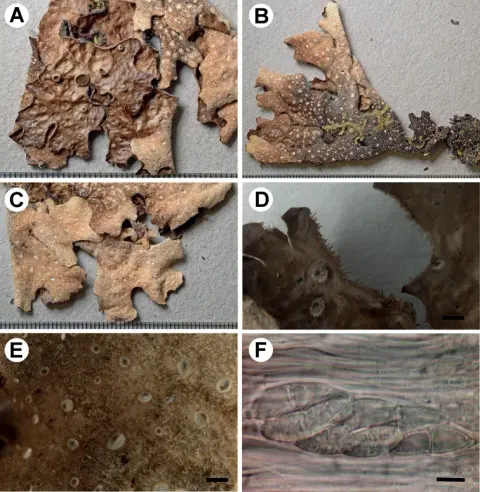
Sticta torii is a lichen with cyanobacteria (genus Nostoc) as its primary photosynthetic partner. It lacks a stalk and has an irregular thallus that can grow up to 1.5–2.0 cm in diameter. Initially single-d, it eventually becomes multi-lobed and is quite fragile. The lobes are rounded to elongate, often ascending but sometimes curving downward at the tips, and are (overlapping like roof tiles). Secondary lobes can be (rolled inward), with margins sometimes featuring (torn) outgrowths of isidia (small, finger-like reproductive propagules). The upper surface is smooth, gray to dark brown, and may be matt or somewhat shiny, with occasional sparse (spots) near the tips. Isidia are present and abundant, primarily along the margins but also on the surface, growing into branching, tree-like structures up to 0.6 mm long. The medulla (inner layer) is compact and white. The lower surface is even and cream to brown-colored, with dense tomentum (hairy layer) that becomes sparser toward the margin. Sticta torii has no rhizines (root-like structures) but features sparse cyphellae (small, pore-like structures) scattered throughout, which are rounded to irregular with wide pores. The upper cortex is 25–55 μm thick, consisting of 2–4 layers of cells. The is 35–65 μm thick, while the medulla is 110–240 μm thick. The lower cortex is 25–45 μm thick, also with 3–4 cell layers. The lower tomentum consists of unbranched, cylindrical hyphae in bundles, with occasional (rosary-like) appearance near the margins.
Habitat dan peran ekologis
Sticta torii grows on the outermost branches of Alnus rubra (red alder), Malus fusca (Pacific crabapple), and Picea sitchensis (Sitka spruce) in coastal areas exposed to storms and the open ocean. This lichen is restricted to hypermaritime regions where winter temperatures rarely drop below freezing. The Alaskan habitat has been ice-free for about 16,000 years BP. In British Columbia, Sticta torii coexists with other epiphytic lichens such as Arctomia borbonica, Cavernularia hultenii, Collema furfuraceum, Erioderma sorediatum, Fuscopannaria laceratula, F. leucostictoides, Lobaria anomala, Lobaria anthraspis, Nephroma laevigatum, Pannaria malmei, Pseudocyphellaria mallota, P. hawaiiensis, Sticta limbata, and Usnea longissima. Two paratype specimens from British Columbia were collected from the same locality in different years on dwarfed Picea sitchensis branches at a sheltered, north-facing site just above the high-tide line on a small rocky islet. These islets, which provide roosting sites for migratory passerine birds such as warblers, kinglets, and sparrows, may contribute to the presence of Sticta torii in these areas despite extensive searches elsewhere.
- Habitat atau konteks temuan
- Informasi belum tersedia pada sumber rilis ini.
- Substrat
- Informasi belum tersedia pada sumber rilis ini.
- Peran atau konteks
- Pembentuk liken
Reproduksi
Sticta torii is a lichen with cyanobacteria (genus Nostoc) as its primary photosynthetic partner. It lacks a stalk and has an irregular thallus that can grow up to 1.5–2.0 cm in diameter. Initially single-d, it eventually becomes multi-lobed and is quite fragile. The lobes are rounded to elongate, often ascending but sometimes curving downward at the tips, and are (overlapping like roof tiles). Secondary lobes can be (rolled inward), with margins sometimes featuring (torn) outgrowths of isidia (small, finger-like reproductive propagules). The upper surface is smooth, gray to dark brown, and may be matt or somewhat shiny, with occasional sparse (spots) near the tips. Isidia are present and abundant, primarily along the margins but also on the surface, growing into branching, tree-like structures up to 0.6 mm long.
Catatan identitas dan cakupan
- Nama diterima mengikuti Catalogue of Life Base2026-09-11; uraian mempertahankan konsep dan nama sumber aslinya.
- Original geographic, specimen and life-cycle scope retained; source import awaits individual editorial review.
- Impor dan terjemahan otomatis belum diperiksa editorial per profil. Struktur reproduktif yang disebutkan tidak membuktikan seluruh siklus hidup diketahui.
- Pengukuran pada uraian mengikuti spesimen, kultur, dan metode sumber; angka tidak diperluas ke semua populasi.
Catatan distribusi dalam narasi mengikuti sumbernya. Dokumentasi spesimen atau foto mengikuti catatan sumber. Bukti wilayah Indonesia dan penilaian konservasi tidak disimpulkan dari gambar.
Melihat dengan konteks
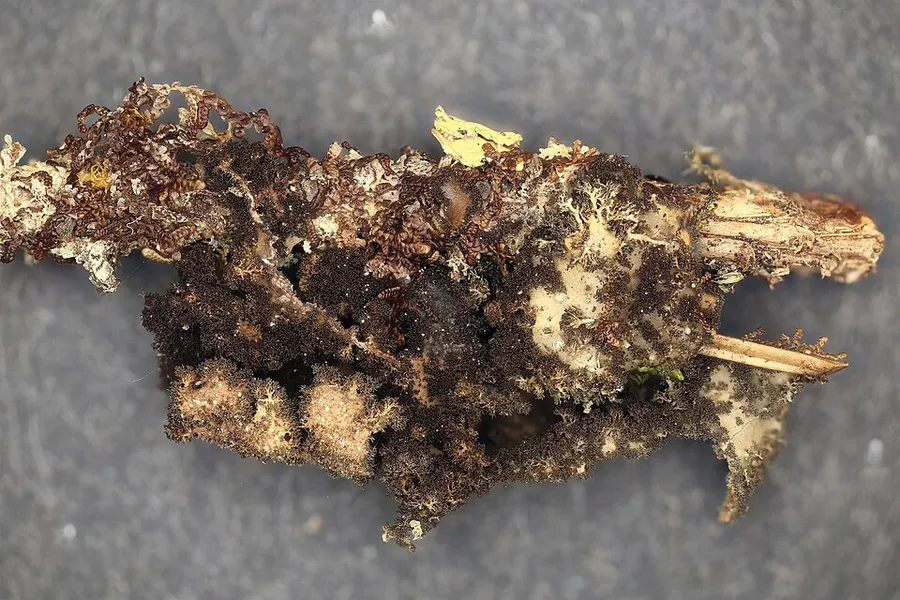
Dokumentasi Sticta torii dari Wikimedia Commons. A new to science lichen species was discovered on Coronation Island wilderness. It has been named Sticta torii, after the well-known lichenologist from Norway Tør Tønsberg. Dr. Tønsberg is not a stranger to the Tongass, and he occasionally visits our forest in search of lichens. This lichen was collected by forest ecologist Karen Dillman while working on Coronation island, installing air quality monitoring plots. It has not yet been found in any other location in Alaska. It is also known from one location in Canada, near Vancouver, and in coastal Oregon. It is very small, but can be easily distinguished from the others in its genus. Molecular analysis helped determine its uniqueness as a species. Lichens are a species-rich group on the Tongass, with nearly 1000 species in all terrestrial habitats from sea shore to alpine. Identifikasi mengikuti record berkas sumber.
- Jenis
- Fotografi
- Kredit
- United States Forest Service
- Lisensi
- Public domain
- Sumber media
- Buka entri sumber
Sumber profil
- [1] Sticta torii — Wikipedia (en)
- [2] Catalogue of Life Base2026-09-11 — Sticta torii
- [3] Dokumentasi visual — Sticta torii
Rujukan halaman ini
Fungi. Sticta torii. Rilis data fungi-2026-10-12-expansion-2. https://fungi-atlas.mgadib.chatgpt.site/jamur/sticta-torii/.
Status: impor sumber; pemeriksaan editorial per profil belum selesai. Untuk klaim biologis, gunakan rujukan pada bagian terkait dan periksa konteks sumber aslinya.