01 / Morfologi

Ciri dan struktur

Differing from S. pseudoimpressula in the predominantly bicellular spores and the absence of secondary tomentum and the K+ violet (instead of carmine-red) reaction of the apothecial atraquinone. Primary photobiont cyanobacterial (Nostoc). Stipe absent. Thallus irregular to suborbicular, up to 10 cm diam., moderately branched, with 3–5 branches per 5 cm radius, branching polytomous; lobes laciniate to flabellate, adjacent, involute to weakly canaliculate, with obtuse to truncate, plane to revolute apices and their margins entire, slightly thickened; lobe internodes (3–)6–8(–20) mm long, (4–)7–10(–13) mm broad; thallus coriaceous. Upper surface pitted to shallowly scrobiculate to rugose, light brown with darker apices in the herbarium, shiny, with the marginal line in the same colour; surface glabrous, without papillae and pruina, without maculae; marginal cilia present, about 0.5 mm, abundant to scarce, white to golden brown, agglutinated. Apothecia scarce, laminal, dispersed, subpedicellate, with pronounced invagination on lower side, up to 2.5 mm diam.; disc orange-brown (in young apothecia) to brown or greenish (in older apothecia) due to the presence of pruina, along the margin with an orange pigment; margin hirsute, with white to golden brown hairs. Vegetative propagules absent. Lower surface uneven, beige to light brown; primary tomentum dense to the margin, thick, but thinner towards the margin, spongy, soft, white to dark brown often with brown tips; secondary tomentum absent. Rhizines absent. Cyphellae 1–10 per cm 2 towards the thallus centre and 21–40 per cm 2 towards the margin, abundant, scattered, rounded to irregular, urceolate with wide pore, prominent, remaining below the level of the primary tomentum, with the margin raised and involute, white to brown coloured, without or with tomentum at the base; pore (0.25–)0.5–1(–1.5) mm diam.; basal membrane pruinose in the appearance, white, K– to K+ yellow, C–, KC –, Pd –.

Sebagian uraian ditampilkan dalam bahasa sumber; terjemahannya belum tersedia atau belum lolos pemeriksaan.

Rujukan: [1]

Pengukuran mengikuti objek, spesimen atau kultur, dan metode yang disebutkan sumber. Baca uraian asli untuk konteks lengkap.

02 / Kehidupan

Habitat dan peran ekologis

The species is known from the Parque Nacional y Área Natural de Manejo Integrado Madidi, a protected area in the Department La Paz. It was found epiphytic at an elevation of 3290 m.

Sebagian uraian ditampilkan dalam bahasa sumber; terjemahannya belum tersedia atau belum lolos pemeriksaan.

Rujukan: [1]

Habitat atau konteks temuan
Informasi belum tersedia pada sumber rilis ini.
Substrat
Informasi belum tersedia pada sumber rilis ini.
Peran atau konteks
Pembentuk liken
Temukan hubungan serupa
03 / Siklus hidup

Reproduksi

Differing from S. pseudoimpressula in the predominantly bicellular spores and the absence of secondary tomentum and the K+ violet (instead of carmine-red) reaction of the apothecial atraquinone. Primary photobiont cyanobacterial (Nostoc). Stipe absent. Thallus irregular to suborbicular, up to 10 cm diam., moderately branched, with 3–5 branches per 5 cm radius, branching polytomous; lobes laciniate to flabellate, adjacent, involute to weakly canaliculate, with obtuse to truncate, plane to revolute apices and their margins entire, slightly thickened; lobe internodes (3–)6–8(–20) mm long, (4–)7–10(–13) mm broad; thallus coriaceous. Upper surface pitted to shallowly scrobiculate to rugose, light brown with darker apices in the herbarium, shiny, with the marginal line in the same colour; surface glabrous, without papillae and pruina, without maculae; marginal cilia present, about 0.5 mm, abundant to scarce, white to golden brown, agglutinated.

Sebagian uraian ditampilkan dalam bahasa sumber; terjemahannya belum tersedia atau belum lolos pemeriksaan.

Rujukan: [1]

04 / Batas informasi

Catatan identitas dan cakupan

  • Nama diterima mengikuti Catalogue of Life Base2026-09-11; uraian mempertahankan konsep dan nama sumber aslinya.
  • Preserve original treatment localities, hosts and substrate scope. Materials examined describe documented specimens, not the full global range.
  • Impor dan terjemahan otomatis belum diperiksa editorial per profil. Struktur reproduktif yang disebutkan tidak membuktikan seluruh siklus hidup diketahui.
  • Pengukuran pada uraian mengikuti spesimen, kultur, dan metode sumber; angka tidak diperluas ke semua populasi.

Catatan distribusi dalam narasi mengikuti sumbernya. Dokumentasi spesimen atau foto mengikuti catatan sumber. Bukti wilayah Indonesia dan penilaian konservasi tidak disimpulkan dari gambar.

05 / Dokumentasi

Melihat dengan konteks

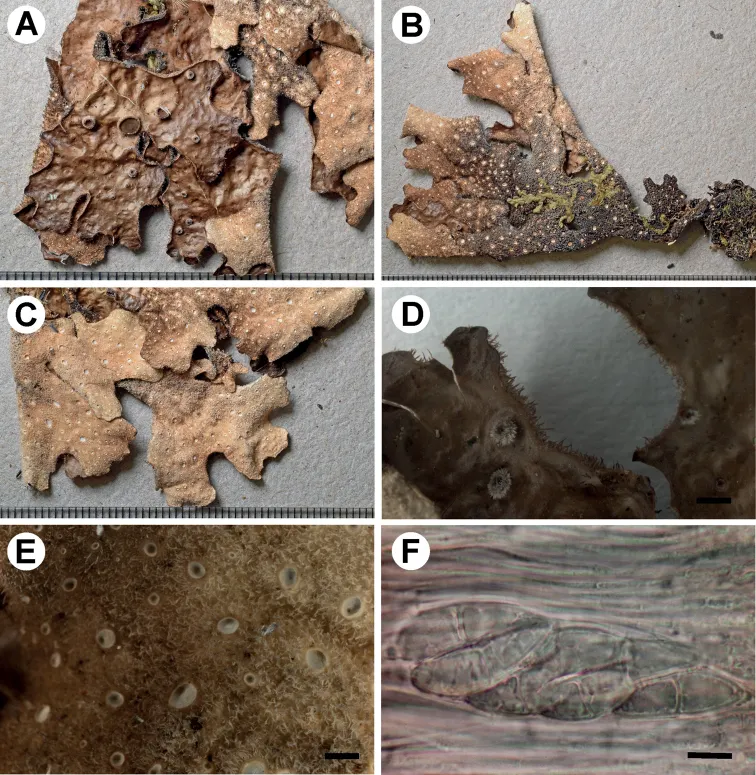
Morphology of Sticta bicellulata (holotype) A enlarged part of thallus showing pitted to rugose upper surface and laminal apothecia B lower surface C enlarged part of lower surface of the thallus D apothecia with hirsute margins and cilia at the lobe margins E tomentum and cyphellae F ascus with 1-septate ascospores. Scale bars: 1 mm (A–E); 10 μm (F).

Jenis
Pelat ilmiah
Kredit
Emilia Anna Ossowska, Bibiana Moncada, Martin Kukwa, Adam Flakus, Pamela Rodriguez-Flakus, Sandra Olszewska, Robert Lücking
Lisensi
CC BY 4.0
Sumber media
Buka entri sumber

Gambar menunjukkan objek menurut identifikasi sumber, bukan verifikasi independen spesimen oleh Fungi. Tidak ada skala baru yang ditambahkan.

06 / Rujukan

Sumber profil

  1. [1] New species of Sticta (lichenised Ascomycota, lobarioid Peltigeraceae) from Bolivia suggest a high level of endemism in the Central Andes — Sticta bicellulataBagian sumber: PMC9849061_section_23
    Tanggal penghimpunan sumber: 2026-10-12
    Teks sumber: CC BY 4.0 · Ossowska EA, Moncada B, Kukwa M, Flakus A, Rodriguez-Flakus P, Olszewska S, Lücking R.
  2. [2] Catalogue of Life Base2026-09-11 — Sticta bicellulataBagian sumber: ColDP NameUsage.tsv ID B2SFC; accepted species; source 2073
    Tanggal penghimpunan sumber: 2026-10-12
  3. [3] Dokumentasi visual — Sticta bicellulataBagian sumber: Individual media record; identification follows the source, not independent determination
    Tanggal penghimpunan sumber: 2026-10-12
    Media sumber: CC BY 4.0 · Emilia Anna Ossowska, Bibiana Moncada, Martin Kukwa, Adam Flakus, Pamela Rodriguez-Flakus, Sandra Olszewska, Robert Lücking

Adaptasi teks: CC BY 4.0. Ossowska EA, Moncada B, Kukwa M, Flakus A, Rodriguez-Flakus P, Olszewska S, Lücking R. — New species of Sticta (lichenised Ascomycota, lobarioid Peltigeraceae) from Bolivia suggest a high level of endemism in the Central Andes — Sticta bicellulata

Uraian asli dan riwayat sumber

Riwayat atau halaman sumber

Ringkasan sumber

Differing from S. pseudoimpressula in the predominantly bicellular spores and the absence of secondary tomentum and the K+ violet (instead of carmine-red) reaction of the apothecial atraquinone. Primary photobiont cyanobacterial (Nostoc). Stipe absent. Thallus irregular to suborbicular, up to 10 cm diam., moderately branched, with 3–5 branches per 5 cm radius, branching polytomous; lobes laciniate to flabellate, adjacent, involute to weakly canaliculate, with obtuse to truncate, plane to revolute apices and their margins entire, slightly thickened; lobe internodes (3–)6–8(–20) mm long, (4–)7–10(–13) mm broad; thallus coriaceous.

Revisi sumber

Morfologi sumber

Differing from S. pseudoimpressula in the predominantly bicellular spores and the absence of secondary tomentum and the K+ violet (instead of carmine-red) reaction of the apothecial atraquinone. Primary photobiont cyanobacterial (Nostoc). Stipe absent. Thallus irregular to suborbicular, up to 10 cm diam., moderately branched, with 3–5 branches per 5 cm radius, branching polytomous; lobes laciniate to flabellate, adjacent, involute to weakly canaliculate, with obtuse to truncate, plane to revolute apices and their margins entire, slightly thickened; lobe internodes (3–)6–8(–20) mm long, (4–)7–10(–13) mm broad; thallus coriaceous. Upper surface pitted to shallowly scrobiculate to rugose, light brown with darker apices in the herbarium, shiny, with the marginal line in the same colour; surface glabrous, without papillae and pruina, without maculae; marginal cilia present, about 0.5 mm, abundant to scarce, white to golden brown, agglutinated. Apothecia scarce, laminal, dispersed, subpedicellate, with pronounced invagination on lower side, up to 2.5 mm diam.; disc orange-brown (in young apothecia) to brown or greenish (in older apothecia) due to the presence of pruina, along the margin with an orange pigment; margin hirsute, with white to golden brown hairs. Vegetative propagules absent. Lower surface uneven, beige to light brown; primary tomentum dense to the margin, thick, but thinner towards the margin, spongy, soft, white to dark brown often with brown tips; secondary tomentum absent. Rhizines absent. Cyphellae 1–10 per cm 2 towards the thallus centre and 21–40 per cm 2 towards the margin, abundant, scattered, rounded to irregular, urceolate with wide pore, prominent, remaining below the level of the primary tomentum, with the margin raised and involute, white to brown coloured, without or with tomentum at the base; pore (0.25–)0.5–1(–1.5) mm diam.; basal membrane pruinose in the appearance, white, K– to K+ yellow, C–, KC –, Pd –.

Revisi sumber

Ekologi sumber

The species is known from the Parque Nacional y Área Natural de Manejo Integrado Madidi, a protected area in the Department La Paz. It was found epiphytic at an elevation of 3290 m.

Revisi sumber

Struktur reproduksi sumber

Differing from S. pseudoimpressula in the predominantly bicellular spores and the absence of secondary tomentum and the K+ violet (instead of carmine-red) reaction of the apothecial atraquinone. Primary photobiont cyanobacterial (Nostoc). Stipe absent. Thallus irregular to suborbicular, up to 10 cm diam., moderately branched, with 3–5 branches per 5 cm radius, branching polytomous; lobes laciniate to flabellate, adjacent, involute to weakly canaliculate, with obtuse to truncate, plane to revolute apices and their margins entire, slightly thickened; lobe internodes (3–)6–8(–20) mm long, (4–)7–10(–13) mm broad; thallus coriaceous. Upper surface pitted to shallowly scrobiculate to rugose, light brown with darker apices in the herbarium, shiny, with the marginal line in the same colour; surface glabrous, without papillae and pruina, without maculae; marginal cilia present, about 0.5 mm, abundant to scarce, white to golden brown, agglutinated.

Revisi sumber

Rujukan halaman ini

Fungi. Sticta bicellulata. Rilis data fungi-2026-10-12-expansion-2. https://fungi-atlas.mgadib.chatgpt.site/jamur/sticta-bicellulata/.

Status: impor sumber; pemeriksaan editorial per profil belum selesai. Untuk klaim biologis, gunakan rujukan pada bagian terkait dan periksa konteks sumber aslinya.