01 / Morfologi

Ciri dan struktur

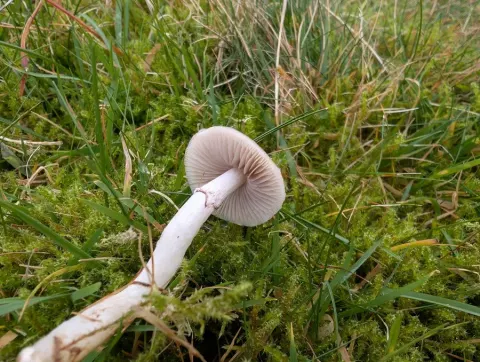
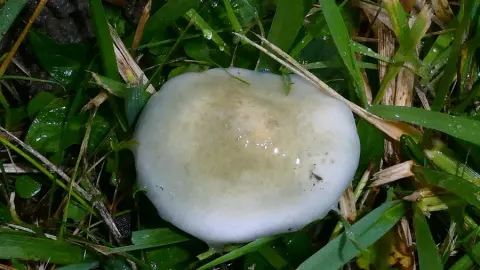
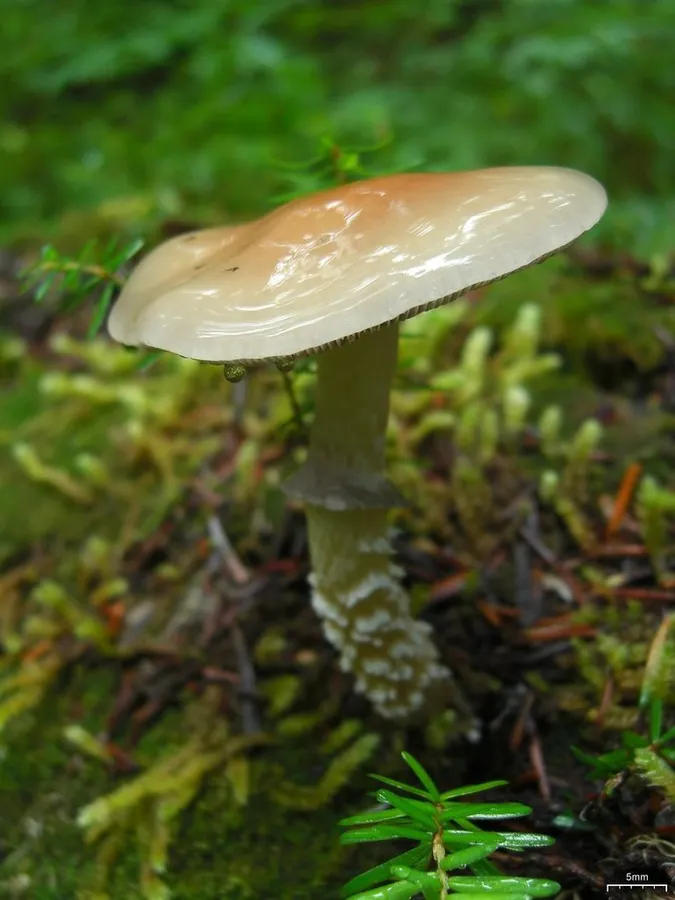
Stropharia hornemannii is a distinctive mushroom-forming fungus species within the genus Stropharia. The fruiting body features a large cap measuring up to 12 cm in diameter, appearing slender with a yellowish-white colouration, occasionally showing brownish-yellow stains. A pendant (hanging), pleated-grooved, fragile ring encircles the upper portion, though this may deteriorate with age. Below the ring, the stipe is covered with whitish, spreading scales that can also disappear in mature specimens, while above it displays a roughly powdered appearance. The gills lamella are closely arranged, broadly attached to the stipe, and extend down it in a thin line. Young specimens display a greyish-violet colour with amethyst tints, later becoming discoloured by the spores. The gill edges appear whitish and fringed under magnification. When cut, the mushroom emits a strong, unpleasant odour, though this is less noticeable externally. The taste is described as unpleasant and bitter after chewing. Microscopically, the spores measure 11.5–13 × 6–6.5 μm, are elliptical with a distinct germination pore, and are carried on four-spored basidia. The gill edges contain numerous marginal hairs (cheilocystidia) while the faces feature chrysocystidia of variable shape. The cap cuticle consists of slender, clamped hyphae with gelatinised walls, while the flesh contains oil-bearing hyphae that fragment into refractive yellow cylindrical bodies. The mushroom is inedible and may be poisonous.

Sebagian uraian ditampilkan dalam bahasa sumber; terjemahannya belum tersedia atau belum lolos pemeriksaan.

Rujukan: [1]

Pengukuran mengikuti objek, spesimen atau kultur, dan metode yang disebutkan sumber. Baca uraian asli untuk konteks lengkap.

02 / Kehidupan

Habitat dan peran ekologis

Stropharia hornemannii is primarily a boreal species with a distribution centred in Northern Europe. It is particularly common in Scandinavia, where Elias Magnus Fries described it as "ubiquitous in our coniferous forests on the ground, rarer on trunks, throughout autumn" in his Monographia. The species has been documented at various locations throughout Central Europe, with detailed occurrence records compiled by various mycologists. The first confirmed collection in France was reported in 1971 from the Massif Central, representing the westernmost extension of its known range at that time. This significant finding included over 50 fruiting bodies growing in several locations near Col de la Charme at an altitude of about 1,200 metres in the Bois Noirs region. The species was found in a gently sloping fir-dominated forest, primarily growing on decaying wood fragments buried within humus and moss (Rhytidiadelphus loreus). The mushroom appears to prefer coniferous woodland habitats, particularly those dominated by fir species. While it is most frequently found terrestrially, it can occasionally be observed growing directly on decaying wood. Its fruiting period extends throughout the autumn months, with documented collections in France occurring in September and October.

Sebagian uraian ditampilkan dalam bahasa sumber; terjemahannya belum tersedia atau belum lolos pemeriksaan.

Rujukan: [1]

Habitat atau konteks temuan
hutan
Substrat
kayu; tanah
Peran atau konteks
Belum dikategorikan pada rilis ini.
Temukan hubungan serupa
03 / Siklus hidup

Reproduksi

Stropharia hornemannii is a distinctive mushroom-forming fungus species within the genus Stropharia. The fruiting body features a large cap measuring up to 12 cm in diameter, appearing slender with a yellowish-white colouration, occasionally showing brownish-yellow stains. A pendant (hanging), pleated-grooved, fragile ring encircles the upper portion, though this may deteriorate with age. Below the ring, the stipe is covered with whitish, spreading scales that can also disappear in mature specimens, while above it displays a roughly powdered appearance. The gills lamella are closely arranged, broadly attached to the stipe, and extend down it in a thin line. Young specimens display a greyish-violet colour with amethyst tints, later becoming discoloured by the spores.

Sebagian uraian ditampilkan dalam bahasa sumber; terjemahannya belum tersedia atau belum lolos pemeriksaan.

Rujukan: [1]

Sinonim menurut acuan taksonomi rilis: Agaricus depilatus; Agaricus hornemannii; Agaricus hornemannii var. depilatus; Fungus depilatus; Naematoloma hornemannii; Psalliota depilata; Psilocybe hornemannii; Stropharia depilata; Stropharia depilata var. microspora
04 / Batas informasi

Catatan identitas dan cakupan

  • Nama diterima mengikuti Catalogue of Life Base2026-09-11; uraian mempertahankan konsep dan nama sumber aslinya.
  • Original geographic, specimen and life-cycle scope retained; source import awaits individual editorial review.
  • Impor dan terjemahan otomatis belum diperiksa editorial per profil. Struktur reproduktif yang disebutkan tidak membuktikan seluruh siklus hidup diketahui.
  • Pengukuran pada uraian mengikuti spesimen, kultur, dan metode sumber; angka tidak diperluas ke semua populasi.

Catatan distribusi dalam narasi mengikuti sumbernya. Dokumentasi spesimen atau foto mengikuti catatan sumber. Bukti wilayah Indonesia dan penilaian konservasi tidak disimpulkan dari gambar.

05 / Dokumentasi

Melihat dengan konteks

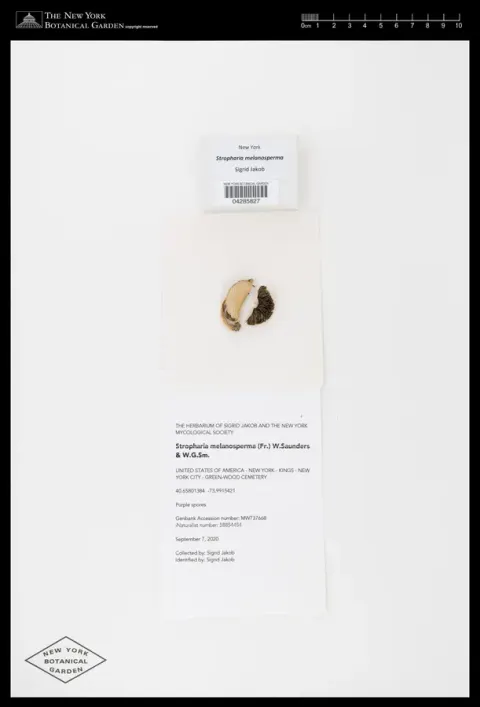
Dokumentasi Stropharia hornemannii menurut asosiasi foto pada record takson iNaturalist. Kredit: Jason Hollinger. Identitas mengikuti sumber; bukan penentuan spesimen independen.

Jenis
Fotografi
Kredit
(c) Jason Hollinger, some rights reserved (CC BY)
Lisensi
CC BY 4.0
Sumber media
Buka entri sumber

Gambar menunjukkan objek menurut identifikasi sumber, bukan verifikasi independen spesimen oleh Fungi. Tidak ada skala baru yang ditambahkan.

06 / Rujukan

Sumber profil

  1. [1] Stropharia hornemannii — Wikipedia (en)Bagian sumber: Frozen revision 1329712224
    Tanggal penghimpunan sumber: 2026-10-12
    Teks sumber: CC BY-SA4.0 · Wikipedia contributors
  2. [2] Catalogue of Life Base2026-09-11 — Stropharia hornemanniiBagian sumber: ColDP NameUsage.tsv ID 535JR; accepted species; source 2073
    Tanggal penghimpunan sumber: 2026-10-12
  3. [3] Dokumentasi visual — Stropharia hornemanniiBagian sumber: Individual media record; identification follows the source, not independent determination
    Tanggal penghimpunan sumber: 2026-10-12
    Media sumber: CC BY 4.0 · (c) Jason Hollinger, some rights reserved (CC BY)

Adaptasi teks: CC BY-SA 4.0. Wikipedia contributors — Stropharia hornemannii — Wikipedia (en)

Uraian asli dan riwayat sumber

Riwayat atau halaman sumber

Ringkasan sumber

Stropharia hornemannii, commonly known as the luxuriant ringstalk or lacerated stropharia, is a species of agaric fungus in the family Strophariaceae. The fungus produces distinctive mushrooms with caps up to 12 cm wide, which range from greyish-brown with purplish tints to reddish-brown, featuring a hanging ring on the stipe and gills that change from greyish-violet to dark purple-brown as they mature.

Revisi sumber

Morfologi sumber

Stropharia hornemannii is a distinctive mushroom-forming fungus species within the genus Stropharia. The fruiting body features a large cap measuring up to 12 cm in diameter, appearing slender with a yellowish-white colouration, occasionally showing brownish-yellow stains. A pendant (hanging), pleated-grooved, fragile ring encircles the upper portion, though this may deteriorate with age. Below the ring, the stipe is covered with whitish, spreading scales that can also disappear in mature specimens, while above it displays a roughly powdered appearance. The gills lamella are closely arranged, broadly attached to the stipe, and extend down it in a thin line. Young specimens display a greyish-violet colour with amethyst tints, later becoming discoloured by the spores. The gill edges appear whitish and fringed under magnification. When cut, the mushroom emits a strong, unpleasant odour, though this is less noticeable externally. The taste is described as unpleasant and bitter after chewing. Microscopically, the spores measure 11.5–13 × 6–6.5 μm, are elliptical with a distinct germination pore, and are carried on four-spored basidia. The gill edges contain numerous marginal hairs (cheilocystidia) while the faces feature chrysocystidia of variable shape. The cap cuticle consists of slender, clamped hyphae with gelatinised walls, while the flesh contains oil-bearing hyphae that fragment into refractive yellow cylindrical bodies. The mushroom is inedible and may be poisonous.

Revisi sumber

Ekologi sumber

Stropharia hornemannii is primarily a boreal species with a distribution centred in Northern Europe. It is particularly common in Scandinavia, where Elias Magnus Fries described it as "ubiquitous in our coniferous forests on the ground, rarer on trunks, throughout autumn" in his Monographia. The species has been documented at various locations throughout Central Europe, with detailed occurrence records compiled by various mycologists. The first confirmed collection in France was reported in 1971 from the Massif Central, representing the westernmost extension of its known range at that time. This significant finding included over 50 fruiting bodies growing in several locations near Col de la Charme at an altitude of about 1,200 metres in the Bois Noirs region. The species was found in a gently sloping fir-dominated forest, primarily growing on decaying wood fragments buried within humus and moss (Rhytidiadelphus loreus). The mushroom appears to prefer coniferous woodland habitats, particularly those dominated by fir species. While it is most frequently found terrestrially, it can occasionally be observed growing directly on decaying wood. Its fruiting period extends throughout the autumn months, with documented collections in France occurring in September and October.

Revisi sumber

Struktur reproduksi sumber

Stropharia hornemannii is a distinctive mushroom-forming fungus species within the genus Stropharia. The fruiting body features a large cap measuring up to 12 cm in diameter, appearing slender with a yellowish-white colouration, occasionally showing brownish-yellow stains. A pendant (hanging), pleated-grooved, fragile ring encircles the upper portion, though this may deteriorate with age. Below the ring, the stipe is covered with whitish, spreading scales that can also disappear in mature specimens, while above it displays a roughly powdered appearance. The gills lamella are closely arranged, broadly attached to the stipe, and extend down it in a thin line. Young specimens display a greyish-violet colour with amethyst tints, later becoming discoloured by the spores.

Revisi sumber

Rujukan halaman ini

Fungi. Stropharia hornemannii. Rilis data fungi-2026-10-12-expansion-2. https://fungi-atlas.mgadib.chatgpt.site/jamur/stropharia-hornemannii/.

Status: impor sumber; pemeriksaan editorial per profil belum selesai. Untuk klaim biologis, gunakan rujukan pada bagian terkait dan periksa konteks sumber aslinya.