01 / Morfologi

Ciri dan struktur

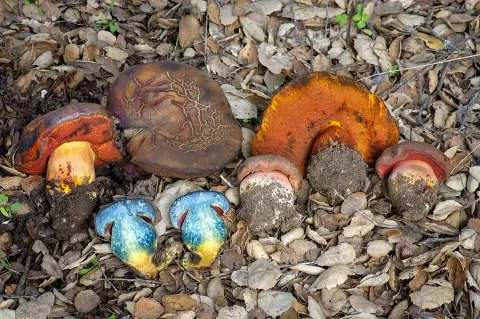
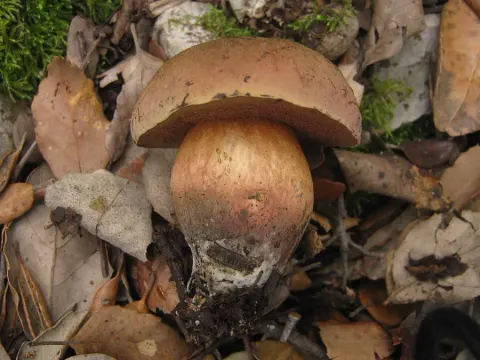
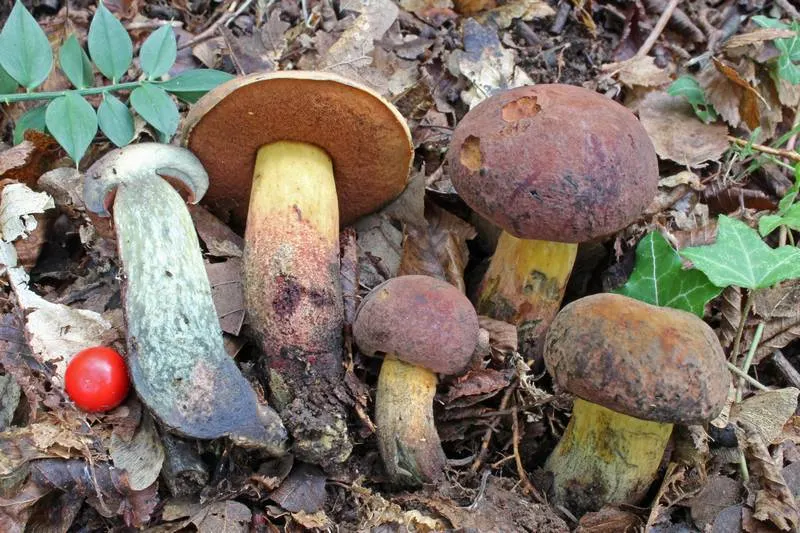
Suillellus adonis has a striking appearance with its vibrant colouration and distinctive features. The cap ranges from 4.5 to 11 cm in diameter and has a convex shape with an uneven surface. It has a dry, finely velvety-tomentose texture and is predominantly deep red. The colour becomes paler toward the margin, transitioning to reddish orange or yellow orange. Some specimens may display purplish-black streaks or spots across the cap surface. The underside of the cap reveals yellow to olive pores that are about 1 mm wide and distinctly maze-like (labyrinthiform). These pores stain intensely blue when bruised or damaged, a characteristic reaction in many bolete mushrooms. The tubes connected to these pores attach to the stipe (adnate) or are slightly depressed near it, measuring up to 17 mm long near the stipe but becoming shorter (3–5 mm) toward the cap margin. The stipe measures 3.5–6.5 cm in length and 1–4 cm in thickness. It can be cylindrical or taper toward the base and is solidly constructed. The stipe colouration ranges from pale yellow to golden yellow, sometimes matching the cap colour partially or completely, while the base displays a dark wine-like (vinaceous) colour. The stipe surface is dry and distinctly covered with a powdery bloom (pruinose), which varies in colour from yellow to orange to red. When cut, the mushroom's internal flesh reveals more diagnostic features. In the cap, the flesh is whitish to pale yellow, becoming golden yellow above the tubes. The stipe flesh shows pale yellow to yellow coloration in the upper third, transitioning to dark vinaceous in the lower part.

Sebagian uraian ditampilkan dalam bahasa sumber; terjemahannya belum tersedia atau belum lolos pemeriksaan.

Rujukan: [1]

Pengukuran mengikuti objek, spesimen atau kultur, dan metode yang disebutkan sumber. Baca uraian asli untuk konteks lengkap.

02 / Kehidupan

Habitat dan peran ekologis

Suillellus adonis is found in Mediterranean regions, specifically recorded from Croatia and Italy. The type specimens were collected in Croatia on the island of Cres, growing among grass in a small sheep pasture near holm oak (Quercus ilex) and European black pine (Pinus nigra) at an elevation of 100 metres above sea level. This apparently rare fungus was later reported from Cyprus. The species grows in groups (gregariously), sometimes in small clusters of two or three fruiting bodies. It appears to form mycorrhizal associations with Mediterranean trees, particularly holm oak.

Sebagian uraian ditampilkan dalam bahasa sumber; terjemahannya belum tersedia atau belum lolos pemeriksaan.

Rujukan: [1]

Habitat atau konteks temuan
padang rumput
Substrat
Informasi belum tersedia pada sumber rilis ini.
Peran atau konteks
Mitra tumbuhan
Temukan hubungan serupa
03 / Siklus hidup

Reproduksi

Under the microscope, Suillellus adonis displays ovate to somewhat elliptic spores measuring roughly 10.5 × 6.2 μm, appearing smooth and ochraceous-brown when viewed in potassium hydroxide solution. The mushroom's cellular structure includes club-shaped basidia (spore-producing cells), scattered cystidia on the tubes, and a cap cuticle composed of interwoven, finely granulated hyphae with specialized terminal cells. A particularly distinctive microscopic feature is the strong reaction with Melzer's reagent, causing all parts of the fruiting body to stain deep turquoise to blackish blue—a characteristic that helps differentiate it from similar-looking species.

Sebagian uraian ditampilkan dalam bahasa sumber; terjemahannya belum tersedia atau belum lolos pemeriksaan.

Rujukan: [1]

Sinonim menurut acuan taksonomi rilis: Boletus adonis
04 / Batas informasi

Catatan identitas dan cakupan

  • Nama diterima mengikuti Catalogue of Life Base2026-09-11; uraian mempertahankan konsep dan nama sumber aslinya.
  • Original geographic, specimen and life-cycle scope retained; source import awaits individual editorial review.
  • Impor dan terjemahan otomatis belum diperiksa editorial per profil. Struktur reproduktif yang disebutkan tidak membuktikan seluruh siklus hidup diketahui.
  • Pengukuran pada uraian mengikuti spesimen, kultur, dan metode sumber; angka tidak diperluas ke semua populasi.

Catatan distribusi dalam narasi mengikuti sumbernya. Dokumentasi spesimen atau foto mengikuti catatan sumber. Bukti wilayah Indonesia dan penilaian konservasi tidak disimpulkan dari gambar.

05 / Dokumentasi

Melihat dengan konteks

Dokumentasi Suillellus adonis menurut asosiasi foto pada record takson iNaturalist. Kredit: Davide Puddu. Identitas mengikuti sumber; bukan penentuan spesimen independen.

Jenis
Fotografi
Kredit
(c) Davide Puddu, einige Rechte vorbehalten (CC BY), hochgeladen von Davide Puddu
Lisensi
CC BY 4.0
Sumber media
Buka entri sumber

Gambar menunjukkan objek menurut identifikasi sumber, bukan verifikasi independen spesimen oleh Fungi. Tidak ada skala baru yang ditambahkan.

06 / Rujukan

Sumber profil

  1. [1] Suillellus adonis — Wikipedia (en)Bagian sumber: Frozen revision 1288935291
    Tanggal penghimpunan sumber: 2026-10-12
    Teks sumber: CC BY-SA4.0 · Wikipedia contributors
  2. [2] Catalogue of Life Base2026-09-11 — Suillellus adonisBagian sumber: ColDP NameUsage.tsv ID 7B4P5; accepted species; source 2073
    Tanggal penghimpunan sumber: 2026-10-12
  3. [3] Dokumentasi visual — Suillellus adonisBagian sumber: Individual media record; identification follows the source, not independent determination
    Tanggal penghimpunan sumber: 2026-10-12
    Media sumber: CC BY 4.0 · (c) Davide Puddu, einige Rechte vorbehalten (CC BY), hochgeladen von Davide Puddu

Adaptasi teks: CC BY-SA 4.0. Wikipedia contributors — Suillellus adonis — Wikipedia (en)

Uraian asli dan riwayat sumber

Riwayat atau halaman sumber

Ringkasan sumber

Suillellus adonis is a species of bolete fungus described from Croatia in 2002 and named after the Greek mythological figure Adonis for its striking beauty and vibrant red colouration. The mushroom produces fruiting bodies with deep red caps that fade to reddish-orange or yellow-orange at the margins, yellow pores that turn intensely blue when bruised, and stipes with yellow to golden colours with a dark wine-red base and powdery surface. Its flesh quickly turns blue when cut, and it has a distinctive microscopic characteristic of staining deep turquoise to blackish blue with Melzer's reagent.

Revisi sumber

Morfologi sumber

Suillellus adonis has a striking appearance with its vibrant colouration and distinctive features. The cap ranges from 4.5 to 11 cm in diameter and has a convex shape with an uneven surface. It has a dry, finely velvety-tomentose texture and is predominantly deep red. The colour becomes paler toward the margin, transitioning to reddish orange or yellow orange. Some specimens may display purplish-black streaks or spots across the cap surface. The underside of the cap reveals yellow to olive pores that are about 1 mm wide and distinctly maze-like (labyrinthiform). These pores stain intensely blue when bruised or damaged, a characteristic reaction in many bolete mushrooms. The tubes connected to these pores attach to the stipe (adnate) or are slightly depressed near it, measuring up to 17 mm long near the stipe but becoming shorter (3–5 mm) toward the cap margin. The stipe measures 3.5–6.5 cm in length and 1–4 cm in thickness. It can be cylindrical or taper toward the base and is solidly constructed. The stipe colouration ranges from pale yellow to golden yellow, sometimes matching the cap colour partially or completely, while the base displays a dark wine-like (vinaceous) colour. The stipe surface is dry and distinctly covered with a powdery bloom (pruinose), which varies in colour from yellow to orange to red. When cut, the mushroom's internal flesh reveals more diagnostic features. In the cap, the flesh is whitish to pale yellow, becoming golden yellow above the tubes. The stipe flesh shows pale yellow to yellow coloration in the upper third, transitioning to dark vinaceous in the lower part.

Revisi sumber

Ekologi sumber

Suillellus adonis is found in Mediterranean regions, specifically recorded from Croatia and Italy. The type specimens were collected in Croatia on the island of Cres, growing among grass in a small sheep pasture near holm oak (Quercus ilex) and European black pine (Pinus nigra) at an elevation of 100 metres above sea level. This apparently rare fungus was later reported from Cyprus. The species grows in groups (gregariously), sometimes in small clusters of two or three fruiting bodies. It appears to form mycorrhizal associations with Mediterranean trees, particularly holm oak.

Revisi sumber

Struktur reproduksi sumber

Under the microscope, Suillellus adonis displays ovate to somewhat elliptic spores measuring roughly 10.5 × 6.2 μm, appearing smooth and ochraceous-brown when viewed in potassium hydroxide solution. The mushroom's cellular structure includes club-shaped basidia (spore-producing cells), scattered cystidia on the tubes, and a cap cuticle composed of interwoven, finely granulated hyphae with specialized terminal cells. A particularly distinctive microscopic feature is the strong reaction with Melzer's reagent, causing all parts of the fruiting body to stain deep turquoise to blackish blue—a characteristic that helps differentiate it from similar-looking species.

Revisi sumber

Rujukan halaman ini

Fungi. Suillellus adonis. Rilis data fungi-2026-10-12-expansion-2. https://fungi-atlas.mgadib.chatgpt.site/jamur/suillellus-adonis/.

Status: impor sumber; pemeriksaan editorial per profil belum selesai. Untuk klaim biologis, gunakan rujukan pada bagian terkait dan periksa konteks sumber aslinya.