01 / Morfologi

Ciri dan struktur

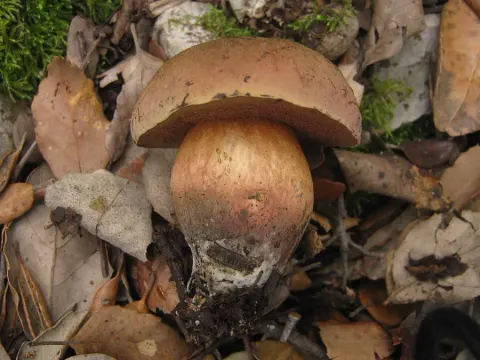
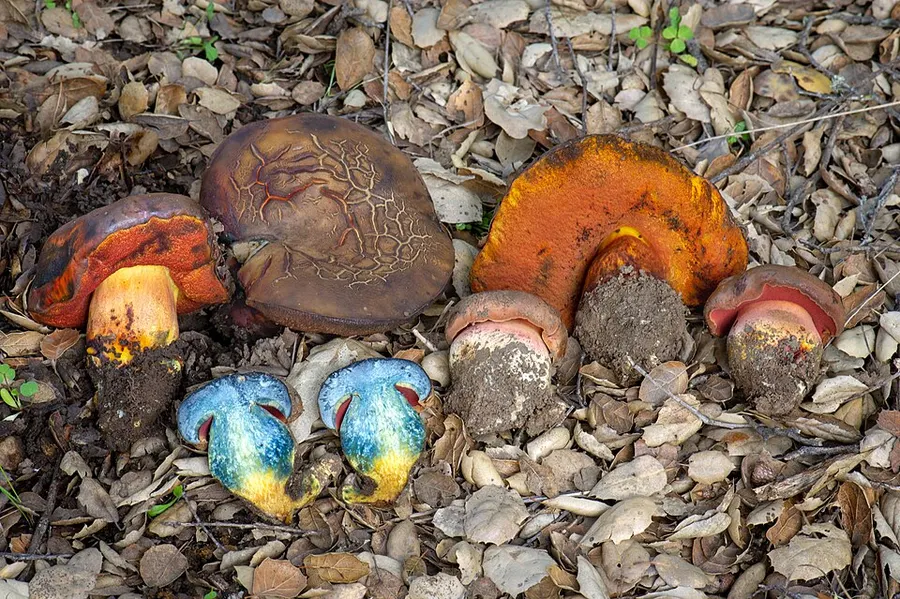
Suillellus amygdalinus is a large solid mushroom with a convex to somewhat flattened, irregular cap that can reach diameters of 6 to 12 cm at maturity. The surface of the cap is dry, and matted with fibers; the cap color of young specimens is red, but the mushrooms typically change to more brownish tones as they mature. The margin of the cap starts out curved inwards (incurved) and gradually becomes curved downwards (decurved) with age. The pores on the underside of the cap are 0.5 to 1 mm wide, angular, and red or red-orange, while the tubes are 1 to 1.5 cm deep. The stipe lacks a netted pattern (reticulation) and is yellow in color but is often covered by red hairs, especially near the base. The stipe is either equal in width throughout, or thicker in the middle; it reaches dimensions of 4 – 9 cm long by 1 – 3 cm thick. The base of the stipe is typically bent. The flesh is 1 to 2 cm thick, and yellow in color, but like all parts of the mushroom, will stain blue immediately upon bruising or cutting. Both the odor and taste of the fruit bodies are mild. Suillellus amygdalinus produces a dark olive-brown spore print. The spores are thick-walled, smooth, and ellipsoid to somewhat spindle-shaped, with dimensions of 11.2–16 by 5.2–8 μm. They become dark ochraceous when stained with Melzer's reagent, and, because of the occasional presence of two large vacuoles, may appear as if they are two-celled. The basidia (the spore-bearing cells) are club-shaped, contain numerous vacuoles, and measure 30–35 by 9–11 μm. Cystidia are present on sides of the tubes, and they measure 45–54 by 10–12 μm.

Sebagian uraian ditampilkan dalam bahasa sumber; terjemahannya belum tersedia atau belum lolos pemeriksaan.

Rujukan: [1]

Pengukuran mengikuti objek, spesimen atau kultur, dan metode yang disebutkan sumber. Baca uraian asli untuk konteks lengkap.

02 / Kehidupan

Habitat dan peran ekologis

Suillellus amygdalinus jamur tumbuh di tanah dalam kelompok, atau berkeliaran. Jamur telah dilaporkan dari hutan kayu keras yang rendah yang terdiri dari ek hidup, manzanita dan madrone di California, dan Oregon. Fruiting occurs setelah hujan musim gugur dimulai, biasanya antara October and Januari. Jamur ini bisa sulit untuk dideteksi, karena topi mirip dengan daun pohon madron yang dikaitkan dengannya, dan karena jamur sering dikubur di bawah daun.

Rujukan: [1]

Habitat atau konteks temuan
hutan
Substrat
tanah
Peran atau konteks
Belum dikategorikan pada rilis ini.
Temukan hubungan serupa
03 / Siklus hidup

Reproduksi

Suillellus amygdalinus produces a dark olive-brown spore print. The spores are thick-walled, smooth, and ellipsoid to somewhat spindle-shaped, with dimensions of 11.2–16 by 5.2–8 μm. They become dark ochraceous when stained with Melzer's reagent, and, because of the occasional presence of two large vacuoles, may appear as if they are two-celled. The basidia (the spore-bearing cells) are club-shaped, contain numerous vacuoles, and measure 30–35 by 9–11 μm. Cystidia are present on sides of the tubes, and they measure 45–54 by 10–12 μm. Clamp connections are not present in the hyphae of S. amygdalinus.

Sebagian uraian ditampilkan dalam bahasa sumber; terjemahannya belum tersedia atau belum lolos pemeriksaan.

Rujukan: [1]

Sinonim menurut acuan taksonomi rilis: Boletus amygdalinus
04 / Batas informasi

Catatan identitas dan cakupan

  • Nama diterima mengikuti Catalogue of Life Base2026-09-11; uraian mempertahankan konsep dan nama sumber aslinya.
  • Original geographic, specimen and life-cycle scope retained; source import awaits individual editorial review.
  • Impor dan terjemahan otomatis belum diperiksa editorial per profil. Struktur reproduktif yang disebutkan tidak membuktikan seluruh siklus hidup diketahui.
  • Pengukuran pada uraian mengikuti spesimen, kultur, dan metode sumber; angka tidak diperluas ke semua populasi.

Catatan distribusi dalam narasi mengikuti sumbernya. Dokumentasi spesimen atau foto mengikuti catatan sumber. Bukti wilayah Indonesia dan penilaian konservasi tidak disimpulkan dari gambar.

05 / Dokumentasi

Melihat dengan konteks

Dokumentasi Suillellus amygdalinus dari Wikimedia Commons. Suillellus amygdalinus growing with Quercus agrifolia in Baja California, Mexico. https://mushroomobserver.org/359247 Identifikasi mengikuti record berkas sumber.

Jenis
Fotografi
Kredit
Alan Rockefeller
Sumber media
Buka entri sumber

Gambar menunjukkan objek menurut identifikasi sumber, bukan verifikasi independen spesimen oleh Fungi. Tidak ada skala baru yang ditambahkan.

06 / Rujukan

Sumber profil

  1. [1] Suillellus amygdalinus — Wikipedia (en)Bagian sumber: Frozen revision 1301307042
    Tanggal penghimpunan sumber: 2026-10-12
    Teks sumber: CC BY-SA4.0 · Wikipedia contributors
  2. [2] Catalogue of Life Base2026-09-11 — Suillellus amygdalinusBagian sumber: ColDP NameUsage.tsv ID 7B4P2; accepted species; source 2073
    Tanggal penghimpunan sumber: 2026-10-12
  3. [3] Dokumentasi visual — Suillellus amygdalinusBagian sumber: Individual media record; identification follows the source, not independent determination
    Tanggal penghimpunan sumber: 2026-10-12
    Media sumber: CC BY-SA 4.0 · Alan Rockefeller

Adaptasi teks: CC BY-SA 4.0. Wikipedia contributors — Suillellus amygdalinus — Wikipedia (en)

Uraian asli dan riwayat sumber

Riwayat atau halaman sumber

Ringkasan sumber

Suillellus amygdalinus (formerly Boletus amygdalinus) is a fungus of the bolete family found in western North America. The fruit bodies, or mushrooms, are characterized by their thick, red to brown caps, red pores, and the strong bluing reaction observed when the mushroom tissue is injured or cut. The cap can reach diameters of up to 12 cm and the stipe 9 cm long by 3 cm thick at maturity. Other similar red-pored, bluing boletes from North America, including Rubroboletus eastwoodiae, Boletus luridiformis, and B. subvelutipes, can be distinguished from S. amygdalinus either by the color of the cap, the degree of reticulation (a network of raised ridges) on the stipe, or by location.

Revisi sumber

Morfologi sumber

Suillellus amygdalinus is a large solid mushroom with a convex to somewhat flattened, irregular cap that can reach diameters of 6 to 12 cm at maturity. The surface of the cap is dry, and matted with fibers; the cap color of young specimens is red, but the mushrooms typically change to more brownish tones as they mature. The margin of the cap starts out curved inwards (incurved) and gradually becomes curved downwards (decurved) with age. The pores on the underside of the cap are 0.5 to 1 mm wide, angular, and red or red-orange, while the tubes are 1 to 1.5 cm deep. The stipe lacks a netted pattern (reticulation) and is yellow in color but is often covered by red hairs, especially near the base. The stipe is either equal in width throughout, or thicker in the middle; it reaches dimensions of 4 – 9 cm long by 1 – 3 cm thick. The base of the stipe is typically bent. The flesh is 1 to 2 cm thick, and yellow in color, but like all parts of the mushroom, will stain blue immediately upon bruising or cutting. Both the odor and taste of the fruit bodies are mild. Suillellus amygdalinus produces a dark olive-brown spore print. The spores are thick-walled, smooth, and ellipsoid to somewhat spindle-shaped, with dimensions of 11.2–16 by 5.2–8 μm. They become dark ochraceous when stained with Melzer's reagent, and, because of the occasional presence of two large vacuoles, may appear as if they are two-celled. The basidia (the spore-bearing cells) are club-shaped, contain numerous vacuoles, and measure 30–35 by 9–11 μm. Cystidia are present on sides of the tubes, and they measure 45–54 by 10–12 μm.

Revisi sumber

Ekologi sumber

Suillellus amygdalinus mushrooms grow on the ground in groups, or scattered about. The fungus has been reported from low-elevation hardwood forests composed of live oak, manzanita and madrone in California, and Oregon. Fruiting occurs after the onset of autumn rains, usually between the October and January. The mushroom can be difficult to spot, as its cap is similar in coloring to the leaves of the madrone tree with which it is associated, and because the mushroom is frequently buried under leaves.

Revisi sumber

Struktur reproduksi sumber

Suillellus amygdalinus produces a dark olive-brown spore print. The spores are thick-walled, smooth, and ellipsoid to somewhat spindle-shaped, with dimensions of 11.2–16 by 5.2–8 μm. They become dark ochraceous when stained with Melzer's reagent, and, because of the occasional presence of two large vacuoles, may appear as if they are two-celled. The basidia (the spore-bearing cells) are club-shaped, contain numerous vacuoles, and measure 30–35 by 9–11 μm. Cystidia are present on sides of the tubes, and they measure 45–54 by 10–12 μm. Clamp connections are not present in the hyphae of S. amygdalinus.

Revisi sumber

Rujukan halaman ini

Fungi. Suillellus amygdalinus. Rilis data fungi-2026-10-12-expansion-2. https://fungi-atlas.mgadib.chatgpt.site/jamur/suillellus-amygdalinus/.

Status: impor sumber; pemeriksaan editorial per profil belum selesai. Untuk klaim biologis, gunakan rujukan pada bagian terkait dan periksa konteks sumber aslinya.