01 / Morfologi

Ciri dan struktur

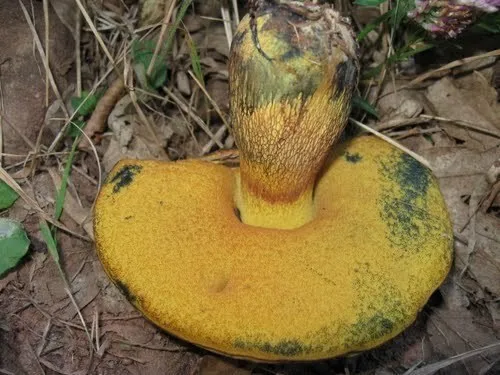
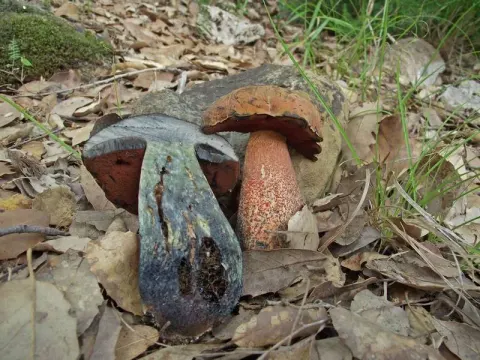
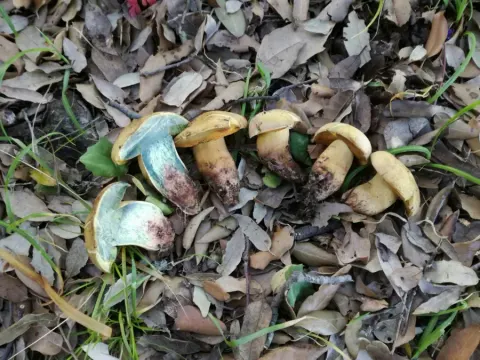
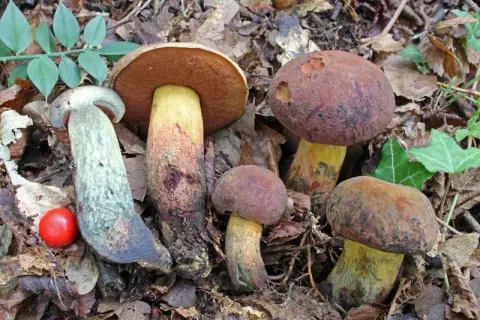
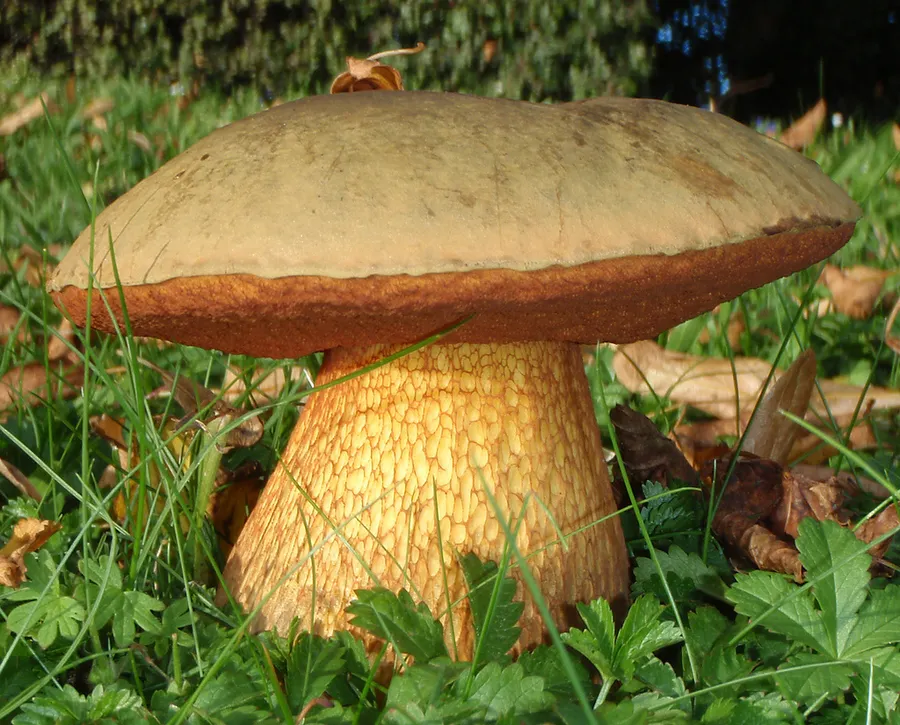
Suillellus luridus is a stout fungus with a thick yellow-olive to olive-brown convex cushion-shaped cap that can reach 20 cm in diameter. The cap colour tends to darken with age, and regions of red, orange, purple, brown, or olive-green can often be present. The cap surface is finely tomentose (velvety) at first, becoming smoother with old age, and viscid in wet weather. The pore surface is initially yellowish-orange or orange, before turning orange-red to sometimes red and stains strongly blue when injured or handled. The pore surface usually has a lighter-coloured zone encircling the margin, as the pores tend to darken from their point of attachment to the stem outwards. There are 2–3 rounded pores per millimetre, and the tubes are 1 – 2 cm long. The tubes are shorter around the cap margin and close to the stem, where they form a circular depression. Initially pale yellow, the tubes gradually become olive-yellow and stain bluish-green upon exposure to air. A frequent feature is the presence of a maroon layer between the tubes and the flesh (known as Bataille’s line), but this is not always present and subhymenial flesh can occasionally be yellow or straw-coloured. The stem is 8 – 14 cm tall and 1 – 3 cm wide, and bears a distinctive, elongated (or "stretched") orange-red reticulum (network) pattern on a paler yellowish, orange, or ochre background, often becoming darker and vinaceous towards the base. The flesh is yellowish, sometimes with red patches in the cap but almost always rhubarb to vinaceous-red towards the stem base, and stains an intense dark blue when bruised or cut.

Sebagian uraian ditampilkan dalam bahasa sumber; terjemahannya belum tersedia atau belum lolos pemeriksaan.

Rujukan: [1]

Pengukuran mengikuti objek, spesimen atau kultur, dan metode yang disebutkan sumber. Baca uraian asli untuk konteks lengkap.

02 / Kehidupan

Habitat dan peran ekologis

Jamur tumbuh di mikoriza asosiasi dengan pohon berdaun lebar seperti ek (Quercus), birch (Betula), kastanea (Castanea) dan bayak (Fagus), di tanah yang berkarat (kalkar). Di Republik Ceko, varietas rubriceps telah dilaporkan tumbuh di bawah linden (Tilia). Juga diduga sebagai mikoriza rekan subshrub rock rose dalam genus Helianthemum. Field studies menunjukkan bahwa jamur, ketika ditambakan sebagai pasangan mikoriza dengan benih konifer Cunninghamia lanceolata, meningkatkan tingkat kelangsungan hidup benih, meningkatkan ketinggian dan diameter tanahnya, dan meningkatkan kandungan klorofil di daun. Efek yang sama yang meningkatkan pertumbuhan telah diamati sebelumnya dengan benih Pinus taiwanensis. Efek bermanfaat ini pada pertumbuhan tanaman adalah hasil dari interaksi ganda antara jamur, tanaman tuan rumah, dan mikroba tanah asli yang meningkatkan biomassa karbon, dan meningkatkan keragaman bakteri di mikorrisosfer. Dalam sebuah studi yang membandingkan ketahanan garam dari tiga jamur umum ektomikoriza (yang lainnya adalah Suillus bovinus dan S. luteus), S. luridus adalah yang paling toleran terhadap konsentrasi garam yang tinggi, dan merupakan spesies kandidat yang baik untuk suntikan benih pohon untuk ditanam di tanah asin.

Rujukan: [1]

Habitat atau konteks temuan
Informasi belum tersedia pada sumber rilis ini.
Substrat
Informasi belum tersedia pada sumber rilis ini.
Peran atau konteks
Mitra tumbuhan
Temukan hubungan serupa
03 / Siklus hidup

Reproduksi

The spore print is olive to brownish olive. Under the microscope, the spores are elliptical to somewhat fusiform (spinde-shaped), measuring 11–15 μm long by 4.5–6.5 μm wide and have a median spore quotient of 2.2. The basidia (spore-bearing cells) are club-shaped and four-spored, and measure 29.2–36.5 by 11.0–12.4 μm. Cystidia on the sides of the tubes (pleurocystidia) are fuse-shaped with swollen middles and long necks, measuring 33–48 by 7.3–13.5 μm; cheilocystidia (on the edges of the pores) have a similar morphology. The cap cuticle is made of cylindrical hyphae 3.7–5.8 μm wide that are interwoven compactly, and the hyphal tips are erect and arranged in bundles. In contrast, the hyphae of the cap flesh is loosely interwoven with hyphae that are cylindrical and branched, measuring 3.7–8.8 μm.

Sebagian uraian ditampilkan dalam bahasa sumber; terjemahannya belum tersedia atau belum lolos pemeriksaan.

Rujukan: [1]

Sinonim menurut acuan taksonomi rilis: Boletus erythrentheron; Boletus luridus; Boletus luridus f. primulicolor; Boletus luridus subsp. erythrentheron; Boletus luridus var. erythrentheron; Boletus luridus var. lupiniformis; Boletus luridus var. obscurus; Boletus luridus var. rubriceps; Boletus luridus var. rubromaculatus; Boletus luridus var. tenuipes; Boletus luridus var. tuberosus; Boletus rubeolarius; Boletus rubeolarius var. miniatus; Boletus rubeolarius var. sanguineus; Boletus rubeolarius var. tuberosus; Boletus satanas var. tuberosus; Boletus subvescus; Boletus tuberosus; Boletus xanthorhodius; Dictyopus luridus; Dictyopus tuberosus; Leccinum luridum; Leccinum rubeolarium; Suillellus luridus f. primulicolor; Suillellus luridus var. erythrentheron; Suillellus luridus var. lupiniformis; Suillellus luridus var. queletiformis; Suillellus luridus var. rubriceps; Suillus luridus; Suillus rubeolarius; Tubiporus luridus; Tubiporus luridus var. rubriceps
04 / Batas informasi

Catatan identitas dan cakupan

  • Nama diterima mengikuti Catalogue of Life Base2026-09-11; uraian mempertahankan konsep dan nama sumber aslinya.
  • Original geographic, specimen and life-cycle scope retained; source import awaits individual editorial review.
  • Impor dan terjemahan otomatis belum diperiksa editorial per profil. Struktur reproduktif yang disebutkan tidak membuktikan seluruh siklus hidup diketahui.
  • Pengukuran pada uraian mengikuti spesimen, kultur, dan metode sumber; angka tidak diperluas ke semua populasi.

Catatan distribusi dalam narasi mengikuti sumbernya. Dokumentasi spesimen atau foto mengikuti catatan sumber. Bukti wilayah Indonesia dan penilaian konservasi tidak disimpulkan dari gambar.

05 / Dokumentasi

Melihat dengan konteks

Dokumentasi Suillellus luridus menurut asosiasi foto pada record takson iNaturalist. Kredit: 2010-09-13_Boletus_luridus_Schaeff_104527.jpg. Identitas mengikuti sumber; bukan penentuan spesimen independen.

Jenis
Fotografi
Kredit
(c) 2010-09-13_Boletus_luridus_Schaeff_104527.jpg, some rights reserved (CC BY-SA)
Sumber media
Buka entri sumber

Gambar menunjukkan objek menurut identifikasi sumber, bukan verifikasi independen spesimen oleh Fungi. Tidak ada skala baru yang ditambahkan.

Dokumentasi tambahan

06 / Rujukan

Sumber profil

  1. [1] Suillellus luridus — Wikipedia (en)Bagian sumber: Frozen revision 1322971499
    Tanggal penghimpunan sumber: 2026-10-12
    Teks sumber: CC BY-SA4.0 · Wikipedia contributors
  2. [2] Catalogue of Life Base2026-09-11 — Suillellus luridusBagian sumber: ColDP NameUsage.tsv ID 7B4RP; accepted species; source 2073
    Tanggal penghimpunan sumber: 2026-10-12
  3. [3] Dokumentasi visual — Suillellus luridusBagian sumber: Identitas mengikuti sumber dokumentasi; bukan penentuan spesimen independen.
    Tanggal penghimpunan sumber: 2026-10-17
    Media sumber: CC BY-SA 4.0 · (c) 2010-09-13_Boletus_luridus_Schaeff_104527.jpg, some rights reserved (CC BY-SA)
  4. [4] Dokumentasi visual — Suillellus luridusBagian sumber: Identitas mengikuti sumber dokumentasi; bukan penentuan spesimen independen.
    Tanggal penghimpunan sumber: 2026-10-17
    Teks sumber: CC BY 4.0 · (c) GLJIVARSKO DRUSTVO NIS, some rights reserved (CC BY)

Adaptasi teks: CC BY-SA 4.0. Wikipedia contributors — Suillellus luridus — Wikipedia (en)

Uraian asli dan riwayat sumber

Riwayat atau halaman sumber

Ringkasan sumber

Suillellus luridus (formerly Boletus luridus), commonly known as the lurid bolete, is a fungus of the family Boletaceae, found in calcareous broadleaved woodlands in Europe. Fruit bodies appear in summer and autumn and may be locally abundant. It is a firm bolete with an olive-brown cap up to 20 cm in diameter, with small orange or red pores on the underside (yellow when young). The stout ochre stem reaches 8 – 14 cm high and 1 – 3 cm wide, and is patterned with a red network. Like several other red-pored boletes, it stains blue when bruised or cut.

Revisi sumber

Morfologi sumber

Suillellus luridus is a stout fungus with a thick yellow-olive to olive-brown convex cushion-shaped cap that can reach 20 cm in diameter. The cap colour tends to darken with age, and regions of red, orange, purple, brown, or olive-green can often be present. The cap surface is finely tomentose (velvety) at first, becoming smoother with old age, and viscid in wet weather. The pore surface is initially yellowish-orange or orange, before turning orange-red to sometimes red and stains strongly blue when injured or handled. The pore surface usually has a lighter-coloured zone encircling the margin, as the pores tend to darken from their point of attachment to the stem outwards. There are 2–3 rounded pores per millimetre, and the tubes are 1 – 2 cm long. The tubes are shorter around the cap margin and close to the stem, where they form a circular depression. Initially pale yellow, the tubes gradually become olive-yellow and stain bluish-green upon exposure to air. A frequent feature is the presence of a maroon layer between the tubes and the flesh (known as Bataille’s line), but this is not always present and subhymenial flesh can occasionally be yellow or straw-coloured. The stem is 8 – 14 cm tall and 1 – 3 cm wide, and bears a distinctive, elongated (or "stretched") orange-red reticulum (network) pattern on a paler yellowish, orange, or ochre background, often becoming darker and vinaceous towards the base. The flesh is yellowish, sometimes with red patches in the cap but almost always rhubarb to vinaceous-red towards the stem base, and stains an intense dark blue when bruised or cut.

Revisi sumber

Ekologi sumber

The fungus grows in a mycorrhizal association with broad-leaved trees such as oak (Quercus), birch (Betula), chestnut (Castanea) and beech (Fagus), on chalky (calcareous) soils. In the Czech Republic, the variety rubriceps has been reported growing under linden (Tilia). It is also suspected of being a mycorrhizal associate of subshrub rock roses in the genus Helianthemum. Field studies indicate that the fungus, when paired as a mycorrhizal partner with seedlings of the conifer Cunninghamia lanceolata, increases the seedling's survival rate, augments its height and ground diameter, and increases the chlorophyll content in the leaves. A similar growth-enhancing effect had been noted earlier with Pinus taiwanensis seedlings. These beneficial effects on plant growth are a result of multiple interactions among the fungus, host plant, and indigenous soil microbes that increase the biomass of carbon, and increase the bacterial diversity in the mycorrhizosphere. In a study comparing the salinity resistance of three common ectomycorrhizal fungi (the others were Suillus bovinus and S. luteus), S. luridus was the most tolerant to high concentrations of salt, and is a good candidate species for the inoculation of tree seedlings to be planted on saline soil.

Revisi sumber

Struktur reproduksi sumber

The spore print is olive to brownish olive. Under the microscope, the spores are elliptical to somewhat fusiform (spinde-shaped), measuring 11–15 μm long by 4.5–6.5 μm wide and have a median spore quotient of 2.2. The basidia (spore-bearing cells) are club-shaped and four-spored, and measure 29.2–36.5 by 11.0–12.4 μm. Cystidia on the sides of the tubes (pleurocystidia) are fuse-shaped with swollen middles and long necks, measuring 33–48 by 7.3–13.5 μm; cheilocystidia (on the edges of the pores) have a similar morphology. The cap cuticle is made of cylindrical hyphae 3.7–5.8 μm wide that are interwoven compactly, and the hyphal tips are erect and arranged in bundles. In contrast, the hyphae of the cap flesh is loosely interwoven with hyphae that are cylindrical and branched, measuring 3.7–8.8 μm.

Revisi sumber

Rujukan halaman ini

Fungi. Suillellus luridus. Rilis data fungi-2026-10-12-expansion-2. https://fungi-atlas.mgadib.chatgpt.site/jamur/suillellus-luridus/.

Status: impor sumber; pemeriksaan editorial per profil belum selesai. Untuk klaim biologis, gunakan rujukan pada bagian terkait dan periksa konteks sumber aslinya.