01 / Morfologi

Ciri dan struktur

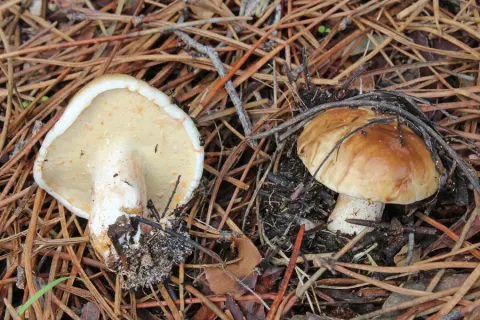
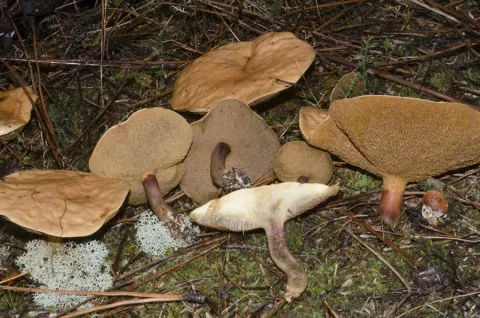
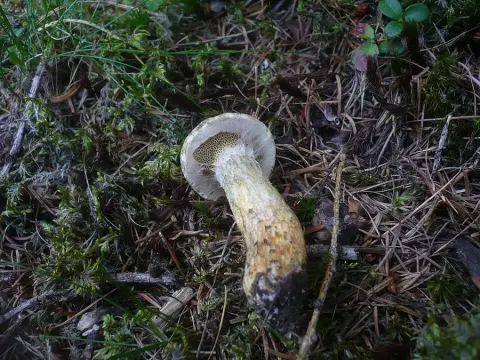
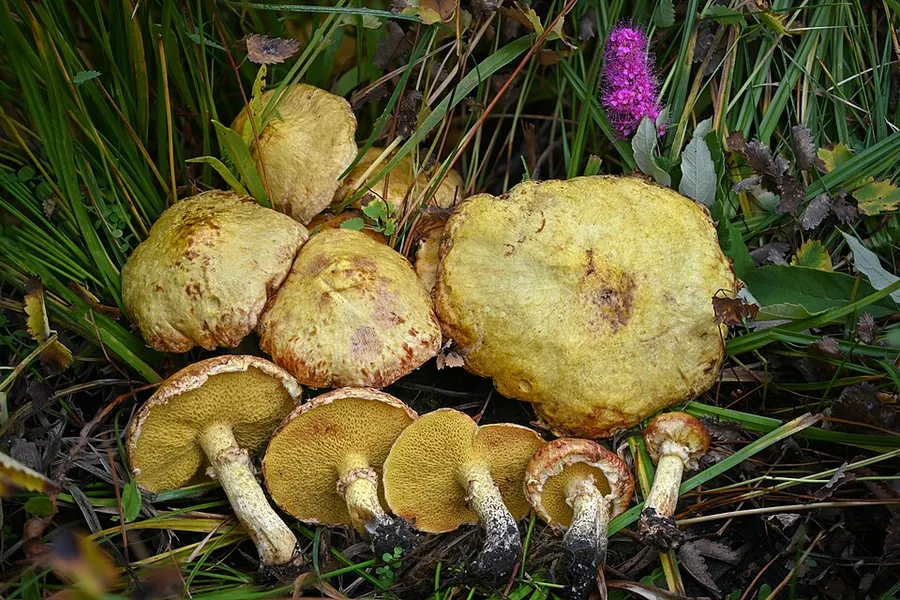
The cap is typically between 3 – 10 cm in diameter, broadly convex with a small umbo to flat with age. The margin is curved inwards in young specimens, and may have remnants of a yellowish, cottony veil hanging from it. The cap surface is colored bright yellow with red or brownish streaks and hairy patches. When the fruit body is young and moist, the surface is slimy; as the cap matures and dries out, it becomes sticky or tacky. The tubes which comprise the pore layer on the underside of the cap are 0.4 to 0.6 cm deep, and have an adnate (attached broadly to the stipe) to decurrent (running down the length of the stipe) attachment to the stipe. They are yellow, and stain reddish-brown when bruised. The yellow pores are large (1–2 mm diameter) and angular, and tend to become darker as they age. The pores are slightly wider than long, so that there are about 9–10 pores per cm measured radially, but 12 to 13 per cm when measured tangentially, about halfway to the edge. As is the case with all boletes, spores form on the inner surfaces of the tubes and sift through their openings to be borne away on the air currents outside. The stipe is 3-9 cm by 0.4-1 cm, roughly equal in width throughout, often crooked, and becomes hollow with age. The color of the stipe surface is lemon yellow, and it is covered with glandular dots that bruise if handled. The partial veil is not attached to the stipe, and usually does not leave a ring on the stipe. A whitish mycelium present at the base of the stipe helps anchor the fruit body in the substrate. The flesh is mustard yellow, and stains pinkish-brown when cut or bruised.

Sebagian uraian ditampilkan dalam bahasa sumber; terjemahannya belum tersedia atau belum lolos pemeriksaan.

Rujukan: [1]

Pengukuran mengikuti objek, spesimen atau kultur, dan metode yang disebutkan sumber. Baca uraian asli untuk konteks lengkap.

02 / Kehidupan

Habitat dan peran ekologis

Suillus americanus buah di tanah, tunggal atau dalam kelompok, di seluruh timur laut Kanada America north, biasanya pada akhir musim panas dan musim gugur. Utara American distributionnya membentang ke selatan ke Guerrero, Meksiko. Hal ini juga dilaporkan dari Guangdong, China, kejadian yang pernah dianggap sebagai disjunct, meskipun sampling yang lebih luas dari urutan DNA ITS sejak itu telah menunjukkan Utara yang jauh lebih luas Hemisphere distribution daripada catatan yang lebih tua saja menyiratkan. Fruit bodies mungkin muncul pada cuaca yang relatif kering ketika jamur lain langka. Di Korea Selatan, spesimen voucher yang dikumpulkan antara 1988 dan 2013 dan disimpan di beberapa koleksi nasional dikonfirmasi sebagai S. americanus menggunakan urutan ITS. Specimens previously yang dilaporkan atau diajukan dengan nama lain (termasuk S. sibiricus, S. tomentosus, dan S. subluteus) diidentifikasi kembali, yang menyebabkan penulis menyimpulkan bahwa Korean records dari takson tersebut tidak dapat diverifikasi dari bahan yang tersedia. Dalam kompilasi global dari urutan ITS, S. americanus diwakili dari kedua Utara America and dan lebar Eurasian range yang membentang dari Timur Europe through Pakistan and India to Russia and Jepang, dan ditafsirkan sebagai spesies yang paling tersebar secara alami dalam genus.

Rujukan: [1]

Habitat atau konteks temuan
Informasi belum tersedia pada sumber rilis ini.
Substrat
tanah
Peran atau konteks
Belum dikategorikan pada rilis ini.
Temukan hubungan serupa
03 / Siklus hidup

Reproduksi

The tubes which comprise the pore layer on the underside of the cap are 0.4 to 0.6 cm deep, and have an adnate (attached broadly to the stipe) to decurrent (running down the length of the stipe) attachment to the stipe. They are yellow, and stain reddish-brown when bruised. The yellow pores are large (1–2 mm diameter) and angular, and tend to become darker as they age. The pores are slightly wider than long, so that there are about 9–10 pores per cm measured radially, but 12 to 13 per cm when measured tangentially, about halfway to the edge. As is the case with all boletes, spores form on the inner surfaces of the tubes and sift through their openings to be borne away on the air currents outside.

Sebagian uraian ditampilkan dalam bahasa sumber; terjemahannya belum tersedia atau belum lolos pemeriksaan.

Rujukan: [1]

Sinonim menurut acuan taksonomi rilis: Boletus americanus; Boletus sibiricus; Ixocomus americanus; Ixocomus sibiricus; Suillus americanus f. helveticus; Suillus americanus f. himalayensis; Suillus americanus f. pseudosibiricus; Suillus americanus f. sibiricus; Suillus himalayensis; Suillus sibiricus; Suillus sibiricus subsp. helveticus
04 / Batas informasi

Catatan identitas dan cakupan

  • Nama diterima mengikuti Catalogue of Life Base2026-09-11; uraian mempertahankan konsep dan nama sumber aslinya.
  • Original geographic, specimen and life-cycle scope retained; source import awaits individual editorial review.
  • Impor dan terjemahan otomatis belum diperiksa editorial per profil. Struktur reproduktif yang disebutkan tidak membuktikan seluruh siklus hidup diketahui.
  • Pengukuran pada uraian mengikuti spesimen, kultur, dan metode sumber; angka tidak diperluas ke semua populasi.

Catatan distribusi dalam narasi mengikuti sumbernya. Dokumentasi spesimen atau foto mengikuti catatan sumber. Bukti wilayah Indonesia dan penilaian konservasi tidak disimpulkan dari gambar.

05 / Dokumentasi

Melihat dengan konteks

Dokumentasi Suillus americanus dari Wikimedia Commons. Suillus americanus photographed at Mt Hood, Oregon, USA In a boggy area under 5 needle pine. https://mushroomobserver.org/506247 Identifikasi mengikuti record berkas sumber.

Jenis
Fotografi
Kredit
Alan Rockefeller
Sumber media
Buka entri sumber

Gambar menunjukkan objek menurut identifikasi sumber, bukan verifikasi independen spesimen oleh Fungi. Tidak ada skala baru yang ditambahkan.

06 / Rujukan

Sumber profil

  1. [1] Suillus americanus — Wikipedia (en)Bagian sumber: Frozen revision 1331018129
    Tanggal penghimpunan sumber: 2026-10-12
    Teks sumber: CC BY-SA4.0 · Wikipedia contributors
  2. [2] Catalogue of Life Base2026-09-11 — Suillus americanusBagian sumber: ColDP NameUsage.tsv ID 53F2F; accepted species; source 2073
    Tanggal penghimpunan sumber: 2026-10-12
  3. [3] Dokumentasi visual — Suillus americanusBagian sumber: Individual media record; identification follows the source, not independent determination
    Tanggal penghimpunan sumber: 2026-10-12
    Media sumber: CC BY-SA 4.0 · Alan Rockefeller

Adaptasi teks: CC BY-SA 4.0. Wikipedia contributors — Suillus americanus — Wikipedia (en)

Uraian asli dan riwayat sumber

Riwayat atau halaman sumber

Ringkasan sumber

Suillus americanus is a species of mushroom-forming fungus in the family Suillaceae. Commonly known as the chicken fat mushroom and the American suillus, it produces bright yellow, often slimy caps marked with red to reddish-brown scales, a pore surface of large yellow angular pores that can stain brownish when bruised, and a slender yellow stipe dotted with darker glandular spots. The species was first described in the late 19th century by the American mycologist Charles Horton Peck and later transferred to Suillus.

Revisi sumber

Morfologi sumber

The cap is typically between 3 – 10 cm in diameter, broadly convex with a small umbo to flat with age. The margin is curved inwards in young specimens, and may have remnants of a yellowish, cottony veil hanging from it. The cap surface is colored bright yellow with red or brownish streaks and hairy patches. When the fruit body is young and moist, the surface is slimy; as the cap matures and dries out, it becomes sticky or tacky. The tubes which comprise the pore layer on the underside of the cap are 0.4 to 0.6 cm deep, and have an adnate (attached broadly to the stipe) to decurrent (running down the length of the stipe) attachment to the stipe. They are yellow, and stain reddish-brown when bruised. The yellow pores are large (1–2 mm diameter) and angular, and tend to become darker as they age. The pores are slightly wider than long, so that there are about 9–10 pores per cm measured radially, but 12 to 13 per cm when measured tangentially, about halfway to the edge. As is the case with all boletes, spores form on the inner surfaces of the tubes and sift through their openings to be borne away on the air currents outside. The stipe is 3-9 cm by 0.4-1 cm, roughly equal in width throughout, often crooked, and becomes hollow with age. The color of the stipe surface is lemon yellow, and it is covered with glandular dots that bruise if handled. The partial veil is not attached to the stipe, and usually does not leave a ring on the stipe. A whitish mycelium present at the base of the stipe helps anchor the fruit body in the substrate. The flesh is mustard yellow, and stains pinkish-brown when cut or bruised.

Revisi sumber

Ekologi sumber

Suillus americanus fruits on the ground, singly or in clusters, throughout northeastern North America north into Canada, typically in late summer and autumn. Its North American distribution extends south to Guerrero, Mexico. It has also been reported from Guangdong, China, an occurrence once treated as disjunct, although broader sampling of ITS DNA sequences has since suggested a much wider Northern Hemisphere distribution than older records alone implied. Fruit bodies may appear in relatively dry weather when other mushrooms are scarce. In South Korea, voucher specimens collected between 1988 and 2013 and held in several national collections were confirmed as S. americanus using ITS sequences. Specimens previously reported or filed under other names (including S. sibiricus, S. tomentosus, and S. subluteus) were re-identified, leading the authors to conclude that Korean records of those taxa could not be verified from the available material. In a global compilation of ITS sequences, S. americanus was represented from both North America and a broad Eurasian range extending from Eastern Europe through Pakistan and India to Russia and Japan, and was interpreted as the most naturally widespread species in the genus.

Revisi sumber

Struktur reproduksi sumber

The tubes which comprise the pore layer on the underside of the cap are 0.4 to 0.6 cm deep, and have an adnate (attached broadly to the stipe) to decurrent (running down the length of the stipe) attachment to the stipe. They are yellow, and stain reddish-brown when bruised. The yellow pores are large (1–2 mm diameter) and angular, and tend to become darker as they age. The pores are slightly wider than long, so that there are about 9–10 pores per cm measured radially, but 12 to 13 per cm when measured tangentially, about halfway to the edge. As is the case with all boletes, spores form on the inner surfaces of the tubes and sift through their openings to be borne away on the air currents outside.

Revisi sumber

Rujukan halaman ini

Fungi. Suillus americanus. Rilis data fungi-2026-10-12-expansion-2. https://fungi-atlas.mgadib.chatgpt.site/jamur/suillus-americanus/.

Status: impor sumber; pemeriksaan editorial per profil belum selesai. Untuk klaim biologis, gunakan rujukan pada bagian terkait dan periksa konteks sumber aslinya.