Ciri dan struktur
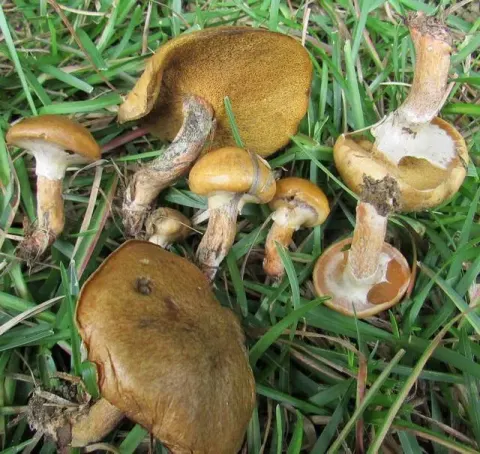
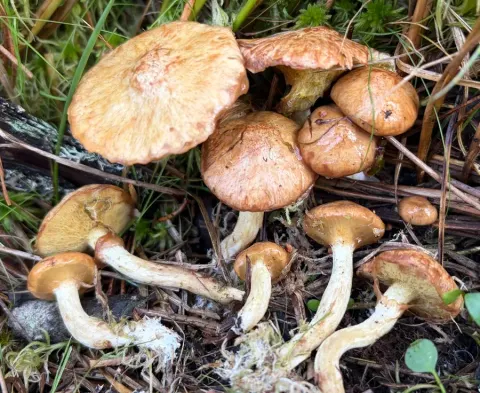
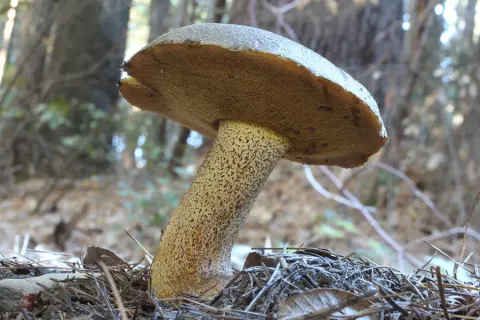
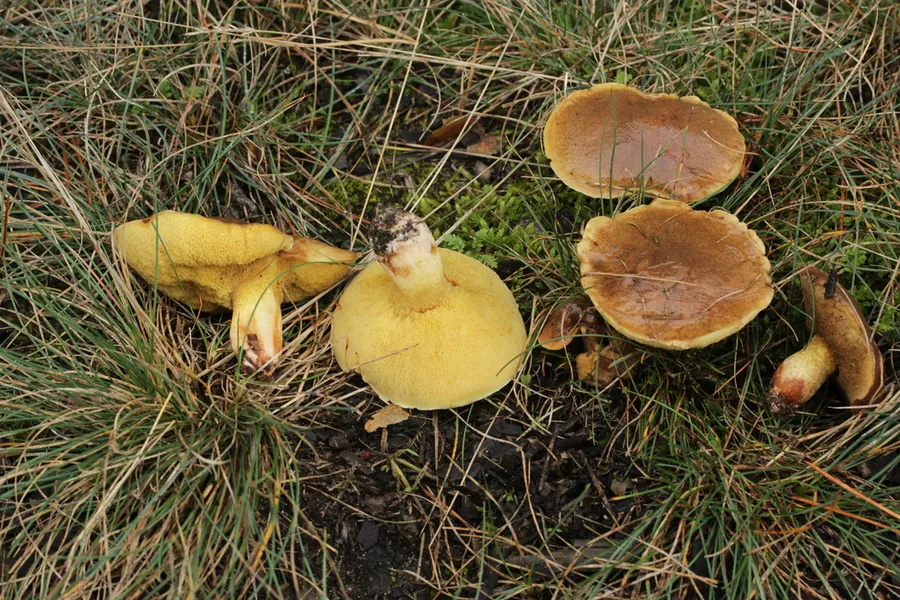
The fruit body of Suillus collinitus is a medium to large, fleshy bolete. The cap is initially rounded, becoming convex and finally flat, reaching up to 11 cm in diameter. The cap is covered with a brown cuticle of variable shade that is decorated with minuscule radial striations, which become more obvious in fully expanded specimens and especially in dry weather. The cap is often shaped irregularly and becomes viscid (sticky) when damp. The tubes are short and their stem attachment is usually slightly decurrent to adnate. The small and angular pores are yellow but darken with age. Young, fresh specimens sometimes bear droplets of a clear fluid that collect on the pore surface. The cylindrical stem is often short and stubby, typically 4 – 7 cm tall by 1 – 2 cm thick, coloured yellowish and ornamented with sparse reddish-brown granules. There is no ring. The base of the stem bears pink overtones and is attached to distinctively pink mycelial threads, which are visible when the fruit body is uprooted. The flesh is yellowish, thick and soft. In a colour reaction test with ammonia solution, the flesh turns reddish. The spores are seen ochre-brown in mass, but pale yellow when viewed with a light microscope. They are fusiform (tapered at each end), sized 8–10.5 by 3–4.5 μm. The basidia (spore-bearing cells of the hymenium) are four-spored. Especially characteristic for S. collinitus are the cap striations and pink mycelium. The fungus in many aspects resembles S. granulatus – a common species in European pine forests. S. granulatus, however, has a homogeneous brown cap without striations, and its mycelium is characteristically white.
Habitat dan peran ekologis
Suillus collinitus ditemukan di seluruh Eropa. Ini adalah jamur ektomikoriza, membentuk hubungan simbiotik yang saling menguntungkan dengan beberapa spesies pinus (Pinus). Ini termasuk beberapa dua jarum European species pinus: Aleppo pine (P. halepensis) European black pinus (P. nigra), pinus batu (P. pinea), dan Scots pine (P. sylvestris). Jamur ini mendukung tanah batu kapur. S. collinitus adalah termophilic, umum terjadi di Eropa selatan. Hal ini jarang terlihat di daerah-daerah yang lebih utara, seperti Polandia Inggris Isles and. Ini terdaftar dalam daftar merah di Denmark as yang hampir terancam, dan di Estonia as yang terancam. Hal ini juga telah dikumpulkan di Iran. Jamur ini dilaporkan di kota Paipa, di departemen Boyaca, Kolombia. Hal ini dilaporkan oleh ahli mikologi Juan Camilo Rodríguez Martínez. Suillus collinitus adalah jamur paling sering yang terkait dengan Aleppo pine ⁇ pohon tahan lama yang digunakan untuk skema reforestasi dan konservasi tanah terhadap erosi di Mediterranean region. Sebuah studi yang dilakukan di selatan France discovered bahwa S. collinitus dan S. mediterraneensis adalah jamur multi-stage ektomikoriza, yang dikaitkan dengan kedua jenis jamur muda dan matang Aleppo pine. Kedua spesies ini mungkin memainkan peran penting dalam kelangsungan hidup dan adaptasi spesies pinus ini di situs berlapis yang terganggu.
- Habitat atau konteks temuan
- Informasi belum tersedia pada sumber rilis ini.
- Substrat
- Informasi belum tersedia pada sumber rilis ini.
- Peran atau konteks
- Mitra tumbuhan
Reproduksi
The spores are seen ochre-brown in mass, but pale yellow when viewed with a light microscope. They are fusiform (tapered at each end), sized 8–10.5 by 3–4.5 μm. The basidia (spore-bearing cells of the hymenium) are four-spored.
Catatan identitas dan cakupan
- Nama diterima mengikuti Catalogue of Life Base2026-09-11; uraian mempertahankan konsep dan nama sumber aslinya.
- Original geographic, specimen and life-cycle scope retained; source import awaits individual editorial review.
- Impor dan terjemahan otomatis belum diperiksa editorial per profil. Struktur reproduktif yang disebutkan tidak membuktikan seluruh siklus hidup diketahui.
- Pengukuran pada uraian mengikuti spesimen, kultur, dan metode sumber; angka tidak diperluas ke semua populasi.
Catatan distribusi dalam narasi mengikuti sumbernya. Dokumentasi spesimen atau foto mengikuti catatan sumber. Bukti wilayah Indonesia dan penilaian konservasi tidak disimpulkan dari gambar.
Melihat dengan konteks
Dokumentasi Suillus collinitus menurut asosiasi foto pada record takson iNaturalist. Kredit: Björn Sothmann. Identitas mengikuti sumber; bukan penentuan spesimen independen.
- Jenis
- Fotografi
- Kredit
- (c) Björn Sothmann, some rights reserved (CC BY-SA), uploaded by Björn Sothmann
- Lisensi
- CC BY-SA 4.0
- Sumber media
- Buka entri sumber
Dokumentasi tambahan
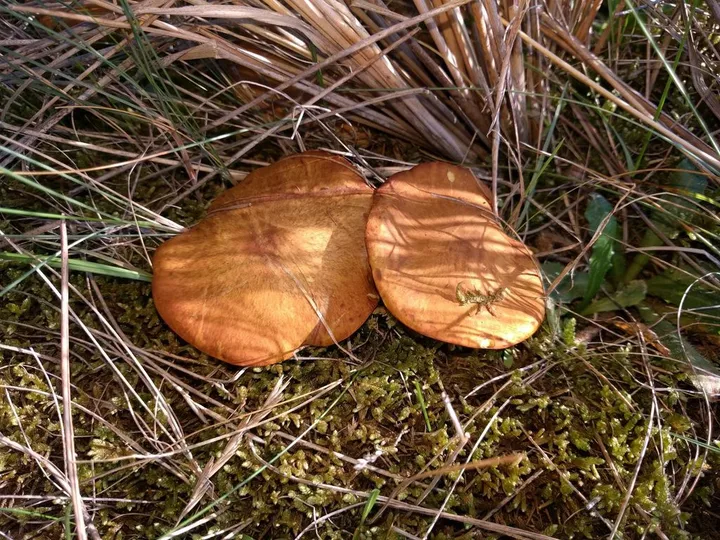
Foto yang diasosiasikan dengan Suillus collinitus pada iNaturalist. Identifikasi mengikuti sumber; bukan penentuan spesimen independen.
Kredit dan penggunaan
(c) Michel Langeveld, some rights reserved (CC BY), uploaded by Michel Langeveld
Ukuran dan format gambar disesuaikan tanpa pemotongan, retus, atau penambahan skala. Lisensi sumber dipertahankan.
Sumber profil
- [1] Suillus collinitus — Wikipedia (en)
- [2] Catalogue of Life Base2026-09-11 — Suillus collinitus
- [3] Dokumentasi visual — Suillus collinitus
- [4] Dokumentasi visual — Suillus collinitus
Rujukan halaman ini
Fungi. Suillus collinitus. Rilis data fungi-2026-10-12-expansion-2. https://fungi-atlas.mgadib.chatgpt.site/jamur/suillus-collinitus/.
Status: impor sumber; pemeriksaan editorial per profil belum selesai. Untuk klaim biologis, gunakan rujukan pada bagian terkait dan periksa konteks sumber aslinya.