Ciri dan struktur
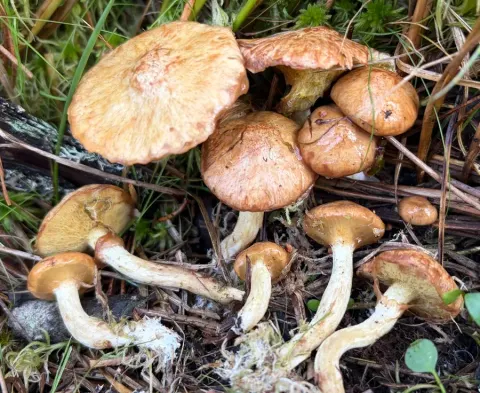
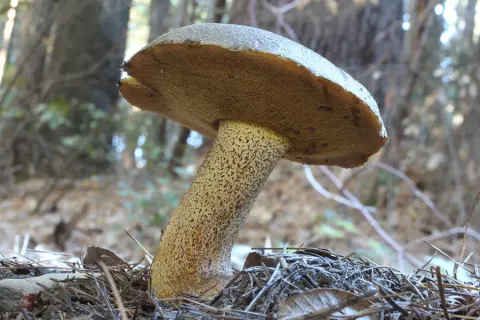
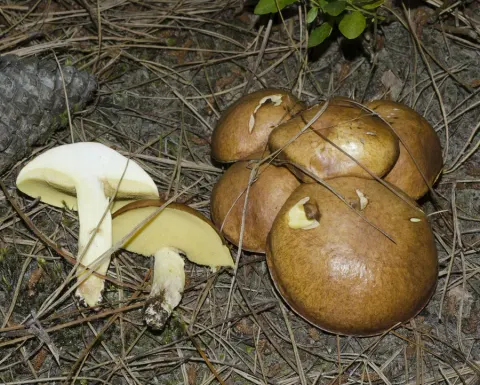
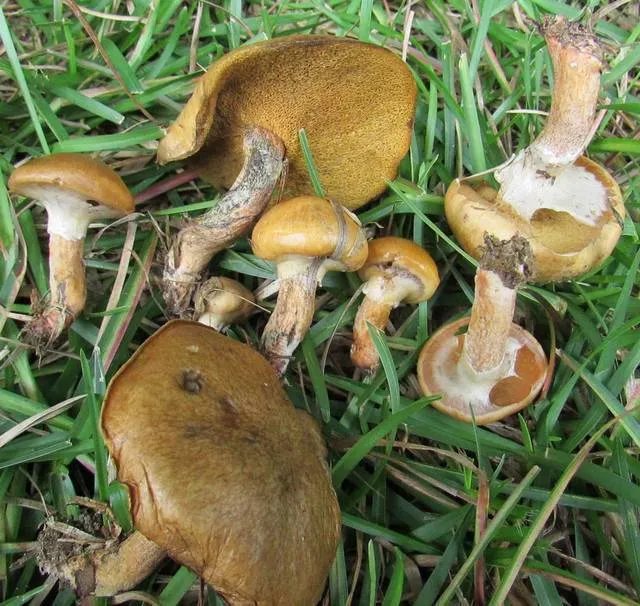
The cap is obtuse to convex, and sometimes develops a broad umbo. The cap margin is initially turned inward, and usually has remnants of the partial veil hanging off. The cap surface is smooth, sticky, with a variable color ranging from yellow to yellow-brown to yellow-orange to cinnamon to olive brown to grayish brown or dark brown. The flesh is marbled orangish and pale yellow, and when cut or otherwise injured, it will stain dark purple-drab. The odor of the corthunatus ranges from fragrant to indistinct, and the taste is indistinct. The pore surface on the underside of the cap is initially pale yellow to orange-yellow, but it becomes brownish yellow when mature. The pores, which number 1 or 2 per millimeter, are irregular to radially elongated. The tubes comprising the pore layer are roughly 4 mm deep. The stem measure 2.5 – 6 cm long by 0.5 – 1.0 cm thick, and it is nearly equal in width throughout or slightly larger near the base. It is solid (i.e. not hollow) with a dry surface that is covered with scattered brownish glandular dots on a whitish to yellowish to brownish background color. It has a thick, baggy partial veil that is whitish and somewhat rubbery in texture. The partial veil is slimy on the outer layer, and forms a band-like ring on the stem with a flaring lower edge. The mycelium at the base of the stem is salmon-colored. Suillus cothurnatus produces a brown spore print. Spores are roughly elliptical to oblong to somewhat cylindrical, smooth, and measure 8–10 by 2.5–3.5 μm. Fruit bodies are edible. They are used in mushroom dyeing to produce colors such as beige, light brown, or brownish orange, depending on the mordant used.
Habitat dan peran ekologis
The fruit bodies of Suillus cothurnatus grow scattered or in groups on the ground in sandy soil near pine, especially two-needled pine such as red pine and jack pine. In the United States, its range extends from Texas to Florida, and north to North Carolina. Spesies ini juga ada di Meksiko, dan telah diperkenalkan ke Brasil. Hal ini juga telah direkam dari Cameron Highlands in Malaysia.
- Habitat atau konteks temuan
- Informasi belum tersedia pada sumber rilis ini.
- Substrat
- tanah
- Peran atau konteks
- Belum dikategorikan pada rilis ini.
Reproduksi
Suillus cothurnatus produces a brown spore print. Spores are roughly elliptical to oblong to somewhat cylindrical, smooth, and measure 8–10 by 2.5–3.5 μm.
Catatan identitas dan cakupan
- Nama diterima mengikuti Catalogue of Life Base2026-09-11; uraian mempertahankan konsep dan nama sumber aslinya.
- Original geographic, specimen and life-cycle scope retained; source import awaits individual editorial review.
- Impor dan terjemahan otomatis belum diperiksa editorial per profil. Struktur reproduktif yang disebutkan tidak membuktikan seluruh siklus hidup diketahui.
- Pengukuran pada uraian mengikuti spesimen, kultur, dan metode sumber; angka tidak diperluas ke semua populasi.
Catatan distribusi dalam narasi mengikuti sumbernya. Dokumentasi spesimen atau foto mengikuti catatan sumber. Bukti wilayah Indonesia dan penilaian konservasi tidak disimpulkan dari gambar.
Melihat dengan konteks
Dokumentasi Suillus cothurnatus menurut asosiasi foto pada record takson iNaturalist. Kredit: Jimmy Craine. Identitas mengikuti sumber; bukan penentuan spesimen independen.
- Jenis
- Fotografi
- Kredit
- (c) Jimmy Craine, some rights reserved (CC BY-SA)
- Lisensi
- CC BY-SA 4.0
- Sumber media
- Buka entri sumber
Dokumentasi tambahan
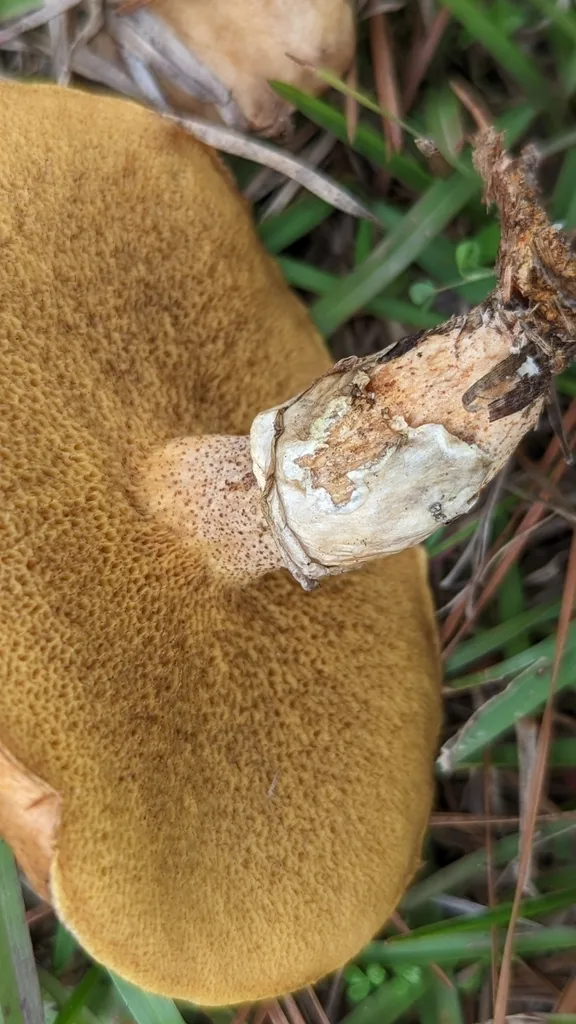
Foto yang diasosiasikan dengan Suillus cothurnatus pada iNaturalist. Identifikasi mengikuti sumber; bukan penentuan spesimen independen.
Kredit dan penggunaan
(c) Alan Rockefeller, some rights reserved (CC BY), uploaded by Alan Rockefeller
Ukuran dan format gambar disesuaikan tanpa pemotongan, retus, atau penambahan skala. Lisensi sumber dipertahankan.
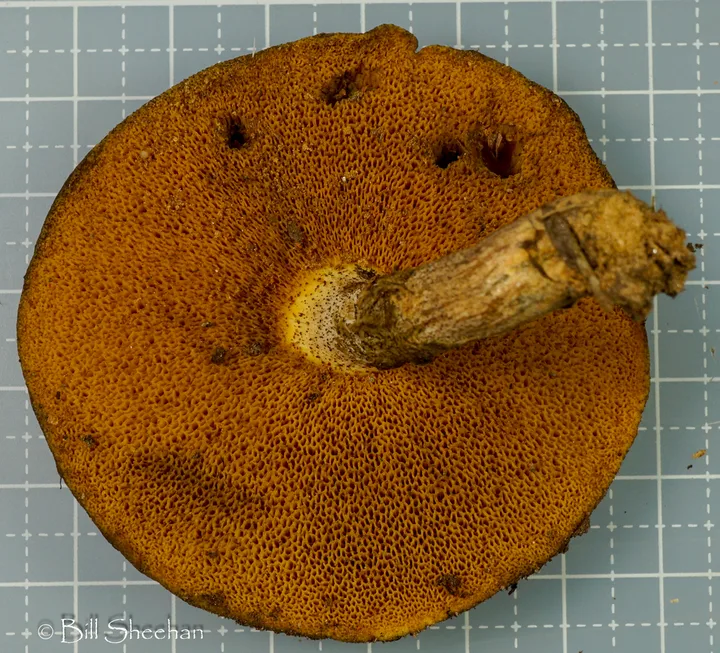
Foto yang diasosiasikan dengan Suillus cothurnatus pada iNaturalist. Identifikasi mengikuti sumber; bukan penentuan spesimen independen.
Kredit dan penggunaan
(c) Bill Sheehan, some rights reserved (CC BY-SA), uploaded by Bill Sheehan
Ukuran dan format gambar disesuaikan tanpa pemotongan, retus, atau penambahan skala. Lisensi sumber dipertahankan.
Sumber profil
- [1] Suillus cothurnatus — Wikipedia (en)
- [2] Catalogue of Life Base2026-09-11 — Suillus cothurnatus
- [3] Dokumentasi visual — Suillus cothurnatus
- [4] Dokumentasi visual — Suillus cothurnatus
- [5] Dokumentasi visual — Suillus cothurnatus
Rujukan halaman ini
Fungi. Suillus cothurnatus. Rilis data fungi-2026-10-12-expansion-2. https://fungi-atlas.mgadib.chatgpt.site/jamur/suillus-cothurnatus/.
Status: impor sumber; pemeriksaan editorial per profil belum selesai. Untuk klaim biologis, gunakan rujukan pada bagian terkait dan periksa konteks sumber aslinya.