01 / Morfologi

Ciri dan struktur

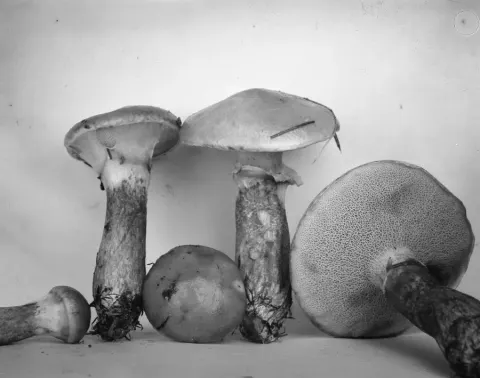
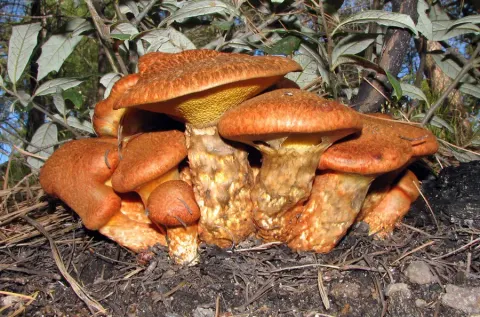
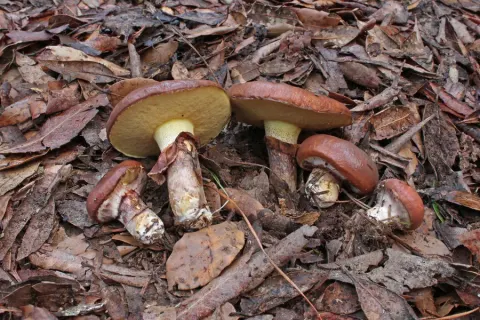
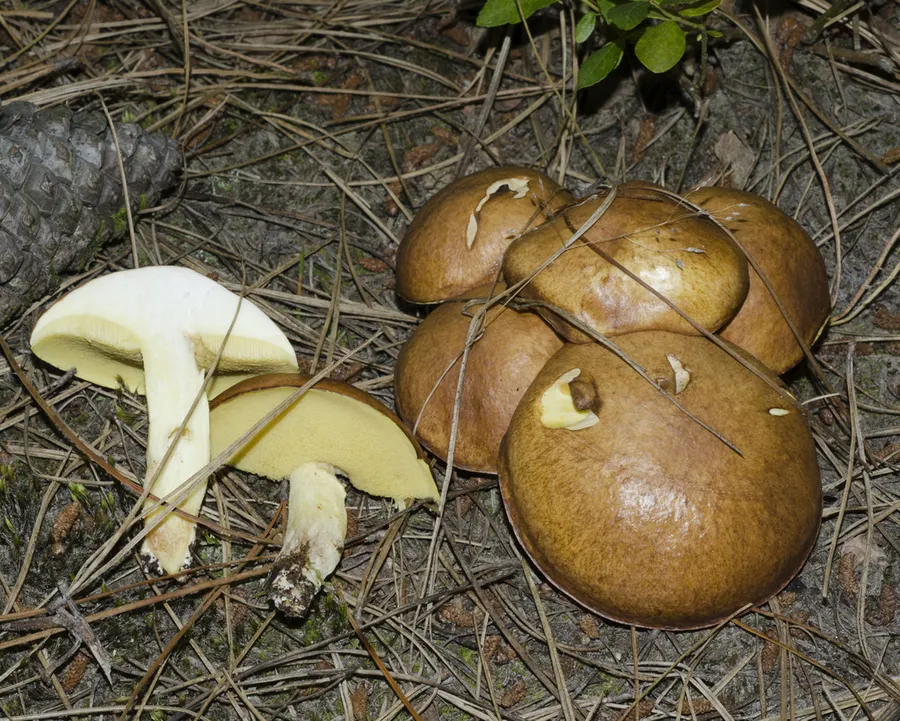
PILEUS: convex to plano-convex. 5-13-(16) cm diam., mucilaginous, glabrous, buff yellow, tan, reddish tan or orange cinnamon, occasionally dull reddish brown; cuticle an ixotrichodermium, readily separable; margin entire, often incurved and extending beyond pores when young. HYMENOPHORE: tubes 7-13 mm long, adnate to subdecurrent, pallid creamy white when young, becoming yellow to sordid yellow at maturity; pores concolorous with tubes, becoming spotted dark reddish brown at maturity, angular to radially elongated. 0.5-1 mm diam., beaded with droplets of cloudy, white liquid when young. STIPE: 4.5-8 cm long, more or less equal, 1-2.5 cm diam., solid, white to creamy white at first, becoming bright yellow apically, sordid brownish below; glandulae numerous, pinkish brown to reddish brown; flesh white at first, becoming yellow with age; annulus absent. SPORES: spore print yellowish brown (between Cinnamon and Pinkish-Cinnamon); spores pallid melleous, elliptic-subfusiform, 7.1-9.3-(10.6) X 2.8-3.1-(3.4) µm., smooth. HYMENIUM: basidia hyaline, clavate, 19-26 X 5.5-8 µm. 4-spored; cystidia scattered or crowded in groups at or near tube mouths, hyaline or encrusted with brown, resinous material, cylindrical to clavate, 33-45 X 6.5-10 µm. HYMENOPHORAL TRAMA: bilateral, of the Boletus subtype; clamp connections absent. CONTEXT OF PILEUS: white when young, becoming pallid yellow at maturity often with watery greenish yellow line immediately above tubes, unchanging on exposure to air. TASTE: mild. SMELL: not distinctive. CHEMICAL REACTIONS: KOH on pileus— greyish brown; on context of pileus—immediate red flush turning lilac; NH4OH on pileus—slowly darkening; on context—immediate red flush turning lilac.

Sebagian uraian ditampilkan dalam bahasa sumber; terjemahannya belum tersedia atau belum lolos pemeriksaan.

Rujukan: [1]

Pengukuran mengikuti objek, spesimen atau kultur, dan metode yang disebutkan sumber. Baca uraian asli untuk konteks lengkap.

02 / Kehidupan

Habitat dan peran ekologis

Suillus granulatus is an introduced species associated with Pinus in the temperate zone of the northern hemisphere and is widely distributed in both Europe and North America. The relatively large degree of variability encountered in Suillus granulatus over its natural geographical range has resulted in the recognition of a large number of infraspecific taxa. Of the more recent attempts to divide the species the most comprehensive treatments are those of Singer (1945a) and Blum (1965). Singer distinguished four subspecies on the basis of minor differences in spore size, small differences in colour of the fruitbodies, geographical distribution, and mycorrhizal associations in nature. The results of applying this classification to New Zealand specimens are inconclusive, for many collections possess spore and colour characters intermediate between two subspecies. However, it should be noted that Singer's classification arose from observations on specimens growing in their indigenous habitats. It is possible that under New Zealand conditions, where both fungus and mycorrhizal partner have been introduced, a degree of morphological modification of Suillus granulatus has occurred, with the result that subspecific differences are no longer distinct.

Sebagian uraian ditampilkan dalam bahasa sumber; terjemahannya belum tersedia atau belum lolos pemeriksaan.

Rujukan: [1]

Habitat atau konteks temuan
Informasi belum tersedia pada sumber rilis ini.
Substrat
Informasi belum tersedia pada sumber rilis ini.
Peran atau konteks
Mitra tumbuhan
Temukan hubungan serupa
03 / Siklus hidup

Reproduksi

PILEUS: convex to plano-convex. 5-13-(16) cm diam., mucilaginous, glabrous, buff yellow, tan, reddish tan or orange cinnamon, occasionally dull reddish brown; cuticle an ixotrichodermium, readily separable; margin entire, often incurved and extending beyond pores when young. HYMENOPHORE: tubes 7-13 mm long, adnate to subdecurrent, pallid creamy white when young, becoming yellow to sordid yellow at maturity; pores concolorous with tubes, becoming spotted dark reddish brown at maturity, angular to radially elongated. 0.5-1 mm diam., beaded with droplets of cloudy, white liquid when young. STIPE: 4.5-8 cm long, more or less equal, 1-2.5 cm diam., solid, white to creamy white at first, becoming bright yellow apically, sordid brownish below; glandulae numerous, pinkish brown to reddish brown; flesh white at first, becoming yellow with age; annulus absent.

Sebagian uraian ditampilkan dalam bahasa sumber; terjemahannya belum tersedia atau belum lolos pemeriksaan.

Rujukan: [1]

Sinonim menurut acuan taksonomi rilis: Boletus campanulatus; Boletus circinans var. lactifluus; Boletus flavorufus; Boletus fusipes var. pictilis; Boletus granulatus; Boletus granulatus var. campanulatus; Boletus granulatus var. heterosporus; Boletus granulatus var. longisporus; Boletus granulatus var. meridionalis; Boletus granulatus var. rufopunctatus; Boletus granulatus var. violaceopunctatus; Boletus heterosporus; Boletus lactifluus; Boletus longisporus; Boletus meridionalis; Boletus pictilis; Boletus rufopunctatus; Boletus violaceopunctatus; Ixocomus granulatus; Ixocomus pictilis; Leccinum lactifluum; Rostkovites granulatus; Suillus collinitus var. velatipes; Suillus granulatus f. marchandii; Suillus granulatus subsp. leptopus; Suillus granulatus subsp. snellii; Suillus granulatus var. snellii; Suillus granulatus var. velatipes; Suillus lactifluus; Viscipellis granulata
04 / Batas informasi

Catatan identitas dan cakupan

  • Nama diterima mengikuti Catalogue of Life Base2026-09-11; uraian mempertahankan konsep dan nama sumber aslinya.
  • Historical description as cited by BiotaNZ. Preserve explicit New Zealand/locality, host and specimen qualifiers. Distribution is the cited source scope, not a current global range.
  • Impor dan terjemahan otomatis belum diperiksa editorial per profil. Struktur reproduktif yang disebutkan tidak membuktikan seluruh siklus hidup diketahui.
  • Pengukuran pada uraian mengikuti spesimen, kultur, dan metode sumber; angka tidak diperluas ke semua populasi.

Catatan distribusi dalam narasi mengikuti sumbernya. Dokumentasi spesimen atau foto mengikuti catatan sumber. Bukti wilayah Indonesia dan penilaian konservasi tidak disimpulkan dari gambar.

05 / Dokumentasi

Melihat dengan konteks

Dokumentasi Suillus granulatus menurut asosiasi foto pada record takson iNaturalist. Kredit: Jerry Cooper. Identitas mengikuti sumber; bukan penentuan spesimen independen.

Jenis
Fotografi
Kredit
(c) Jerry Cooper, some rights reserved (CC BY), uploaded by Jerry Cooper
Lisensi
CC BY 4.0
Sumber media
Buka entri sumber

Gambar menunjukkan objek menurut identifikasi sumber, bukan verifikasi independen spesimen oleh Fungi. Tidak ada skala baru yang ditambahkan.

06 / Rujukan

Sumber profil

  1. [1] McNabb, R.F.R. 1968: The Boletaceae of New Zealand. New Zealand Journal of Botany 6(2): 137-176. — Suillus granulatusBagian sumber: biota:1cb0f3f8-36b9-11d5-9548-00d0592d548c:1cb1a650-36b9-11d5-9548-00d0592d548c
    Tanggal penghimpunan sumber: 2026-10-12
    Teks sumber: CC BY 4.0 · McNabb, R.F.R. 1968: The Boletaceae of New Zealand. New Zealand Journal of Botany 6(2): 137-176.
  2. [2] Catalogue of Life Base2026-09-11 — Suillus granulatusBagian sumber: ColDP NameUsage.tsv ID 7B4SV; accepted species; source 2073
    Tanggal penghimpunan sumber: 2026-10-12
  3. [3] Dokumentasi visual — Suillus granulatusBagian sumber: Individual media record; identification follows the source, not independent determination
    Tanggal penghimpunan sumber: 2026-10-12
    Media sumber: CC BY 4.0 · (c) Jerry Cooper, some rights reserved (CC BY), uploaded by Jerry Cooper

Adaptasi teks: CC BY 4.0. McNabb, R.F.R. 1968: The Boletaceae of New Zealand. New Zealand Journal of Botany 6(2): 137-176. — McNabb, R.F.R. 1968: The Boletaceae of New Zealand. New Zealand Journal of Botany 6(2): 137-176. — Suillus granulatus

Uraian asli dan riwayat sumber

Riwayat atau halaman sumber

Ringkasan sumber

PILEUS: convex to plano-convex. 5-13-(16) cm diam., mucilaginous, glabrous, buff yellow, tan, reddish tan or orange cinnamon, occasionally dull reddish brown; cuticle an ixotrichodermium, readily separable; margin entire, often incurved and extending beyond pores when young. HYMENOPHORE: tubes 7-13 mm long, adnate to subdecurrent, pallid creamy white when young, becoming yellow to sordid yellow at maturity; pores concolorous with tubes, becoming spotted dark reddish brown at maturity, angular to radially elongated. 0.5-1 mm diam., beaded with droplets of cloudy, white liquid when young.

Revisi sumber

Morfologi sumber

PILEUS: convex to plano-convex. 5-13-(16) cm diam., mucilaginous, glabrous, buff yellow, tan, reddish tan or orange cinnamon, occasionally dull reddish brown; cuticle an ixotrichodermium, readily separable; margin entire, often incurved and extending beyond pores when young. HYMENOPHORE: tubes 7-13 mm long, adnate to subdecurrent, pallid creamy white when young, becoming yellow to sordid yellow at maturity; pores concolorous with tubes, becoming spotted dark reddish brown at maturity, angular to radially elongated. 0.5-1 mm diam., beaded with droplets of cloudy, white liquid when young. STIPE: 4.5-8 cm long, more or less equal, 1-2.5 cm diam., solid, white to creamy white at first, becoming bright yellow apically, sordid brownish below; glandulae numerous, pinkish brown to reddish brown; flesh white at first, becoming yellow with age; annulus absent. SPORES: spore print yellowish brown (between Cinnamon and Pinkish-Cinnamon); spores pallid melleous, elliptic-subfusiform, 7.1-9.3-(10.6) X 2.8-3.1-(3.4) µm., smooth. HYMENIUM: basidia hyaline, clavate, 19-26 X 5.5-8 µm. 4-spored; cystidia scattered or crowded in groups at or near tube mouths, hyaline or encrusted with brown, resinous material, cylindrical to clavate, 33-45 X 6.5-10 µm. HYMENOPHORAL TRAMA: bilateral, of the Boletus subtype; clamp connections absent. CONTEXT OF PILEUS: white when young, becoming pallid yellow at maturity often with watery greenish yellow line immediately above tubes, unchanging on exposure to air. TASTE: mild. SMELL: not distinctive. CHEMICAL REACTIONS: KOH on pileus— greyish brown; on context of pileus—immediate red flush turning lilac; NH4OH on pileus—slowly darkening; on context—immediate red flush turning lilac.

Revisi sumber

Ekologi sumber

Suillus granulatus is an introduced species associated with Pinus in the temperate zone of the northern hemisphere and is widely distributed in both Europe and North America. The relatively large degree of variability encountered in Suillus granulatus over its natural geographical range has resulted in the recognition of a large number of infraspecific taxa. Of the more recent attempts to divide the species the most comprehensive treatments are those of Singer (1945a) and Blum (1965). Singer distinguished four subspecies on the basis of minor differences in spore size, small differences in colour of the fruitbodies, geographical distribution, and mycorrhizal associations in nature. The results of applying this classification to New Zealand specimens are inconclusive, for many collections possess spore and colour characters intermediate between two subspecies. However, it should be noted that Singer's classification arose from observations on specimens growing in their indigenous habitats. It is possible that under New Zealand conditions, where both fungus and mycorrhizal partner have been introduced, a degree of morphological modification of Suillus granulatus has occurred, with the result that subspecific differences are no longer distinct.

Revisi sumber

Struktur reproduksi sumber

PILEUS: convex to plano-convex. 5-13-(16) cm diam., mucilaginous, glabrous, buff yellow, tan, reddish tan or orange cinnamon, occasionally dull reddish brown; cuticle an ixotrichodermium, readily separable; margin entire, often incurved and extending beyond pores when young. HYMENOPHORE: tubes 7-13 mm long, adnate to subdecurrent, pallid creamy white when young, becoming yellow to sordid yellow at maturity; pores concolorous with tubes, becoming spotted dark reddish brown at maturity, angular to radially elongated. 0.5-1 mm diam., beaded with droplets of cloudy, white liquid when young. STIPE: 4.5-8 cm long, more or less equal, 1-2.5 cm diam., solid, white to creamy white at first, becoming bright yellow apically, sordid brownish below; glandulae numerous, pinkish brown to reddish brown; flesh white at first, becoming yellow with age; annulus absent.

Revisi sumber

Rujukan halaman ini

Fungi. Suillus granulatus. Rilis data fungi-2026-10-12-expansion-2. https://fungi-atlas.mgadib.chatgpt.site/jamur/suillus-granulatus/.

Status: impor sumber; pemeriksaan editorial per profil belum selesai. Untuk klaim biologis, gunakan rujukan pada bagian terkait dan periksa konteks sumber aslinya.