01 / Morfologi

Ciri dan struktur

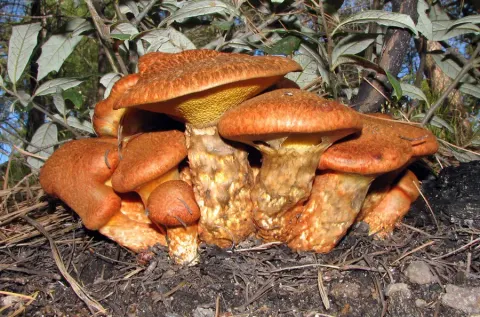
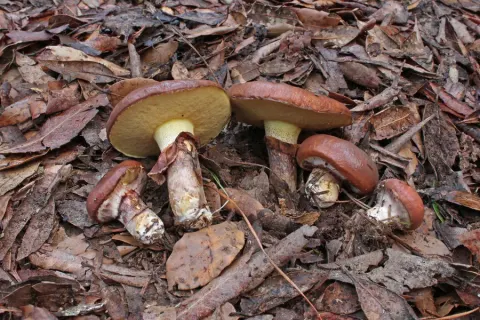
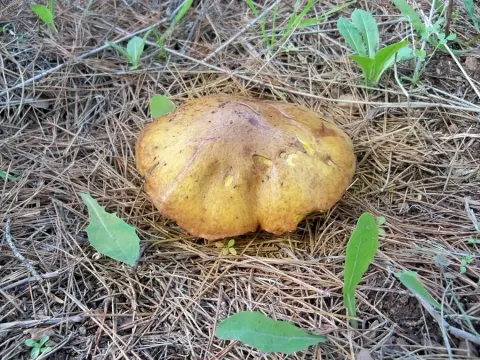
PILEUS: convex to plano-convex, 5-15 cm diam., mucilaginous, glabrous, golden brown, often paling toward margin, frequently streaked or blotched with lemon yellow or golden yellow; cuticle an ixotrichodermium, readily separable, composed of gelatinised, hair-like, septate hyphae 3.5-6 µm diam.; margin typically entire, occasionally lacerate. HYMENOPHORE: tubes to 11 mm long, adnate to subdecurrent, lemon yellow to golden yellow; pores concolorous with tubes, angular, 0.5-1 mm diam., becoming brownish where damaged. STIPE: 4.5-10 cm long, equal or tapering apically, 1-2.3 cm diam., solid, finely but distinctly reticulate above annulus, subpruinose or subglabrous below, concolorous with pores apically, yellow, golden brown or brownish below; glandulae absent: flesh pallid yellow; annulus typically conspicuous, rarely absent, superior, pallid yellow or brownish yellow. SPORES: spore print yellowish brown (between Sayal Brown and Cinnamon); spores pallid melleous, elliptic-subfusiform, (8)-8.6-10-(13.5) X 2.8-3.5-(4) µm, smooth. HYMENIUM: basidia hyaline, clavate, 17.5-25 X 4.5-6.5 µm, 4-spored; cystidia numerous, often in groups, hyaline or encrusted with brown, resinous material, subcylindrical to clavate, 30-55 X 6-9 µm. HYMENOPHORAL TRAMA: bilateral, of the Boletus subtype; clamp connections absent. CONTEXT OF PILEUS: lemon yellow, often with golden yellow areas, unchanging on exposure to air. TASTE: mild. SMELL: not distinctive. CHEMICAL REACTIONS: KOH on pileus—grey; on context of pileus—immediate red flush turning lilac; NH4OH on pileus—orange tan; on context—immediate red flush turning lilac.

Sebagian uraian ditampilkan dalam bahasa sumber; terjemahannya belum tersedia atau belum lolos pemeriksaan.

Rujukan: [1]

Pengukuran mengikuti objek, spesimen atau kultur, dan metode yang disebutkan sumber. Baca uraian asli untuk konteks lengkap.

02 / Kehidupan

Habitat dan peran ekologis

Suillus grevillei is an introduced species, which under natural conditions forms mycorrhizal associations solely with Larix. However, Young (1940) has shown that in pure culture it is capable of forming mycorrhizas with Pinus caribea and P. taeda. In New Zealand it is commonly associated with Larix decidua and has been observed under L. leptolepis (W. A. Holloway, pers. comm.). Slipp and Snell (1944) and Smith, Thiers, and Miller (1965) recorded exannulate fruitbodies of Suillus grevillei. In one of the above collections (24341), a quarter of the fruitbodies lacked an annulus, and in some there were no indications of velar remnants on the pileus margin. The species is reported to be edible, but opinions differ as to its quality. S. grevillei may be distinguished by the presence of an annulus, absence of glandulae on the stipe, and its association with Larix. Which was first recorded from New Zealand (as Boletus elegans) by Rawlings (1951).

Sebagian uraian ditampilkan dalam bahasa sumber; terjemahannya belum tersedia atau belum lolos pemeriksaan.

Rujukan: [1]

Habitat atau konteks temuan
kultur yang didokumentasikan
Substrat
Informasi belum tersedia pada sumber rilis ini.
Peran atau konteks
Mitra tumbuhan
Temukan hubungan serupa
03 / Siklus hidup

Reproduksi

PILEUS: convex to plano-convex, 5-15 cm diam., mucilaginous, glabrous, golden brown, often paling toward margin, frequently streaked or blotched with lemon yellow or golden yellow; cuticle an ixotrichodermium, readily separable, composed of gelatinised, hair-like, septate hyphae 3.5-6 µm diam.; margin typically entire, occasionally lacerate. HYMENOPHORE: tubes to 11 mm long, adnate to subdecurrent, lemon yellow to golden yellow; pores concolorous with tubes, angular, 0.5-1 mm diam., becoming brownish where damaged. STIPE: 4.5-10 cm long, equal or tapering apically, 1-2.3 cm diam., solid, finely but distinctly reticulate above annulus, subpruinose or subglabrous below, concolorous with pores apically, yellow, golden brown or brownish below; glandulae absent: flesh pallid yellow; annulus typically conspicuous, rarely absent, superior, pallid yellow or brownish yellow.

Sebagian uraian ditampilkan dalam bahasa sumber; terjemahannya belum tersedia atau belum lolos pemeriksaan.

Rujukan: [1]

Sinonim menurut acuan taksonomi rilis: Boletinus grevillei; Boletopsis elegans; Boletus annularius; Boletus clintonianus; Boletus cortinatus; Boletus elegans var. aureus; Boletus elegans var. cyanescens; Boletus flavus var. elegans; Boletus grevillei; Boletus theclae; Cricunopus elegans; Ixocomus elegans; Ixocomus flavus var. elegans; Ixocomus grevillei; Ixocomus grevillei f. badius; Solenia elegans; Suillus clintonianus; Suillus cortinatus; Suillus elegans; Suillus grevillei f. badius; Suillus grevillei var. badius; Suillus grevillei var. clintonianus; Suillus grevillei var. proximus; Suillus proximus; Viscipellis elegans; Viscipellis flava var. elegans
04 / Batas informasi

Catatan identitas dan cakupan

  • Nama diterima mengikuti Catalogue of Life Base2026-09-11; uraian mempertahankan konsep dan nama sumber aslinya.
  • Historical description as cited by BiotaNZ. Preserve explicit New Zealand/locality, host and specimen qualifiers. Distribution is the cited source scope, not a current global range.
  • Impor dan terjemahan otomatis belum diperiksa editorial per profil. Struktur reproduktif yang disebutkan tidak membuktikan seluruh siklus hidup diketahui.
  • Pengukuran pada uraian mengikuti spesimen, kultur, dan metode sumber; angka tidak diperluas ke semua populasi.

Catatan distribusi dalam narasi mengikuti sumbernya. Dokumentasi spesimen atau foto mengikuti catatan sumber. Bukti wilayah Indonesia dan penilaian konservasi tidak disimpulkan dari gambar.

05 / Dokumentasi

Melihat dengan konteks

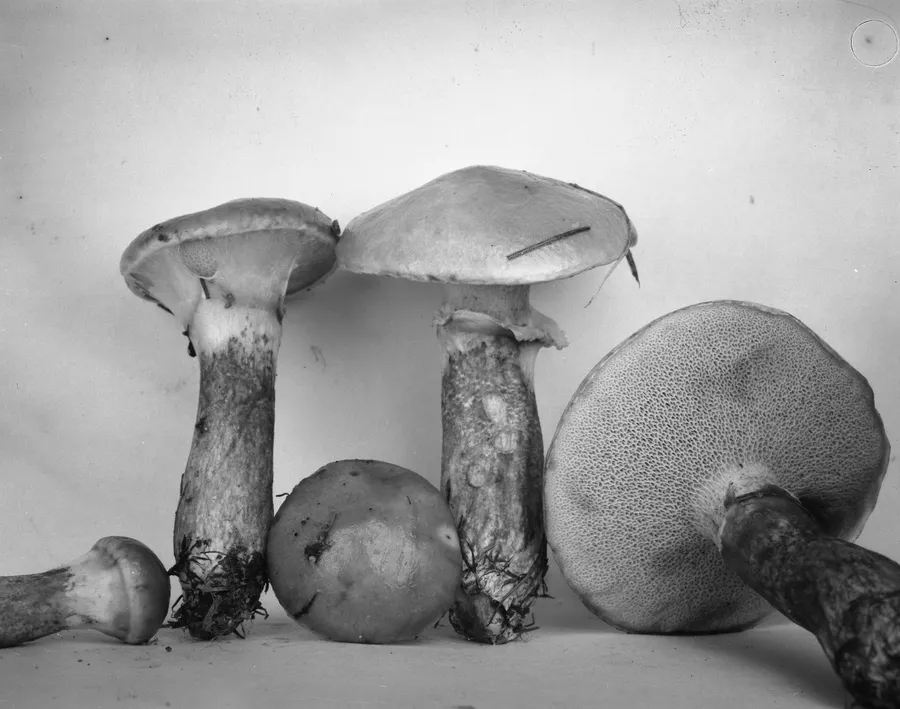
Voucher herbarium Suillus grevillei (28164), The New York Botanical Garden. Identifikasi mengikuti record spesimen sumber. Foto bahan, kemasan, atau label herbarium sebagaimana tersedia pada record institusi; bukan foto lapangan atau penentuan spesimen independen.

Jenis
Voucher herbarium
Kredit
The New York Botanical Garden
Lisensi
CC BY 4.0
Sumber media
Buka entri sumber

Gambar menunjukkan objek menurut identifikasi sumber, bukan verifikasi independen spesimen oleh Fungi. Tidak ada skala baru yang ditambahkan.

06 / Rujukan

Sumber profil

  1. [1] McNabb, R.F.R. 1968: The Boletaceae of New Zealand. New Zealand Journal of Botany 6(2): 137-176. — Suillus grevilleiBagian sumber: biota:1cb0f3f8-36b9-11d5-9548-00d0592d548c:1cb1a651-36b9-11d5-9548-00d0592d548c
    Tanggal penghimpunan sumber: 2026-10-12
    Teks sumber: CC BY 4.0 · McNabb, R.F.R. 1968: The Boletaceae of New Zealand. New Zealand Journal of Botany 6(2): 137-176.
  2. [2] Catalogue of Life Base2026-09-11 — Suillus grevilleiBagian sumber: ColDP NameUsage.tsv ID 53F4V; accepted species; source 2073
    Tanggal penghimpunan sumber: 2026-10-12
  3. [3] Dokumentasi visual — Suillus grevilleiBagian sumber: Individual media record; identification follows the source, not independent determination
    Tanggal penghimpunan sumber: 2026-10-12
    Media sumber: CC BY 4.0 · The New York Botanical Garden

Adaptasi teks: CC BY 4.0. McNabb, R.F.R. 1968: The Boletaceae of New Zealand. New Zealand Journal of Botany 6(2): 137-176. — McNabb, R.F.R. 1968: The Boletaceae of New Zealand. New Zealand Journal of Botany 6(2): 137-176. — Suillus grevillei

Uraian asli dan riwayat sumber

Riwayat atau halaman sumber

Ringkasan sumber

PILEUS: convex to plano-convex, 5-15 cm diam., mucilaginous, glabrous, golden brown, often paling toward margin, frequently streaked or blotched with lemon yellow or golden yellow; cuticle an ixotrichodermium, readily separable, composed of gelatinised, hair-like, septate hyphae 3.5-6 µm diam.; margin typically entire, occasionally lacerate. HYMENOPHORE: tubes to 11 mm long, adnate to subdecurrent, lemon yellow to golden yellow; pores concolorous with tubes, angular, 0.5-1 mm diam., becoming brownish where damaged.

Revisi sumber

Morfologi sumber

PILEUS: convex to plano-convex, 5-15 cm diam., mucilaginous, glabrous, golden brown, often paling toward margin, frequently streaked or blotched with lemon yellow or golden yellow; cuticle an ixotrichodermium, readily separable, composed of gelatinised, hair-like, septate hyphae 3.5-6 µm diam.; margin typically entire, occasionally lacerate. HYMENOPHORE: tubes to 11 mm long, adnate to subdecurrent, lemon yellow to golden yellow; pores concolorous with tubes, angular, 0.5-1 mm diam., becoming brownish where damaged. STIPE: 4.5-10 cm long, equal or tapering apically, 1-2.3 cm diam., solid, finely but distinctly reticulate above annulus, subpruinose or subglabrous below, concolorous with pores apically, yellow, golden brown or brownish below; glandulae absent: flesh pallid yellow; annulus typically conspicuous, rarely absent, superior, pallid yellow or brownish yellow. SPORES: spore print yellowish brown (between Sayal Brown and Cinnamon); spores pallid melleous, elliptic-subfusiform, (8)-8.6-10-(13.5) X 2.8-3.5-(4) µm, smooth. HYMENIUM: basidia hyaline, clavate, 17.5-25 X 4.5-6.5 µm, 4-spored; cystidia numerous, often in groups, hyaline or encrusted with brown, resinous material, subcylindrical to clavate, 30-55 X 6-9 µm. HYMENOPHORAL TRAMA: bilateral, of the Boletus subtype; clamp connections absent. CONTEXT OF PILEUS: lemon yellow, often with golden yellow areas, unchanging on exposure to air. TASTE: mild. SMELL: not distinctive. CHEMICAL REACTIONS: KOH on pileus—grey; on context of pileus—immediate red flush turning lilac; NH4OH on pileus—orange tan; on context—immediate red flush turning lilac.

Revisi sumber

Ekologi sumber

Suillus grevillei is an introduced species, which under natural conditions forms mycorrhizal associations solely with Larix. However, Young (1940) has shown that in pure culture it is capable of forming mycorrhizas with Pinus caribea and P. taeda. In New Zealand it is commonly associated with Larix decidua and has been observed under L. leptolepis (W. A. Holloway, pers. comm.). Slipp and Snell (1944) and Smith, Thiers, and Miller (1965) recorded exannulate fruitbodies of Suillus grevillei. In one of the above collections (24341), a quarter of the fruitbodies lacked an annulus, and in some there were no indications of velar remnants on the pileus margin. The species is reported to be edible, but opinions differ as to its quality. S. grevillei may be distinguished by the presence of an annulus, absence of glandulae on the stipe, and its association with Larix. Which was first recorded from New Zealand (as Boletus elegans) by Rawlings (1951).

Revisi sumber

Struktur reproduksi sumber

PILEUS: convex to plano-convex, 5-15 cm diam., mucilaginous, glabrous, golden brown, often paling toward margin, frequently streaked or blotched with lemon yellow or golden yellow; cuticle an ixotrichodermium, readily separable, composed of gelatinised, hair-like, septate hyphae 3.5-6 µm diam.; margin typically entire, occasionally lacerate. HYMENOPHORE: tubes to 11 mm long, adnate to subdecurrent, lemon yellow to golden yellow; pores concolorous with tubes, angular, 0.5-1 mm diam., becoming brownish where damaged. STIPE: 4.5-10 cm long, equal or tapering apically, 1-2.3 cm diam., solid, finely but distinctly reticulate above annulus, subpruinose or subglabrous below, concolorous with pores apically, yellow, golden brown or brownish below; glandulae absent: flesh pallid yellow; annulus typically conspicuous, rarely absent, superior, pallid yellow or brownish yellow.

Revisi sumber

Rujukan halaman ini

Fungi. Suillus grevillei. Rilis data fungi-2026-10-12-expansion-2. https://fungi-atlas.mgadib.chatgpt.site/jamur/suillus-grevillei/.

Status: impor sumber; pemeriksaan editorial per profil belum selesai. Untuk klaim biologis, gunakan rujukan pada bagian terkait dan periksa konteks sumber aslinya.