01 / Morfologi

Ciri dan struktur

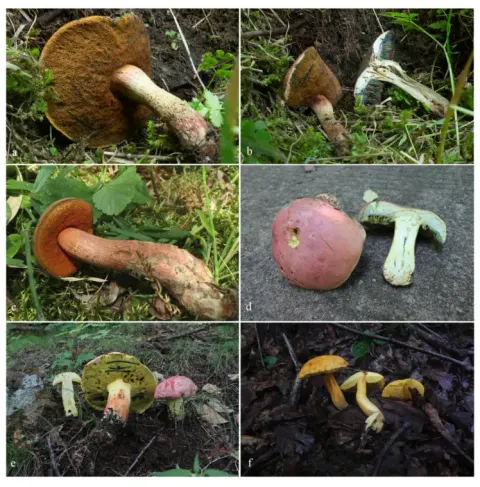
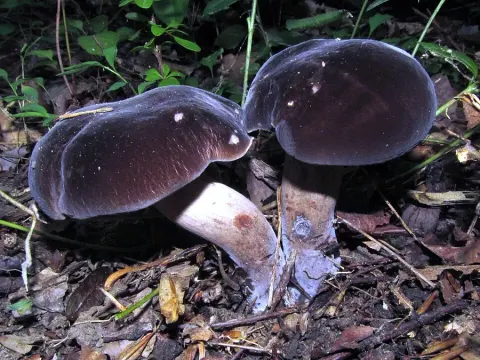
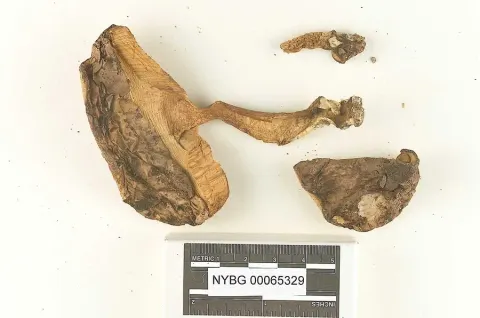
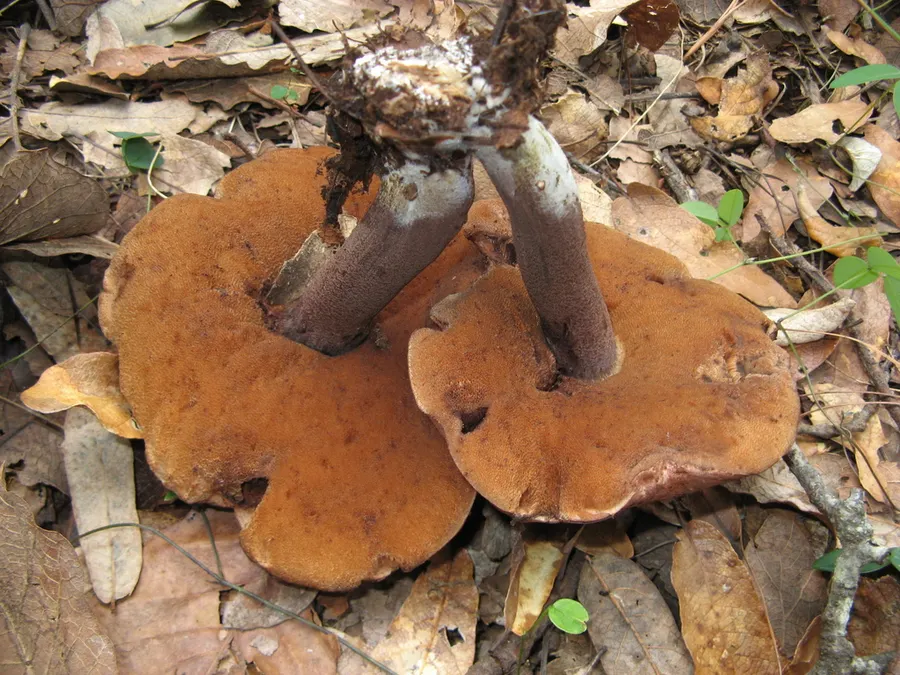
Fruit bodies have caps that are initially convex, later becoming broadly convex to more or less flat, with a diameter of 5 – 12 cm. The cap surface is dry to slightly sticky, with a texture ranging from smooth to somewhat felt-like. Its color is purplish brown to grayish brown to reddish brown; young specimens are often covered with a fine whitish bloom (a delicate, powdery coating). The flesh is whitish, and slowly stains gray-brown when it is cut or injured. It has no distinctive odor, and a mild to slightly bitter taste. On the cap underside, the pore surface is dark chocolate brown to purple brown, and stains dark brown where bruised. The nearly circular pores number up to 3 per millimeter, and the tubes are 0.9 – 2.2 cm deep. The solid stipe measures 4.5 – 9 cm long by 1 – 4 cm thick. Its color is similar to that of the cap, and it has a scurfy surface from a dense coating of purplish to purple-brown scabers. The lilac-brown bolete produces a pinkish to reddish-brown to amber-brown spore print. The smooth, translucent spores are narrowly spindle shaped and measure 11–17 by 3.5–5 μm. Collections made in Costa Rica have shorter spores (10.5–13.3 μm) and smaller fruitbodies than eastern North American material; Guyanese material also has smaller spores, measuring 9.7–12 μm. These differences are attributed to clinal variation. The basidia (spore-bearing cells) are club shaped, four-spored, and measure 23–30 by 7–8 μm. The cystidia on the pore edges (cheilocystidia) are narrowly spindle-shaped (fusoid), measuring 20–30 by 7–8 μm. Cystidia on the pore surface (pleurocystidia) are thin-walled, fusoid to swollen (ventricose), with dimensions of 27–42 by 8–12 μm.

Sebagian uraian ditampilkan dalam bahasa sumber; terjemahannya belum tersedia atau belum lolos pemeriksaan.

Rujukan: [1]

Pengukuran mengikuti objek, spesimen atau kultur, dan metode yang disebutkan sumber. Baca uraian asli untuk konteks lengkap.

02 / Kehidupan

Habitat dan peran ekologis

Fruit bodies of Sutorius eximius grow in the soil singly or scattered among leaf litter. A mycorrhizal species, the bolete has been recorded growing in association with plants from various genera, including Dicymbe, Dipterocarpus, Fagus, Hopea, Quercus, Shorea, and Tsuga. The species has been recorded from North America (in the east from June to September), Costa Rica, and Indonesia. In Costa Rica, where it usually associates with the endemic oaks Quercus seemannii and Q. copeyensis, the lilac-brown bolete can be locally abundant in the Cordillera Central and the Cordillera de Talamanca. Additional locations with collections that have not been confirmed by DNA analysis include Guyana, Japan, China. Although S. eximius has been reported from Thailand, molecular analysis of Thai collections suggests that they represent a distinct, as-yet unnamed species.

Sebagian uraian ditampilkan dalam bahasa sumber; terjemahannya belum tersedia atau belum lolos pemeriksaan.

Rujukan: [1]

Habitat atau konteks temuan
Informasi belum tersedia pada sumber rilis ini.
Substrat
Informasi belum tersedia pada sumber rilis ini.
Peran atau konteks
Mitra tumbuhan
Temukan hubungan serupa
03 / Siklus hidup

Reproduksi

The lilac-brown bolete produces a pinkish to reddish-brown to amber-brown spore print. The smooth, translucent spores are narrowly spindle shaped and measure 11–17 by 3.5–5 μm. Collections made in Costa Rica have shorter spores (10.5–13.3 μm) and smaller fruitbodies than eastern North American material; Guyanese material also has smaller spores, measuring 9.7–12 μm. These differences are attributed to clinal variation. The basidia (spore-bearing cells) are club shaped, four-spored, and measure 23–30 by 7–8 μm. The cystidia on the pore edges (cheilocystidia) are narrowly spindle-shaped (fusoid), measuring 20–30 by 7–8 μm. Cystidia on the pore surface (pleurocystidia) are thin-walled, fusoid to swollen (ventricose), with dimensions of 27–42 by 8–12 μm.

Sebagian uraian ditampilkan dalam bahasa sumber; terjemahannya belum tersedia atau belum lolos pemeriksaan.

Rujukan: [1]

Sinonim menurut acuan taksonomi rilis: Boletus eximius; Boletus robustus; Ceriomyces eximius; Leccinum eximium; Suillus eximius; Tylopilus eximius var. nanus
04 / Batas informasi

Catatan identitas dan cakupan

  • Nama diterima mengikuti Catalogue of Life Base2026-09-11; uraian mempertahankan konsep dan nama sumber aslinya.
  • Original geographic, specimen and life-cycle scope retained; source import awaits individual editorial review.
  • Impor dan terjemahan otomatis belum diperiksa editorial per profil. Struktur reproduktif yang disebutkan tidak membuktikan seluruh siklus hidup diketahui.
  • Pengukuran pada uraian mengikuti spesimen, kultur, dan metode sumber; angka tidak diperluas ke semua populasi.

Catatan distribusi dalam narasi mengikuti sumbernya. Dokumentasi spesimen atau foto mengikuti catatan sumber. Bukti wilayah Indonesia dan penilaian konservasi tidak disimpulkan dari gambar.

05 / Dokumentasi

Melihat dengan konteks

Dokumentasi Sutorius eximius menurut asosiasi foto pada record takson iNaturalist. Kredit: Alan Rockefeller. Identitas mengikuti sumber; bukan penentuan spesimen independen.

Jenis
Fotografi
Kredit
(c) Alan Rockefeller, some rights reserved (CC BY), uploaded by Alan Rockefeller
Lisensi
CC BY 4.0
Sumber media
Buka entri sumber

Gambar menunjukkan objek menurut identifikasi sumber, bukan verifikasi independen spesimen oleh Fungi. Tidak ada skala baru yang ditambahkan.

06 / Rujukan

Sumber profil

  1. [1] Sutorius eximius — Wikipedia (en)Bagian sumber: Frozen revision 1374535109
    Tanggal penghimpunan sumber: 2026-10-12
    Teks sumber: CC BY-SA4.0 · Wikipedia contributors
  2. [2] Catalogue of Life Base2026-09-11 — Sutorius eximiusBagian sumber: ColDP NameUsage.tsv ID 7B5P4; accepted species; source 2073
    Tanggal penghimpunan sumber: 2026-10-12
  3. [3] Dokumentasi visual — Sutorius eximiusBagian sumber: Individual media record; identification follows the source, not independent determination
    Tanggal penghimpunan sumber: 2026-10-12
    Media sumber: CC BY 4.0 · (c) Alan Rockefeller, some rights reserved (CC BY), uploaded by Alan Rockefeller

Adaptasi teks: CC BY-SA 4.0. Wikipedia contributors — Sutorius eximius — Wikipedia (en)

Uraian asli dan riwayat sumber

Riwayat atau halaman sumber

Ringkasan sumber

Sutorius eximius, commonly known as the lilac-brown bolete, is a species of fungus in the family Boletaceae. Originally described in 1874 as a species of Boletus, the fungus has also been classified in the genus Leccinum because of the scabers on the stipe, or in Tylopilus because of the color of the spore print. Molecular genetic analysis revealed that the lilac-brown bolete was separate from both of these genera, and merited placement in a new genus. Sutorius was created to contain this bolete and the closely related Australian species S. australiensis.

Revisi sumber

Morfologi sumber

Fruit bodies have caps that are initially convex, later becoming broadly convex to more or less flat, with a diameter of 5 – 12 cm. The cap surface is dry to slightly sticky, with a texture ranging from smooth to somewhat felt-like. Its color is purplish brown to grayish brown to reddish brown; young specimens are often covered with a fine whitish bloom (a delicate, powdery coating). The flesh is whitish, and slowly stains gray-brown when it is cut or injured. It has no distinctive odor, and a mild to slightly bitter taste. On the cap underside, the pore surface is dark chocolate brown to purple brown, and stains dark brown where bruised. The nearly circular pores number up to 3 per millimeter, and the tubes are 0.9 – 2.2 cm deep. The solid stipe measures 4.5 – 9 cm long by 1 – 4 cm thick. Its color is similar to that of the cap, and it has a scurfy surface from a dense coating of purplish to purple-brown scabers. The lilac-brown bolete produces a pinkish to reddish-brown to amber-brown spore print. The smooth, translucent spores are narrowly spindle shaped and measure 11–17 by 3.5–5 μm. Collections made in Costa Rica have shorter spores (10.5–13.3 μm) and smaller fruitbodies than eastern North American material; Guyanese material also has smaller spores, measuring 9.7–12 μm. These differences are attributed to clinal variation. The basidia (spore-bearing cells) are club shaped, four-spored, and measure 23–30 by 7–8 μm. The cystidia on the pore edges (cheilocystidia) are narrowly spindle-shaped (fusoid), measuring 20–30 by 7–8 μm. Cystidia on the pore surface (pleurocystidia) are thin-walled, fusoid to swollen (ventricose), with dimensions of 27–42 by 8–12 μm.

Revisi sumber

Ekologi sumber

Fruit bodies of Sutorius eximius grow in the soil singly or scattered among leaf litter. A mycorrhizal species, the bolete has been recorded growing in association with plants from various genera, including Dicymbe, Dipterocarpus, Fagus, Hopea, Quercus, Shorea, and Tsuga. The species has been recorded from North America (in the east from June to September), Costa Rica, and Indonesia. In Costa Rica, where it usually associates with the endemic oaks Quercus seemannii and Q. copeyensis, the lilac-brown bolete can be locally abundant in the Cordillera Central and the Cordillera de Talamanca. Additional locations with collections that have not been confirmed by DNA analysis include Guyana, Japan, China. Although S. eximius has been reported from Thailand, molecular analysis of Thai collections suggests that they represent a distinct, as-yet unnamed species.

Revisi sumber

Struktur reproduksi sumber

The lilac-brown bolete produces a pinkish to reddish-brown to amber-brown spore print. The smooth, translucent spores are narrowly spindle shaped and measure 11–17 by 3.5–5 μm. Collections made in Costa Rica have shorter spores (10.5–13.3 μm) and smaller fruitbodies than eastern North American material; Guyanese material also has smaller spores, measuring 9.7–12 μm. These differences are attributed to clinal variation. The basidia (spore-bearing cells) are club shaped, four-spored, and measure 23–30 by 7–8 μm. The cystidia on the pore edges (cheilocystidia) are narrowly spindle-shaped (fusoid), measuring 20–30 by 7–8 μm. Cystidia on the pore surface (pleurocystidia) are thin-walled, fusoid to swollen (ventricose), with dimensions of 27–42 by 8–12 μm.

Revisi sumber

Rujukan halaman ini

Fungi. Sutorius eximius. Rilis data fungi-2026-10-12-expansion-2. https://fungi-atlas.mgadib.chatgpt.site/jamur/sutorius-eximius/.

Status: impor sumber; pemeriksaan editorial per profil belum selesai. Untuk klaim biologis, gunakan rujukan pada bagian terkait dan periksa konteks sumber aslinya.