01 / Morfologi

Ciri dan struktur

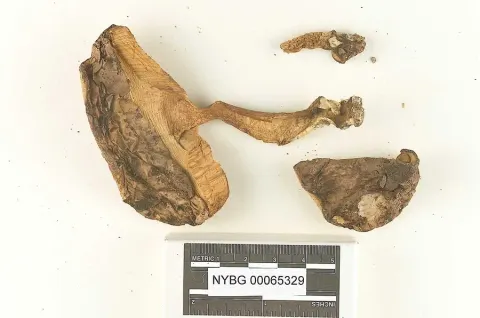
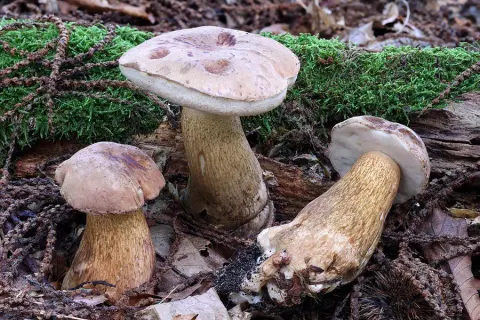
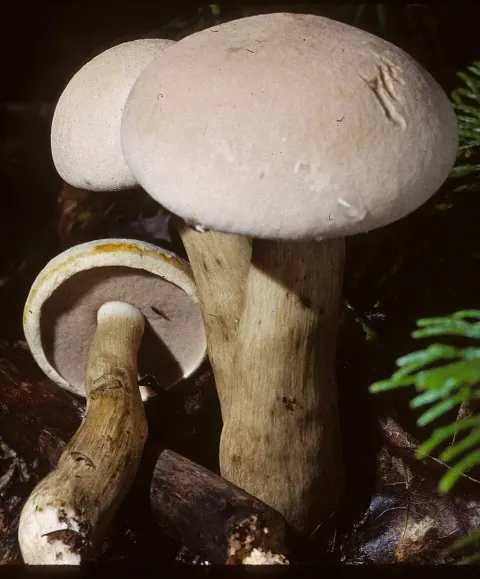
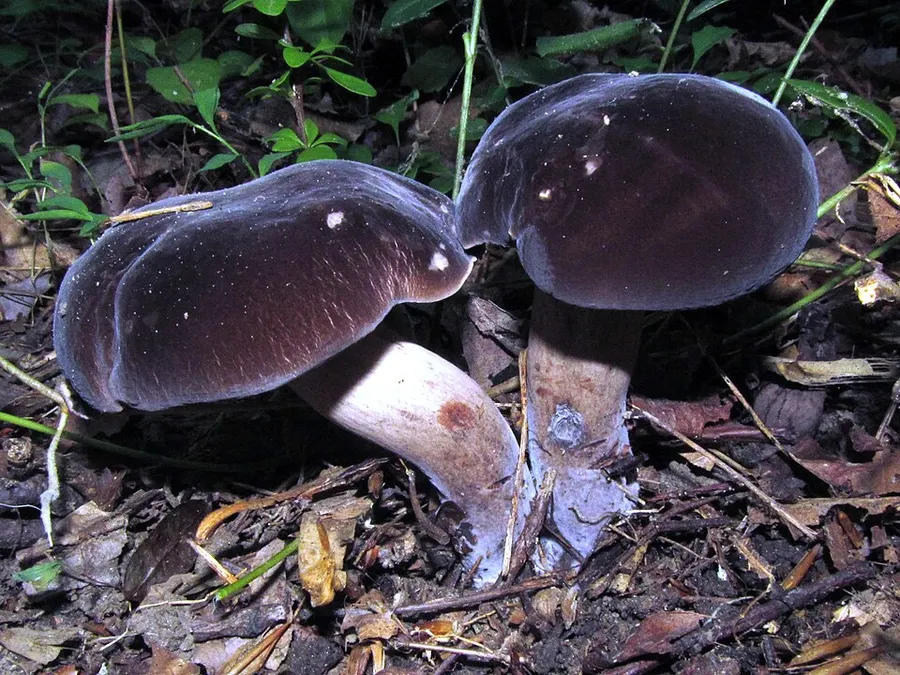
The shape of the cap is initially convex before later becoming broadly convex to eventually flattened in maturity; the diameter of the cap is typically between 3 and 15 cm. The cap surface is dry, with a velvet-like texture, although in age it can become rimose (developing a network of cracks and small crevices). The cap color is initially black to dark grayish brown; young specimens can have a whitish bloom (resembling a dusting of fine powder) on the surface. Fruit bodies, especially young specimens, tend to be free of maggots and other insect larvae. As the mushroom matures, the bloom disappears and the color fades to become grayish to grayish brown. The cap flesh is whitish, but after it is cut or injured, it will stain pink to reddish gray, and eventually turn black. Spores are produced in basidia that are arranged in a vertically arranged layer of minute tubes on the underside of the cap that create a surface of pores. This surface is whitish when young before turning dull pink or flesh-colored in maturity. When bruised, the pore surface initially stains reddish and slowly turns black. The shape of the pores is angular to irregular, and they are small, with roughly two pores per millimeter. The tubes are 5 – 10 mm deep, and usually sunken around the area of attachment to the stem. The stem is 4 – 10 cm long by 2 – 4 cm thick, and is equal in width throughout its length, slightly thicker towards the base, or somewhat thicker in the middle. It is the same color as the cap, or paler. The surface texture of the stem is usually smooth, although some specimens may be slightly reticulated near the top.

Sebagian uraian ditampilkan dalam bahasa sumber; terjemahannya belum tersedia atau belum lolos pemeriksaan.

Rujukan: [1]

Pengukuran mengikuti objek, spesimen atau kultur, dan metode yang disebutkan sumber. Baca uraian asli untuk konteks lengkap.

02 / Kehidupan

Habitat dan peran ekologis

Tylopilus alboater is a mycorrhizal species, and its fruit bodies grow on the ground solitarily, scattered, or in groups under deciduous trees, particularly oak. Fruiting occurs in deciduous, coniferous, and mixed forests. where it is widely distributed east of the Rocky Mountains. Wilayahnya mulai dari Kanada Quebec in, selatan ke New England states ke Florida, dan berlanjut ke Missouri, Michigan, dan Texas. Ia juga ditemukan di Meksiko. Di Asia, telah tercatat dari Cina (Anhui, Fujian, Guangdong, Guangxi, dan Sichuan), Jepang, Taiwan, dan Thailand.

Sebagian uraian ditampilkan dalam bahasa sumber; terjemahannya belum tersedia atau belum lolos pemeriksaan.

Rujukan: [1]

Habitat atau konteks temuan
hutan
Substrat
tanah
Peran atau konteks
Mitra tumbuhan
Temukan hubungan serupa
03 / Siklus hidup

Reproduksi

Spores are produced in basidia that are arranged in a vertically arranged layer of minute tubes on the underside of the cap that create a surface of pores. This surface is whitish when young before turning dull pink or flesh-colored in maturity. When bruised, the pore surface initially stains reddish and slowly turns black. The shape of the pores is angular to irregular, and they are small, with roughly two pores per millimeter. The tubes are 5 – 10 mm deep, and usually sunken around the area of attachment to the stem. The stem is 4 – 10 cm long by 2 – 4 cm thick, and is equal in width throughout its length, slightly thicker towards the base, or somewhat thicker in the middle. It is the same color as the cap, or paler.

Sebagian uraian ditampilkan dalam bahasa sumber; terjemahannya belum tersedia atau belum lolos pemeriksaan.

Rujukan: [1]

Sinonim menurut acuan taksonomi rilis: Boletus alboater; Porphyrellus alboater; Suillus alboater
04 / Batas informasi

Catatan identitas dan cakupan

  • Nama diterima mengikuti Catalogue of Life Base2026-09-11; uraian mempertahankan konsep dan nama sumber aslinya.
  • Original geographic, specimen and life-cycle scope retained; source import awaits individual editorial review.
  • Impor dan terjemahan otomatis belum diperiksa editorial per profil. Struktur reproduktif yang disebutkan tidak membuktikan seluruh siklus hidup diketahui.
  • Pengukuran pada uraian mengikuti spesimen, kultur, dan metode sumber; angka tidak diperluas ke semua populasi.

Catatan distribusi dalam narasi mengikuti sumbernya. Dokumentasi spesimen atau foto mengikuti catatan sumber. Bukti wilayah Indonesia dan penilaian konservasi tidak disimpulkan dari gambar.

05 / Dokumentasi

Melihat dengan konteks

Dokumentasi Tylopilus alboater dari Wikimedia Commons. Fruit bodies of the bolete fungus Tylopilus alboater (Schwein.) Murrill. Specimens found in The Rock Creek Regional Park, Montgomery Co., Maryland, USA. Identifikasi mengikuti record berkas sumber.

Jenis
Fotografi
Kredit
This image was created by user Martin Livezey (MLivezey) at Mushroom Observer , a source for mycological images. You can contact this user here .
Sumber media
Buka entri sumber

Gambar menunjukkan objek menurut identifikasi sumber, bukan verifikasi independen spesimen oleh Fungi. Tidak ada skala baru yang ditambahkan.

06 / Rujukan

Sumber profil

  1. [1] Tylopilus alboater — Wikipedia (en)Bagian sumber: Frozen revision 1374918541
    Tanggal penghimpunan sumber: 2026-10-12
    Teks sumber: CC BY-SA4.0 · Wikipedia contributors
  2. [2] Catalogue of Life Base2026-09-11 — Tylopilus alboaterBagian sumber: ColDP NameUsage.tsv ID 7CZYF; accepted species; source 2073
    Tanggal penghimpunan sumber: 2026-10-12
  3. [3] Dokumentasi visual — Tylopilus alboaterBagian sumber: Individual media record; identification follows the source, not independent determination
    Tanggal penghimpunan sumber: 2026-10-12
    Media sumber: CC BY-SA 3.0 · This image was created by user Martin Livezey (MLivezey) at Mushroom Observer , a source for mycological images. You can contact this user here .

Adaptasi teks: CC BY-SA 4.0. Wikipedia contributors — Tylopilus alboater — Wikipedia (en)

Uraian asli dan riwayat sumber

Riwayat atau halaman sumber

Ringkasan sumber

Tylopilus alboater, also known as the black velvet bolete, is a bolete fungus in the family Boletaceae. The fruit bodies have a black to grayish-brown cap that measures up to 15 cm in diameter. The caps of young specimens have a velvety texture and are covered with a whitish to gray powdery coating; this texture and coating is gradually lost as the mushroom matures, and the cap often develops cracks. The pores on the underside of the cap are small and pinkish. The stem is bluish purple to black, and measures up to 10 cm long by 4 cm thick.

Revisi sumber

Morfologi sumber

The shape of the cap is initially convex before later becoming broadly convex to eventually flattened in maturity; the diameter of the cap is typically between 3 and 15 cm. The cap surface is dry, with a velvet-like texture, although in age it can become rimose (developing a network of cracks and small crevices). The cap color is initially black to dark grayish brown; young specimens can have a whitish bloom (resembling a dusting of fine powder) on the surface. Fruit bodies, especially young specimens, tend to be free of maggots and other insect larvae. As the mushroom matures, the bloom disappears and the color fades to become grayish to grayish brown. The cap flesh is whitish, but after it is cut or injured, it will stain pink to reddish gray, and eventually turn black. Spores are produced in basidia that are arranged in a vertically arranged layer of minute tubes on the underside of the cap that create a surface of pores. This surface is whitish when young before turning dull pink or flesh-colored in maturity. When bruised, the pore surface initially stains reddish and slowly turns black. The shape of the pores is angular to irregular, and they are small, with roughly two pores per millimeter. The tubes are 5 – 10 mm deep, and usually sunken around the area of attachment to the stem. The stem is 4 – 10 cm long by 2 – 4 cm thick, and is equal in width throughout its length, slightly thicker towards the base, or somewhat thicker in the middle. It is the same color as the cap, or paler. The surface texture of the stem is usually smooth, although some specimens may be slightly reticulated near the top.

Revisi sumber

Ekologi sumber

Tylopilus alboater is a mycorrhizal species, and its fruit bodies grow on the ground solitarily, scattered, or in groups under deciduous trees, particularly oak. Fruiting occurs in deciduous, coniferous, and mixed forests. where it is widely distributed east of the Rocky Mountains. Its range stretches from Quebec in Canada, south to the New England states down to Florida, extending west to Missouri, Michigan, and Texas. It is also found in Mexico. In Asia, it has been recorded from China (Anhui, Fujian, Guangdong, Guangxi, and Sichuan), Japan, Taiwan, and Thailand.

Revisi sumber

Struktur reproduksi sumber

Spores are produced in basidia that are arranged in a vertically arranged layer of minute tubes on the underside of the cap that create a surface of pores. This surface is whitish when young before turning dull pink or flesh-colored in maturity. When bruised, the pore surface initially stains reddish and slowly turns black. The shape of the pores is angular to irregular, and they are small, with roughly two pores per millimeter. The tubes are 5 – 10 mm deep, and usually sunken around the area of attachment to the stem. The stem is 4 – 10 cm long by 2 – 4 cm thick, and is equal in width throughout its length, slightly thicker towards the base, or somewhat thicker in the middle. It is the same color as the cap, or paler.

Revisi sumber

Rujukan halaman ini

Fungi. Tylopilus alboater. Rilis data fungi-2026-10-12-expansion-2. https://fungi-atlas.mgadib.chatgpt.site/jamur/tylopilus-alboater/.

Status: impor sumber; pemeriksaan editorial per profil belum selesai. Untuk klaim biologis, gunakan rujukan pada bagian terkait dan periksa konteks sumber aslinya.