01 / Morfologi

Ciri dan struktur

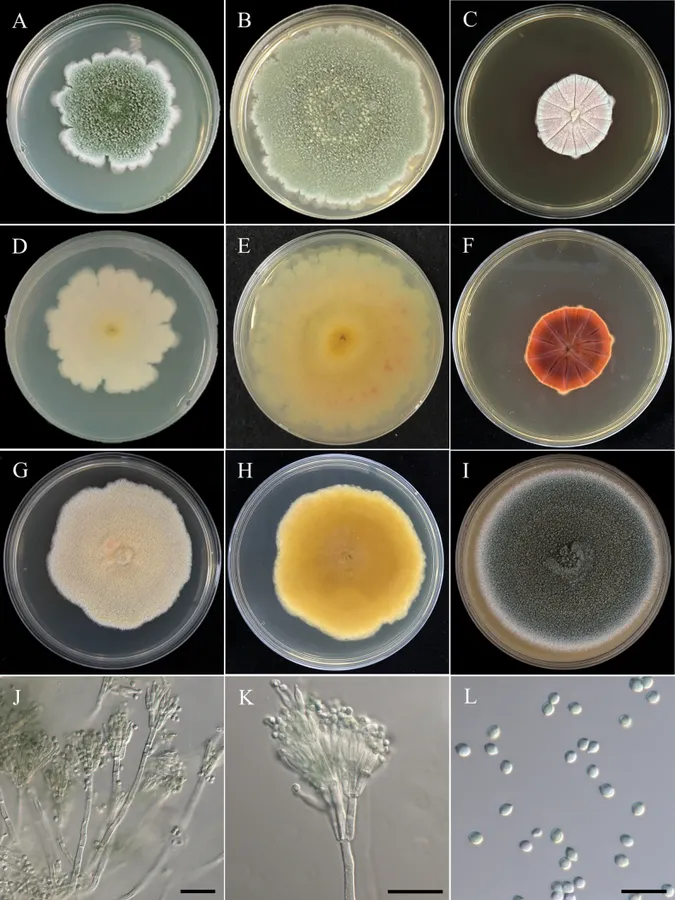
Sexual morph undetermined. Asexual morph Conidiophores arose from aerial hyphae, or roping hyphal aggregations, hyaline, straight, bi-verticillate. Metulae 9.6–15.5 µm × 2.4–3.0 µm. Phialides 3–5, flask-shaped, 8.5–10.8 µm × 2.1–2.6 µm. Conidia globose to subglobose, hyaline, few pale green, 2.2–2.5 µm × 1.6–2.1 µm (x̄ = 2.3 × 1.9 µm, L/W ratio = 1.20, n = 25). CYA, 25 °C, 14 days, sulcate, margin entire and white to buff, floccose, sporulation sparse, pale gray to grayish-green, soluble pigments absent, exudates clear droplets; reverse in coffee brown to caramel. MEA, 25 °C, 14 days, margin slightly irregular and beige, floccose to funiculose, sporulation dense, grayish-green, soluble pigments absent, exudates clear droplets; reverse in light yellowish brown. OA, 25 °C, 14 days, margin entire and pale gray, floccose to funiculose, sporulation dense, dark green, soluble pigments absent, exudates clear droplets; reverse in buff. PDA, 25 °C, 14 days, margin irregular and whitish, floccose to funiculose, sporulation dense, olive green, soluble pigments absent, exudates clear droplets; reverse in cream-buff. YESA, 25 °C, 14 days, margin slightly irregular, floccose, sporulation moderately dense, warm beige, soluble pigments and exudates absent; reverse in light gold to metallic gold.

Sebagian uraian ditampilkan dalam bahasa sumber; terjemahannya belum tersedia atau belum lolos pemeriksaan.

Rujukan: [1]

Pengukuran mengikuti objek, spesimen atau kultur, dan metode yang disebutkan sumber. Baca uraian asli untuk konteks lengkap.

02 / Kehidupan

Habitat dan peran ekologis

In the present study, our strain (NTUPPMCC 22-271) clustered within the clade containing ex-type strain, along with other representative strains of T. adpressus with strong statistical support (100%/1.00) (Fig. 19). T. adpressus NTUPPMCC 22-271 exhibited similar asexual morph to the ex-type strain of T. adpressus (CBS 140620), with bi-verticillate conidiophores, phialides 3–5, and subglobose conidia (Fig. 18); however, our strain (NTUPPMCC 22-271) did not grow on CYAS (Chen et al. 2016). T. adpressus has been reported from a wide range of substrates including sea sand, indoor air, peanut, Heterodera zeae cysts, Oryza coarctata as endophytic fungi (Chen et al. 2016; Peterson and Jurjevic 2019; Airin et al. 2023; Lee et al. 2023; Mo et al. 2024). However, this study represents the first discovery of T. adpressus in Taiwan.

Sebagian uraian ditampilkan dalam bahasa sumber; terjemahannya belum tersedia atau belum lolos pemeriksaan.

Rujukan: [1]

Habitat atau konteks temuan
Informasi belum tersedia pada sumber rilis ini.
Substrat
Informasi belum tersedia pada sumber rilis ini.
Peran atau konteks
Belum dikategorikan pada rilis ini.
Temukan hubungan serupa
03 / Siklus hidup

Reproduksi

Sexual morph undetermined. Asexual morph Conidiophores arose from aerial hyphae, or roping hyphal aggregations, hyaline, straight, bi-verticillate. Metulae 9.6–15.5 µm × 2.4–3.0 µm. Phialides 3–5, flask-shaped, 8.5–10.8 µm × 2.1–2.6 µm. Conidia globose to subglobose, hyaline, few pale green, 2.2–2.5 µm × 1.6–2.1 µm (x̄ = 2.3 × 1.9 µm, L/W ratio = 1.20, n = 25). CYA, 25 °C, 14 days, sulcate, margin entire and white to buff, floccose, sporulation sparse, pale gray to grayish-green, soluble pigments absent, exudates clear droplets; reverse in coffee brown to caramel. MEA, 25 °C, 14 days, margin slightly irregular and beige, floccose to funiculose, sporulation dense, grayish-green, soluble pigments absent, exudates clear droplets; reverse in light yellowish brown.

Sebagian uraian ditampilkan dalam bahasa sumber; terjemahannya belum tersedia atau belum lolos pemeriksaan.

Rujukan: [1]

04 / Batas informasi

Catatan identitas dan cakupan

  • Nama diterima mengikuti Catalogue of Life Base2026-09-11; uraian mempertahankan konsep dan nama sumber aslinya.
  • Preserve original treatment localities, hosts and substrate scope. Materials examined describe documented specimens, not the full global range.
  • Impor dan terjemahan otomatis belum diperiksa editorial per profil. Struktur reproduktif yang disebutkan tidak membuktikan seluruh siklus hidup diketahui.
  • Pengukuran pada uraian mengikuti spesimen, kultur, dan metode sumber; angka tidak diperluas ke semua populasi.

Catatan distribusi dalam narasi mengikuti sumbernya. Dokumentasi spesimen atau foto mengikuti catatan sumber. Bukti wilayah Indonesia dan penilaian konservasi tidak disimpulkan dari gambar.

05 / Dokumentasi

Melihat dengan konteks

Morphology of Talaromyces adpressus NTUPPMCC 22-271. A, D 14-days-old colony on PDA; B, E 14-days-old colony on MEA; C, F 14-days-old colony on CYA; G, H 14-days-old colony on YESA; I 14-days-old colony on OA; J, K Conidiophores, phialides, and conidiogenous cells; L Conidia. Scale bars: 20 µm (J, K); 10 µm (L).

Jenis
Pelat ilmiah
Kredit
Kai-Wen Cheng, Jiue-in Yang, Piroonporn Srimongkol, Marc Stadler, Aphichart Karnchanatat, Hiran A. Ariyawansa
Lisensi
CC BY 4.0
Sumber media
Buka entri sumber

Gambar menunjukkan objek menurut identifikasi sumber, bukan verifikasi independen spesimen oleh Fungi. Tidak ada skala baru yang ditambahkan.

06 / Rujukan

Sumber profil

  1. [1] Fungal frontiers in toxic terrain: Revealing culturable fungal communities in Serpentine paddy fields of Taiwan — Talaromyces adpressusBagian sumber: PMC12355036_section_79
    Tanggal penghimpunan sumber: 2026-10-12
    Teks sumber: CC BY 4.0 · Cheng KW, Yang JI, Srimongkol P, Stadler M, Karnchanatat A, Ariyawansa HA.
  2. [2] Catalogue of Life Base2026-09-11 — Talaromyces adpressusBagian sumber: ColDP NameUsage.tsv ID 54KWP; accepted species; source 2073
    Tanggal penghimpunan sumber: 2026-10-12
  3. [3] Dokumentasi visual — Talaromyces adpressusBagian sumber: Individual media record; identification follows the source, not independent determination
    Tanggal penghimpunan sumber: 2026-10-12
    Media sumber: CC BY 4.0 · Kai-Wen Cheng, Jiue-in Yang, Piroonporn Srimongkol, Marc Stadler, Aphichart Karnchanatat, Hiran A. Ariyawansa

Adaptasi teks: CC BY 4.0. Cheng KW, Yang JI, Srimongkol P, Stadler M, Karnchanatat A, Ariyawansa HA. — Fungal frontiers in toxic terrain: Revealing culturable fungal communities in Serpentine paddy fields of Taiwan — Talaromyces adpressus

Uraian asli dan riwayat sumber

Riwayat atau halaman sumber

Ringkasan sumber

Sexual morph undetermined. Asexual morph Conidiophores arose from aerial hyphae, or roping hyphal aggregations, hyaline, straight, bi-verticillate. Metulae 9.6–15.5 µm × 2.4–3.0 µm. Phialides 3–5, flask-shaped, 8.5–10.8 µm × 2.1–2.6 µm. Conidia globose to subglobose, hyaline, few pale green, 2.2–2.5 µm × 1.6–2.1 µm (x̄ = 2.3 × 1.9 µm, L/W ratio = 1.20, n = 25). CYA, 25 °C, 14 days, sulcate, margin entire and white to buff, floccose, sporulation sparse, pale gray to grayish-green, soluble pigments absent, exudates clear droplets; reverse in coffee brown to caramel.

Revisi sumber

Morfologi sumber

Sexual morph undetermined. Asexual morph Conidiophores arose from aerial hyphae, or roping hyphal aggregations, hyaline, straight, bi-verticillate. Metulae 9.6–15.5 µm × 2.4–3.0 µm. Phialides 3–5, flask-shaped, 8.5–10.8 µm × 2.1–2.6 µm. Conidia globose to subglobose, hyaline, few pale green, 2.2–2.5 µm × 1.6–2.1 µm (x̄ = 2.3 × 1.9 µm, L/W ratio = 1.20, n = 25). CYA, 25 °C, 14 days, sulcate, margin entire and white to buff, floccose, sporulation sparse, pale gray to grayish-green, soluble pigments absent, exudates clear droplets; reverse in coffee brown to caramel. MEA, 25 °C, 14 days, margin slightly irregular and beige, floccose to funiculose, sporulation dense, grayish-green, soluble pigments absent, exudates clear droplets; reverse in light yellowish brown. OA, 25 °C, 14 days, margin entire and pale gray, floccose to funiculose, sporulation dense, dark green, soluble pigments absent, exudates clear droplets; reverse in buff. PDA, 25 °C, 14 days, margin irregular and whitish, floccose to funiculose, sporulation dense, olive green, soluble pigments absent, exudates clear droplets; reverse in cream-buff. YESA, 25 °C, 14 days, margin slightly irregular, floccose, sporulation moderately dense, warm beige, soluble pigments and exudates absent; reverse in light gold to metallic gold.

Revisi sumber

Ekologi sumber

In the present study, our strain (NTUPPMCC 22-271) clustered within the clade containing ex-type strain, along with other representative strains of T. adpressus with strong statistical support (100%/1.00) (Fig. 19). T. adpressus NTUPPMCC 22-271 exhibited similar asexual morph to the ex-type strain of T. adpressus (CBS 140620), with bi-verticillate conidiophores, phialides 3–5, and subglobose conidia (Fig. 18); however, our strain (NTUPPMCC 22-271) did not grow on CYAS (Chen et al. 2016). T. adpressus has been reported from a wide range of substrates including sea sand, indoor air, peanut, Heterodera zeae cysts, Oryza coarctata as endophytic fungi (Chen et al. 2016; Peterson and Jurjevic 2019; Airin et al. 2023; Lee et al. 2023; Mo et al. 2024). However, this study represents the first discovery of T. adpressus in Taiwan.

Revisi sumber

Struktur reproduksi sumber

Sexual morph undetermined. Asexual morph Conidiophores arose from aerial hyphae, or roping hyphal aggregations, hyaline, straight, bi-verticillate. Metulae 9.6–15.5 µm × 2.4–3.0 µm. Phialides 3–5, flask-shaped, 8.5–10.8 µm × 2.1–2.6 µm. Conidia globose to subglobose, hyaline, few pale green, 2.2–2.5 µm × 1.6–2.1 µm (x̄ = 2.3 × 1.9 µm, L/W ratio = 1.20, n = 25). CYA, 25 °C, 14 days, sulcate, margin entire and white to buff, floccose, sporulation sparse, pale gray to grayish-green, soluble pigments absent, exudates clear droplets; reverse in coffee brown to caramel. MEA, 25 °C, 14 days, margin slightly irregular and beige, floccose to funiculose, sporulation dense, grayish-green, soluble pigments absent, exudates clear droplets; reverse in light yellowish brown.

Revisi sumber

Rujukan halaman ini

Fungi. Talaromyces adpressus. Rilis data fungi-2026-10-12-expansion-2. https://fungi-atlas.mgadib.chatgpt.site/jamur/talaromyces-adpressus/.

Status: impor sumber; pemeriksaan editorial per profil belum selesai. Untuk klaim biologis, gunakan rujukan pada bagian terkait dan periksa konteks sumber aslinya.