01 / Morfologi

Ciri dan struktur

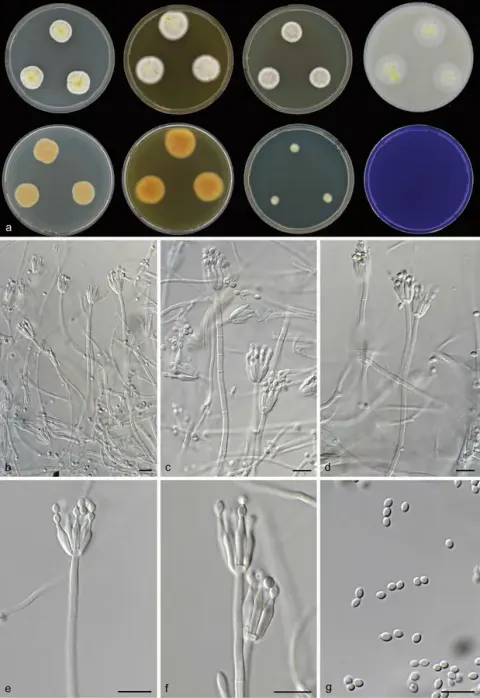
Talaromyces guizhouensis grows poorly on CREA and DG18, does not produce synnemata as well as ascospores. Conidiophores biverticillate, stipes smooth to finely rough, 150–300 × 3–4.5 μm, metulae 3–5, divergent, 11–13 × 3–5 μm; phialides 3–5, acerose to flask shaped, 9–10 × 3–3.5 μm; conidia finely rough, subglobose to fusiform, 2.5–4.5 × 2.5–3 μm. Ascomata not observed.

Sebagian uraian ditampilkan dalam bahasa sumber; terjemahannya belum tersedia atau belum lolos pemeriksaan.

Rujukan: [1]

Pengukuran mengikuti objek, spesimen atau kultur, dan metode yang disebutkan sumber. Baca uraian asli untuk konteks lengkap.

02 / Kehidupan

Habitat dan peran ekologis

section Subinflati previously contained two species namely T. subinflatus and T. palmae. These species do not resemble each other, although both grow poorly on CREA and DG18 (Yilmaz et al. 2014). Talaromyces tzapotlensis was included more recently (Peterson and Jurjević 2017) and we here expand this section with T. guizhouensis and T. resedanus. Like the other species in this section, T. guizhouensis also grows poorly on CREA and DG18. This species is phylogenetically related to T. subinflatus, but the latter grows very restrictedly on common media except MEA (Yilmaz et al. 2014). Talaromyces palmae produces indeterminate synnemata and short stipes (up to 85 μm) (Yilmaz et al. 2014) and these are not observed in T. guizhouensis. Furthermore, T. tzapotlensis grows faster on most media (e.g., 29–30 vs 8–9 mm on CYA; 10–11 vs 4–5 mm on DG18; 20–22 vs 2–3 mm on CREA, all diam. after 7 days (Peterson and Jurjević 2017) and T. resedanus does not grow on CREA and produces smaller conidia measuring 2–3 × 1.5–2 μm.

Sebagian uraian ditampilkan dalam bahasa sumber; terjemahannya belum tersedia atau belum lolos pemeriksaan.

Rujukan: [1]

Habitat atau konteks temuan
Informasi belum tersedia pada sumber rilis ini.
Substrat
Informasi belum tersedia pada sumber rilis ini.
Peran atau konteks
Belum dikategorikan pada rilis ini.
Temukan hubungan serupa
03 / Siklus hidup

Reproduksi

Talaromyces guizhouensis grows poorly on CREA and DG18, does not produce synnemata as well as ascospores. Conidiophores biverticillate, stipes smooth to finely rough, 150–300 × 3–4.5 μm, metulae 3–5, divergent, 11–13 × 3–5 μm; phialides 3–5, acerose to flask shaped, 9–10 × 3–3.5 μm; conidia finely rough, subglobose to fusiform, 2.5–4.5 × 2.5–3 μm. Ascomata not observed.

Sebagian uraian ditampilkan dalam bahasa sumber; terjemahannya belum tersedia atau belum lolos pemeriksaan.

Rujukan: [1]

04 / Batas informasi

Catatan identitas dan cakupan

  • Nama diterima mengikuti Catalogue of Life Base2026-09-11; uraian mempertahankan konsep dan nama sumber aslinya.
  • Preserve original treatment localities, hosts and substrate scope. Materials examined describe documented specimens, not the full global range.
  • Impor dan terjemahan otomatis belum diperiksa editorial per profil. Struktur reproduktif yang disebutkan tidak membuktikan seluruh siklus hidup diketahui.
  • Pengukuran pada uraian mengikuti spesimen, kultur, dan metode sumber; angka tidak diperluas ke semua populasi.

Catatan distribusi dalam narasi mengikuti sumbernya. Dokumentasi spesimen atau foto mengikuti catatan sumber. Bukti wilayah Indonesia dan penilaian konservasi tidak disimpulkan dari gambar.

05 / Dokumentasi

Melihat dengan konteks

Talaromyces guizhouensis CBS 141837 T a colonies from left to right (top row) CYA, MEA, YES and OA; (bottom row) CYA reverse, MEA reverse, DG 18 and CREA b–g conidiophores and conidia. Scale bars: 10 μm (b–g).

Jenis
Pelat ilmiah
Kredit
Bing-Da Sun, Amanda J. Chen, Jos Houbraken, Jens C. Frisvad, Wen-Ping Wu, Hai-Lei Wei, Yu-Guang Zhou, Xian-Zhi Jiang, Robert A. Samson
Lisensi
CC BY 4.0
Sumber media
Buka entri sumber

Gambar menunjukkan objek menurut identifikasi sumber, bukan verifikasi independen spesimen oleh Fungi. Tidak ada skala baru yang ditambahkan.

06 / Rujukan

Sumber profil

  1. [1] New section and species in Talaromyces — Talaromyces guizhouensisBagian sumber: PMC7360636_section_55
    Tanggal penghimpunan sumber: 2026-10-12
    Teks sumber: CC BY 4.0 · Sun BD, Chen AJ, Houbraken J, Frisvad JC, Wu WP, Wei HL, Zhou YG, Jiang XZ, Samson RA.
  2. [2] Catalogue of Life Base2026-09-11 — Talaromyces guizhouensisBagian sumber: ColDP NameUsage.tsv ID 9ZGDP; accepted species; source 2073
    Tanggal penghimpunan sumber: 2026-10-12
  3. [3] Dokumentasi visual — Talaromyces guizhouensisBagian sumber: Individual media record; identification follows the source, not independent determination
    Tanggal penghimpunan sumber: 2026-10-12
    Media sumber: CC BY 4.0 · Bing-Da Sun, Amanda J. Chen, Jos Houbraken, Jens C. Frisvad, Wen-Ping Wu, Hai-Lei Wei, Yu-Guang Zhou, Xian-Zhi Jiang, Robert A. Samson

Adaptasi teks: CC BY 4.0. Sun BD, Chen AJ, Houbraken J, Frisvad JC, Wu WP, Wei HL, Zhou YG, Jiang XZ, Samson RA. — New section and species in Talaromyces — Talaromyces guizhouensis

Uraian asli dan riwayat sumber

Riwayat atau halaman sumber

Ringkasan sumber

Talaromyces guizhouensis grows poorly on CREA and DG18, does not produce synnemata as well as ascospores. Conidiophores biverticillate, stipes smooth to finely rough, 150–300 × 3–4.5 μm, metulae 3–5, divergent, 11–13 × 3–5 μm; phialides 3–5, acerose to flask shaped, 9–10 × 3–3.5 μm; conidia finely rough, subglobose to fusiform, 2.5–4.5 × 2.5–3 μm. Ascomata not observed.

Revisi sumber

Morfologi sumber

Talaromyces guizhouensis grows poorly on CREA and DG18, does not produce synnemata as well as ascospores. Conidiophores biverticillate, stipes smooth to finely rough, 150–300 × 3–4.5 μm, metulae 3–5, divergent, 11–13 × 3–5 μm; phialides 3–5, acerose to flask shaped, 9–10 × 3–3.5 μm; conidia finely rough, subglobose to fusiform, 2.5–4.5 × 2.5–3 μm. Ascomata not observed.

Revisi sumber

Ekologi sumber

section Subinflati previously contained two species namely T. subinflatus and T. palmae. These species do not resemble each other, although both grow poorly on CREA and DG18 (Yilmaz et al. 2014). Talaromyces tzapotlensis was included more recently (Peterson and Jurjević 2017) and we here expand this section with T. guizhouensis and T. resedanus. Like the other species in this section, T. guizhouensis also grows poorly on CREA and DG18. This species is phylogenetically related to T. subinflatus, but the latter grows very restrictedly on common media except MEA (Yilmaz et al. 2014). Talaromyces palmae produces indeterminate synnemata and short stipes (up to 85 μm) (Yilmaz et al. 2014) and these are not observed in T. guizhouensis. Furthermore, T. tzapotlensis grows faster on most media (e.g., 29–30 vs 8–9 mm on CYA; 10–11 vs 4–5 mm on DG18; 20–22 vs 2–3 mm on CREA, all diam. after 7 days (Peterson and Jurjević 2017) and T. resedanus does not grow on CREA and produces smaller conidia measuring 2–3 × 1.5–2 μm.

Revisi sumber

Struktur reproduksi sumber

Talaromyces guizhouensis grows poorly on CREA and DG18, does not produce synnemata as well as ascospores. Conidiophores biverticillate, stipes smooth to finely rough, 150–300 × 3–4.5 μm, metulae 3–5, divergent, 11–13 × 3–5 μm; phialides 3–5, acerose to flask shaped, 9–10 × 3–3.5 μm; conidia finely rough, subglobose to fusiform, 2.5–4.5 × 2.5–3 μm. Ascomata not observed.

Revisi sumber

Rujukan halaman ini

Fungi. Talaromyces guizhouensis. Rilis data fungi-2026-10-12-expansion-2. https://fungi-atlas.mgadib.chatgpt.site/jamur/talaromyces-guizhouensis/.

Status: impor sumber; pemeriksaan editorial per profil belum selesai. Untuk klaim biologis, gunakan rujukan pada bagian terkait dan periksa konteks sumber aslinya.